Alican Baris, Emre Özmen, Esra Circi, Serdar Yuksel, Ozan Beytemür
{"title":"Quantitative analysis of protective Kirschner wire diameters in lateral opening wedge distal femoral osteotomy: A finite element study.","authors":"Alican Baris, Emre Özmen, Esra Circi, Serdar Yuksel, Ozan Beytemür","doi":"10.52312/jdrs.2025.1806","DOIUrl":null,"url":null,"abstract":"<p><strong>Objectives: </strong>This study aims to investigate quantitatively the protective effect of a 1.6-mm or a 2.5-mm Kirschner wire (K-wire) on the medial hinge at different gap distances through finite element analysis (FEA) and to establish whether using a 2.5-mm K-wire can offer benefits compared to a 1.6-mm in preventing medial hinge fractures.</p><p><strong>Materials and methods: </strong>Between June 2024 and July 2024, three different models simulating a lateral opening wedge (LOW) osteotomy of the distal femur were created from a femoral computed tomography (CT) scan of a 36-year-old male patient: no K-wire (Model I), 1.6-mm K-wire (Model II), and 2.5-mm K-wire (Model III). Finite element analysis was performed to simulate 7- to 13-mm gaps at the osteotomy site. Loads, principal stress, strain, and equivalent stress were analyzed around the medial hinge.</p><p><strong>Results: </strong>Model I required 123.0±5.2 N, Model II required 181.7±12.2 N, and Model III required 228.7±13.6 N (p<0.001). Cracked shell elements were the lowest in Model II and the highest in Model I. While the average equivalent/yield stress ratio was not significantly lower in Model II compared to Model III (87.0±10.9% vs. 92.7±12.1%), the maximum equivalent/yield stress ratio values in Model II were significantly lower than both Model I and Model III (1206.2±138.3% vs. 1836.2±165.4% and 1689.1±404.0%, respectively), suggesting a superior dispersion of forces.</p><p><strong>Conclusion: </strong>Using a 1.6-mm K-wire during LOW osteotomy of the distal femur provides a balance between structural reinforcement and stress distribution, significantly improving stability and reducing the risk of medial hinge fractures compared to a 2.5-mm K-wire or no K-wire. The 1.6-mm K-wire optimizes stress dispersion, making it the preferred choice for surgical planning in lateral opening wedge distal femoral osteotomy.</p>","PeriodicalId":73560,"journal":{"name":"Joint diseases and related surgery","volume":"36 1","pages":"97-106"},"PeriodicalIF":1.9000,"publicationDate":"2025-01-02","publicationTypes":"Journal Article","fieldsOfStudy":null,"isOpenAccess":false,"openAccessPdf":"https://www.ncbi.nlm.nih.gov/pmc/articles/PMC11734846/pdf/","citationCount":"0","resultStr":null,"platform":"Semanticscholar","paperid":null,"PeriodicalName":"Joint diseases and related surgery","FirstCategoryId":"1085","ListUrlMain":"https://doi.org/10.52312/jdrs.2025.1806","RegionNum":0,"RegionCategory":null,"ArticlePicture":[],"TitleCN":null,"AbstractTextCN":null,"PMCID":null,"EPubDate":"2024/11/5 0:00:00","PubModel":"Epub","JCR":"Q2","JCRName":"ORTHOPEDICS","Score":null,"Total":0}
引用次数: 0
Abstract
Objectives: This study aims to investigate quantitatively the protective effect of a 1.6-mm or a 2.5-mm Kirschner wire (K-wire) on the medial hinge at different gap distances through finite element analysis (FEA) and to establish whether using a 2.5-mm K-wire can offer benefits compared to a 1.6-mm in preventing medial hinge fractures.
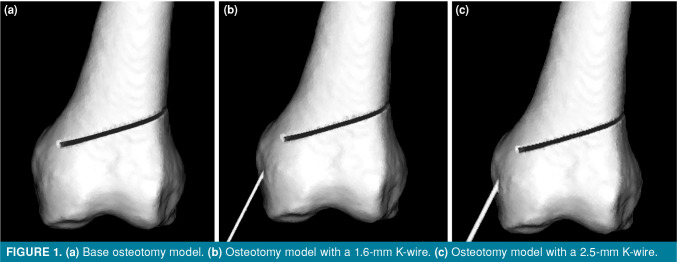
Materials and methods: Between June 2024 and July 2024, three different models simulating a lateral opening wedge (LOW) osteotomy of the distal femur were created from a femoral computed tomography (CT) scan of a 36-year-old male patient: no K-wire (Model I), 1.6-mm K-wire (Model II), and 2.5-mm K-wire (Model III). Finite element analysis was performed to simulate 7- to 13-mm gaps at the osteotomy site. Loads, principal stress, strain, and equivalent stress were analyzed around the medial hinge.
Results: Model I required 123.0±5.2 N, Model II required 181.7±12.2 N, and Model III required 228.7±13.6 N (p<0.001). Cracked shell elements were the lowest in Model II and the highest in Model I. While the average equivalent/yield stress ratio was not significantly lower in Model II compared to Model III (87.0±10.9% vs. 92.7±12.1%), the maximum equivalent/yield stress ratio values in Model II were significantly lower than both Model I and Model III (1206.2±138.3% vs. 1836.2±165.4% and 1689.1±404.0%, respectively), suggesting a superior dispersion of forces.
Conclusion: Using a 1.6-mm K-wire during LOW osteotomy of the distal femur provides a balance between structural reinforcement and stress distribution, significantly improving stability and reducing the risk of medial hinge fractures compared to a 2.5-mm K-wire or no K-wire. The 1.6-mm K-wire optimizes stress dispersion, making it the preferred choice for surgical planning in lateral opening wedge distal femoral osteotomy.
目的:本研究旨在通过有限元分析(FEA)定量研究1.6 mm或2.5 mm克氏针(k -丝)在不同间隙距离下对内侧铰链的保护作用,并确定与1.6 mm克氏针相比,2.5 mm克氏针在预防内侧铰链骨折方面是否更有优势。材料和方法:在2024年6月至2024年7月期间,通过对一名36岁男性患者的股骨计算机断层扫描(CT)创建了三种不同的模型,模拟股骨远端侧开楔形(LOW)截骨:无k -丝(模型I), 1.6 mm k -丝(模型II)和2.5 mm k -丝(模型III)。进行有限元分析,模拟截骨部位7- 13 mm间隙。对中间铰周围的载荷、主应力、应变和等效应力进行了分析。结果:模型I需要123.0±5.2 N,模型II需要181.7±12.2 N,模型III需要228.7±13.6 N (p)结论:与2.5 mm k -丝或不使用k -丝相比,在股骨远端LOW截骨术中使用1.6 mm k -丝可以在结构加固和应力分布之间取得平衡,显著提高稳定性,降低内侧铰链骨折的风险。1.6 mm k线优化应力分散,使其成为外侧开口楔形股骨远端截骨手术计划的首选。





 京公网安备 11010802042870号
京ICP备2023020795号-1
京公网安备 11010802042870号
京ICP备2023020795号-1

 分享
分享

 求助内容:
求助内容: 应助结果提醒方式:
 扫码关注我们
