{"title":"Cobalt(II) Aqua Complex-Mediated Hydrogen Peroxide Activation: Possible Roles of HOOOH and Co(II)–OOOH Intermediates in Singlet Oxygen Generation","authors":"Hsing-Yin Chen, Yu-Fen Lin","doi":"10.1021/acs.inorgchem.4c03966","DOIUrl":null,"url":null,"abstract":"Density functional theory (DFT) calculations indicate that [Co<sup>II</sup>(H<sub>2</sub>O)<sub>6</sub>]<sup>2+</sup> reacts with two H<sub>2</sub>O<sub>2</sub> molecules to form [(H<sub>2</sub>O)<sub>4</sub>Co<sup>II</sup>(OOH)(H<sub>2</sub>O<sub>2</sub>)]<sup>+</sup> reactant complexes, which decompose through three distinct pathways depending on the relative orientation between the coordinated <sup>–</sup>OOH and H<sub>2</sub>O<sub>2</sub> ligands. The reactive intermediates produced via these activation pathways include hydroperoxyl (<sup>•</sup>OOH)/superoxide (O<sub>2</sub><sup>•–</sup>) radicals, singlet oxygen (<sup>1</sup>O<sub>2</sub>), and Co(III) species [(H<sub>2</sub>O)<sub>5</sub>Co<sup>III</sup>(O)]<sup>+</sup>, [(H<sub>2</sub>O)<sub>4</sub>Co<sup>III</sup>(OH)<sub>2</sub>]<sup>+</sup>, and [(H<sub>2</sub>O)<sub>5</sub>Co<sup>III</sup>(OH)]<sup>2+</sup>. The Co(III) species display from moderate to strong oxidizing abilities that have long been overlooked. Remarkably, our DFT calculations reveal the possible formation of hydrogen trioxide (HOOOH) and Co(II)–OOOH intermediates during [(H<sub>2</sub>O)<sub>4</sub>Co<sup>II</sup>(OOH)(H<sub>2</sub>O<sub>2</sub>)]<sup>+</sup> decomposition and that the hydrolysis of these transient species is a route to <sup>1</sup>O<sub>2</sub> production. Because two of the three activation pathways do not involve changes in the oxidation state of the Co center, they may apply to other systems comprising redox-inert metal ions.","PeriodicalId":40,"journal":{"name":"Inorganic Chemistry","volume":"1 1","pages":""},"PeriodicalIF":4.7000,"publicationDate":"2024-12-25","publicationTypes":"Journal Article","fieldsOfStudy":null,"isOpenAccess":false,"openAccessPdf":"","citationCount":"0","resultStr":null,"platform":"Semanticscholar","paperid":null,"PeriodicalName":"Inorganic Chemistry","FirstCategoryId":"92","ListUrlMain":"https://doi.org/10.1021/acs.inorgchem.4c03966","RegionNum":2,"RegionCategory":"化学","ArticlePicture":[],"TitleCN":null,"AbstractTextCN":null,"PMCID":null,"EPubDate":"","PubModel":"","JCR":"Q1","JCRName":"CHEMISTRY, INORGANIC & NUCLEAR","Score":null,"Total":0}
引用次数: 0
Abstract
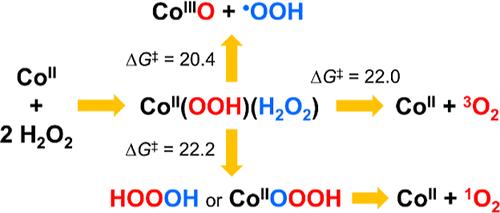
Density functional theory (DFT) calculations indicate that [CoII(H2O)6]2+ reacts with two H2O2 molecules to form [(H2O)4CoII(OOH)(H2O2)]+ reactant complexes, which decompose through three distinct pathways depending on the relative orientation between the coordinated –OOH and H2O2 ligands. The reactive intermediates produced via these activation pathways include hydroperoxyl (•OOH)/superoxide (O2•–) radicals, singlet oxygen (1O2), and Co(III) species [(H2O)5CoIII(O)]+, [(H2O)4CoIII(OH)2]+, and [(H2O)5CoIII(OH)]2+. The Co(III) species display from moderate to strong oxidizing abilities that have long been overlooked. Remarkably, our DFT calculations reveal the possible formation of hydrogen trioxide (HOOOH) and Co(II)–OOOH intermediates during [(H2O)4CoII(OOH)(H2O2)]+ decomposition and that the hydrolysis of these transient species is a route to 1O2 production. Because two of the three activation pathways do not involve changes in the oxidation state of the Co center, they may apply to other systems comprising redox-inert metal ions.
期刊介绍:
Inorganic Chemistry publishes fundamental studies in all phases of inorganic chemistry. Coverage includes experimental and theoretical reports on quantitative studies of structure and thermodynamics, kinetics, mechanisms of inorganic reactions, bioinorganic chemistry, and relevant aspects of organometallic chemistry, solid-state phenomena, and chemical bonding theory. Emphasis is placed on the synthesis, structure, thermodynamics, reactivity, spectroscopy, and bonding properties of significant new and known compounds.



 京公网安备 11010802042870号
京ICP备2023020795号-1
京公网安备 11010802042870号
京ICP备2023020795号-1

 分享
分享
 求助内容:
求助内容: 应助结果提醒方式:
 扫码关注我们
