Mostafa Salehirozveh, Robin Bonné, Peeyush Kumar, Farbod Abazar, Parisa Dehghani, Ivan Mijakovic and Vellaisamy A. L. Roy
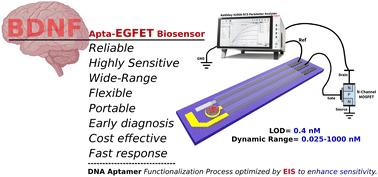
{"title":"Enhanced detection of Brain-Derived Neurotrophic Factor (BDNF) using a reduced graphene oxide field-effect transistor aptasensor†","authors":"Mostafa Salehirozveh, Robin Bonné, Peeyush Kumar, Farbod Abazar, Parisa Dehghani, Ivan Mijakovic and Vellaisamy A. L. Roy","doi":"10.1039/D4NR04228J","DOIUrl":null,"url":null,"abstract":"<p >Neurodegenerative diseases, characterized by the progressive deterioration of neuronal function and structure, pose significant global public health and economic challenges. Brain-Derived Neurotrophic Factor (BDNF), a key regulator of neuroplasticity and neuronal survival, has emerged as a critical biomarker for various neurodegenerative and psychiatric disorders, including Alzheimer's disease. Traditional diagnostic methods, such as Enzyme-Linked Immunosorbent Assay (ELISA) and electrochemiluminescence (ECL) assays, face limitations in terms of sensitivity, stability, reproducibility, and cost-effectiveness. In this research, we developed the first electrical aptasensor for BDNF detection, constructed on a flexible polyimide (PI) membrane coated with reduced graphene oxide (r-GO) and utilized an extended-gate field-effect transistor (EGFET) as the transducer. Comprehensive characterization of the sensor, coupled with the fine-tuning of aptamer concentration and the binding time of DNA aptamers to the chemical linker, was achieved through Electrochemical Impedance Spectroscopy (EIS) to boost sensitivity. Consequently, by utilizing the unique properties of r-GO and DNA aptamers, the aptasensor exhibited exceptional detection abilities, with a detection limit as low as 0.4 nM and an extensive response range spanning from 0.025 to 1000 nM. The flexible PI-based electrode offers exceptional stability, affordability, and durability for home diagnostics, enriched by the reusability of its electronic transducer, making the device highly portable and suitable for prolonged monitoring. Our aptasensor surpasses traditional methods, showcasing superior real-time performance and reliability. The high sensitivity and specificity of our aptasensor highlight its potential to significantly improve early diagnosis and therapeutic monitoring of neurodegenerative diseases such as Alzheimer's, representing a considerable advancement in the diagnosis and management of such conditions.</p>","PeriodicalId":92,"journal":{"name":"Nanoscale","volume":" 8","pages":" 4543-4555"},"PeriodicalIF":5.1000,"publicationDate":"2024-12-26","publicationTypes":"Journal Article","fieldsOfStudy":null,"isOpenAccess":false,"openAccessPdf":"https://pubs.rsc.org/en/content/articlepdf/2025/nr/d4nr04228j?page=search","citationCount":"0","resultStr":null,"platform":"Semanticscholar","paperid":null,"PeriodicalName":"Nanoscale","FirstCategoryId":"88","ListUrlMain":"https://pubs.rsc.org/en/content/articlelanding/2025/nr/d4nr04228j","RegionNum":3,"RegionCategory":"材料科学","ArticlePicture":[],"TitleCN":null,"AbstractTextCN":null,"PMCID":null,"EPubDate":"","PubModel":"","JCR":"Q1","JCRName":"CHEMISTRY, MULTIDISCIPLINARY","Score":null,"Total":0}
引用次数: 0
Abstract
Neurodegenerative diseases, characterized by the progressive deterioration of neuronal function and structure, pose significant global public health and economic challenges. Brain-Derived Neurotrophic Factor (BDNF), a key regulator of neuroplasticity and neuronal survival, has emerged as a critical biomarker for various neurodegenerative and psychiatric disorders, including Alzheimer's disease. Traditional diagnostic methods, such as Enzyme-Linked Immunosorbent Assay (ELISA) and electrochemiluminescence (ECL) assays, face limitations in terms of sensitivity, stability, reproducibility, and cost-effectiveness. In this research, we developed the first electrical aptasensor for BDNF detection, constructed on a flexible polyimide (PI) membrane coated with reduced graphene oxide (r-GO) and utilized an extended-gate field-effect transistor (EGFET) as the transducer. Comprehensive characterization of the sensor, coupled with the fine-tuning of aptamer concentration and the binding time of DNA aptamers to the chemical linker, was achieved through Electrochemical Impedance Spectroscopy (EIS) to boost sensitivity. Consequently, by utilizing the unique properties of r-GO and DNA aptamers, the aptasensor exhibited exceptional detection abilities, with a detection limit as low as 0.4 nM and an extensive response range spanning from 0.025 to 1000 nM. The flexible PI-based electrode offers exceptional stability, affordability, and durability for home diagnostics, enriched by the reusability of its electronic transducer, making the device highly portable and suitable for prolonged monitoring. Our aptasensor surpasses traditional methods, showcasing superior real-time performance and reliability. The high sensitivity and specificity of our aptasensor highlight its potential to significantly improve early diagnosis and therapeutic monitoring of neurodegenerative diseases such as Alzheimer's, representing a considerable advancement in the diagnosis and management of such conditions.
期刊介绍:
Nanoscale is a high-impact international journal, publishing high-quality research across nanoscience and nanotechnology. Nanoscale publishes a full mix of research articles on experimental and theoretical work, including reviews, communications, and full papers.Highly interdisciplinary, this journal appeals to scientists, researchers and professionals interested in nanoscience and nanotechnology, quantum materials and quantum technology, including the areas of physics, chemistry, biology, medicine, materials, energy/environment, information technology, detection science, healthcare and drug discovery, and electronics.



 京公网安备 11010802042870号
京ICP备2023020795号-1
京公网安备 11010802042870号
京ICP备2023020795号-1

 分享
分享
 求助内容:
求助内容: 应助结果提醒方式:
 扫码关注我们
