Jiayu Wang, Xiangyang Zhao, Qingli Zou and Min Wei
{"title":"Manganese cobalt sulfide-doped fibrous sulfurized polyacrylonitrile for high-rate and long-life lithium–sulfur batteries†","authors":"Jiayu Wang, Xiangyang Zhao, Qingli Zou and Min Wei","doi":"10.1039/D4TA08712G","DOIUrl":null,"url":null,"abstract":"<p >Sulfurized polyacrylonitrile (SPAN) is regarded as a promising cathode material for next-generation lithium batteries. However, the insufficient electronic and ionic conductivity of the SPAN material leads to low rate-performance, unsatisfactory active material utilization, and limited cycling stability. Here, we propose a strategy to increase the electronic conductivity of SPAN by compositing PAN with manganese cobalt sulfide (MCS), which increases the graphitization degree during the subsequent vulcanization as manifested by higher graphitic nitrogen content. In addition, the incorporation of MCS promotes the formation of a thinner and uniform cathode electrolyte interface, which suppresses the dissolution of sulfur species into the electrolyte as revealed by <em>in situ</em> UV-vis spectroscopy. Together with an electrospun fibrous morphology that minimizes the migration path of Li<small><sup>+</sup></small> inside the SPAN, the resulting SPAN composite displays fast reaction kinetics, high active material utilization and stable long-term cycling at high current density, achieving a high capacity retention of 437 mA h g<small><sup>−1</sup></small> (based on the composite) after 1500 cycles at 5C (1C = 600 mA g<small><sup>−1</sup></small>) without obvious capacity fading, and 338 mA h g<small><sup>−1</sup></small> after 2000 cycles at 10C with a low fading rate of 0.01% per cycle.</p>","PeriodicalId":82,"journal":{"name":"Journal of Materials Chemistry A","volume":" 6","pages":" 4150-4158"},"PeriodicalIF":9.5000,"publicationDate":"2024-12-28","publicationTypes":"Journal Article","fieldsOfStudy":null,"isOpenAccess":false,"openAccessPdf":"","citationCount":"0","resultStr":null,"platform":"Semanticscholar","paperid":null,"PeriodicalName":"Journal of Materials Chemistry A","FirstCategoryId":"88","ListUrlMain":"https://pubs.rsc.org/en/content/articlelanding/2025/ta/d4ta08712g","RegionNum":2,"RegionCategory":"材料科学","ArticlePicture":[],"TitleCN":null,"AbstractTextCN":null,"PMCID":null,"EPubDate":"","PubModel":"","JCR":"Q1","JCRName":"CHEMISTRY, PHYSICAL","Score":null,"Total":0}
引用次数: 0
Abstract
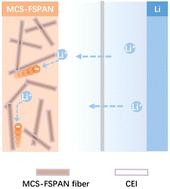
Sulfurized polyacrylonitrile (SPAN) is regarded as a promising cathode material for next-generation lithium batteries. However, the insufficient electronic and ionic conductivity of the SPAN material leads to low rate-performance, unsatisfactory active material utilization, and limited cycling stability. Here, we propose a strategy to increase the electronic conductivity of SPAN by compositing PAN with manganese cobalt sulfide (MCS), which increases the graphitization degree during the subsequent vulcanization as manifested by higher graphitic nitrogen content. In addition, the incorporation of MCS promotes the formation of a thinner and uniform cathode electrolyte interface, which suppresses the dissolution of sulfur species into the electrolyte as revealed by in situ UV-vis spectroscopy. Together with an electrospun fibrous morphology that minimizes the migration path of Li+ inside the SPAN, the resulting SPAN composite displays fast reaction kinetics, high active material utilization and stable long-term cycling at high current density, achieving a high capacity retention of 437 mA h g−1 (based on the composite) after 1500 cycles at 5C (1C = 600 mA g−1) without obvious capacity fading, and 338 mA h g−1 after 2000 cycles at 10C with a low fading rate of 0.01% per cycle.
硫化聚丙烯腈(SPAN)是一种很有前途的新一代锂电池正极材料。然而,由于SPAN材料的电子和离子电导率不足,导致其倍率性能较低,活性材料利用率不高,循环稳定性有限。本文提出通过与硫化钴锰(MCS)复合来提高PAN的电导率,从而提高后续硫化过程中的石墨化程度和石墨氮含量。此外,原位紫外可见光谱显示,MCS的加入促进了阴极电解质界面更薄、更均匀的形成,抑制了硫物质在电解质中的溶解。连同一个实际上电纺纤维形态的迁移路径最小化李+跨度内,由此产生的跨组合显示快速反应动力学,活性物质利用率高、稳定的长时间骑自行车在高电流密度,实现高capacity-retention马437 h g - 1(基于复合)级1500次后5度(1 C = 600 mA g1)没有明显的容量衰减,马和338 h g - 1 2000次后10 C级小每周期衰减率为0.01%。
期刊介绍:
The Journal of Materials Chemistry A, B & C covers a wide range of high-quality studies in the field of materials chemistry, with each section focusing on specific applications of the materials studied. Journal of Materials Chemistry A emphasizes applications in energy and sustainability, including topics such as artificial photosynthesis, batteries, and fuel cells. Journal of Materials Chemistry B focuses on applications in biology and medicine, while Journal of Materials Chemistry C covers applications in optical, magnetic, and electronic devices. Example topic areas within the scope of Journal of Materials Chemistry A include catalysis, green/sustainable materials, sensors, and water treatment, among others.



 京公网安备 11010802042870号
京ICP备2023020795号-1
京公网安备 11010802042870号
京ICP备2023020795号-1

 分享
分享
 求助内容:
求助内容: 应助结果提醒方式:
 扫码关注我们
