Hina Tariq, Joel Dunn, Samantha Forrester, Kathryn Collins, Sam Porter
{"title":"Development and evaluation of a quality improvement educational video on joint contractures for care home staff.","authors":"Hina Tariq, Joel Dunn, Samantha Forrester, Kathryn Collins, Sam Porter","doi":"10.1136/bmjoq-2024-002923","DOIUrl":null,"url":null,"abstract":"<p><strong>Background: </strong>Contractures are a debilitating problem for individuals living in long-term care settings. However, there is a lack of education and training among the care staff regarding the identification of risk factors related to contractures and the preventive strategies that can decrease their development or progression. Addressing this knowledge gap has the potential to improve the quality of care provided to residents in care homes.The objective of this quality improvement (QI) project was to investigate the impact of a newly developed educational video on the awareness, knowledge and understanding of contractures among the care staff.</p><p><strong>Methods: </strong>This QI project involved two sequential Plan-Do-Study-Act cycles and employed a pre and post-test design to evaluate the impact of the contracture educational video. Primary outcomes were assessed using paper surveys to capture prevideo and postvideo levels of knowledge and understanding of contractures. Furthermore, both verbal and written feedback from participants were gathered to identify areas of strengths and improvement.</p><p><strong>Results: </strong>Baseline data revealed that about 56% of the care staff lacked knowledge and understanding of contractures with another 33% reporting possessing only basic knowledge. Following the video intervention, percentage of care staff who reported good knowledge and understanding increased to 67% while 22% reported basic knowledge and understanding of contractures. The care staff suggested changes to the video to improve accessibility of the information, this was incorporated in the refilming of the video.</p><p><strong>Conclusion: </strong>This QI project demonstrated that the introduction of a contracture educational video is a feasible and positively received method of enhancing awareness, knowledge and understanding of contractures among care staff. Educating care staff about the risk factors and prevention strategies for contractures will potentially improve their ability to identify the risk of contractures and help prevent their occurrence, ultimately enhancing the quality of care of the residents.</p>","PeriodicalId":9052,"journal":{"name":"BMJ Open Quality","volume":"13 4","pages":""},"PeriodicalIF":1.6000,"publicationDate":"2024-12-27","publicationTypes":"Journal Article","fieldsOfStudy":null,"isOpenAccess":false,"openAccessPdf":"https://www.ncbi.nlm.nih.gov/pmc/articles/PMC11683971/pdf/","citationCount":"0","resultStr":null,"platform":"Semanticscholar","paperid":null,"PeriodicalName":"BMJ Open Quality","FirstCategoryId":"1085","ListUrlMain":"https://doi.org/10.1136/bmjoq-2024-002923","RegionNum":0,"RegionCategory":null,"ArticlePicture":[],"TitleCN":null,"AbstractTextCN":null,"PMCID":null,"EPubDate":"","PubModel":"","JCR":"Q4","JCRName":"HEALTH CARE SCIENCES & SERVICES","Score":null,"Total":0}
引用次数: 0
Abstract
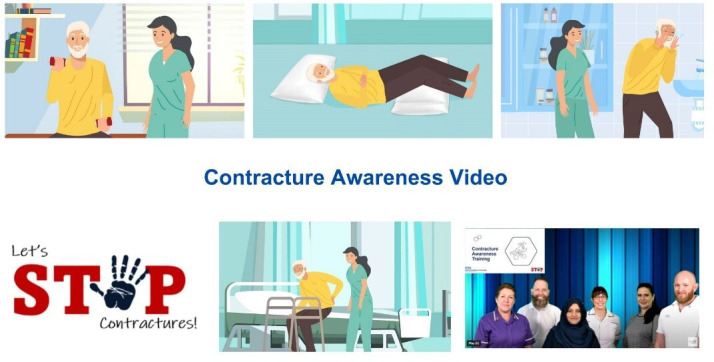
Background: Contractures are a debilitating problem for individuals living in long-term care settings. However, there is a lack of education and training among the care staff regarding the identification of risk factors related to contractures and the preventive strategies that can decrease their development or progression. Addressing this knowledge gap has the potential to improve the quality of care provided to residents in care homes.The objective of this quality improvement (QI) project was to investigate the impact of a newly developed educational video on the awareness, knowledge and understanding of contractures among the care staff.
Methods: This QI project involved two sequential Plan-Do-Study-Act cycles and employed a pre and post-test design to evaluate the impact of the contracture educational video. Primary outcomes were assessed using paper surveys to capture prevideo and postvideo levels of knowledge and understanding of contractures. Furthermore, both verbal and written feedback from participants were gathered to identify areas of strengths and improvement.
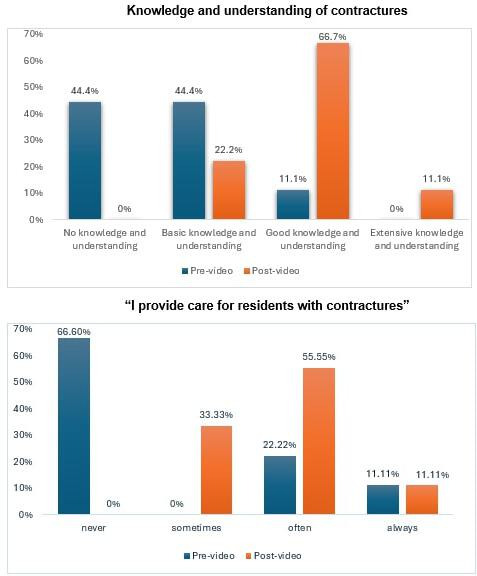
Results: Baseline data revealed that about 56% of the care staff lacked knowledge and understanding of contractures with another 33% reporting possessing only basic knowledge. Following the video intervention, percentage of care staff who reported good knowledge and understanding increased to 67% while 22% reported basic knowledge and understanding of contractures. The care staff suggested changes to the video to improve accessibility of the information, this was incorporated in the refilming of the video.
Conclusion: This QI project demonstrated that the introduction of a contracture educational video is a feasible and positively received method of enhancing awareness, knowledge and understanding of contractures among care staff. Educating care staff about the risk factors and prevention strategies for contractures will potentially improve their ability to identify the risk of contractures and help prevent their occurrence, ultimately enhancing the quality of care of the residents.




 京公网安备 11010802042870号
京ICP备2023020795号-1
京公网安备 11010802042870号
京ICP备2023020795号-1

 分享
分享
 求助内容:
求助内容: 应助结果提醒方式:
 扫码关注我们
