Elisheva Levine, Samar Abo-Gush, Bath Sheva Ezagui, Ruth David, Puah Kopuit, Naama Bagrish, Todd Zalut, Marc V Assous, Yossi Freier-Dror, Amos M Yinnon, Shmuel Benenson
{"title":"Assessing and upgrading the cleanliness of the emergency department brief title: upgrading the emergency room's cleanliness.","authors":"Elisheva Levine, Samar Abo-Gush, Bath Sheva Ezagui, Ruth David, Puah Kopuit, Naama Bagrish, Todd Zalut, Marc V Assous, Yossi Freier-Dror, Amos M Yinnon, Shmuel Benenson","doi":"10.1017/ice.2024.177","DOIUrl":null,"url":null,"abstract":"<p><strong>Objective: </strong>To upgrade cleaning and disinfection of patient rooms in a crowded emergency department (ED).</p><p><strong>Setting: </strong>Tertiary referral hospital.</p><p><strong>Design: </strong>Prospective, 3-component, before-and-after intervention study.</p><p><strong>Methods: </strong>Phase 1 consisted of a 4-week baseline determination of ED patient-room cleanliness, using two means: (1) the fluorescence spray, applied before cleaning and assessed subsequently with an ultraviolet lamp. Results are expressed as % of removed spots/all spots (≥7/10 cleaned spots/room was considered clean; (2) ATP swabs obtained after cleaning, which test for presence of residual organic material; readings <45 were considered clean. Phase 2 consisted of revision and reorganization of established cleaning practices. Phase 3 consisted of adding one cleaning person in afternoon/evening shifts, for 4-weeks, during which room cleanliness was assessed as previously described.</p><p><strong>Results: </strong>Cleanliness of the 79 patient rooms, for which fluorescence tests were available from before and after cleaning for all three phases of the study, increased from a baseline of 50% ± 35 removed spots/all spots, to 61% ± 36 after the first intervention (CI95 -0.6 - 21, <i>P</i> = 0.54) and to 68% ± 35 after the second intervention (CI95 5 - 31, <i>P</i> = 0.004, as compared to the baseline). Subanalysis showed that evening shifts improved most remarkably, from 47% ± 32 (n = 45), to 60% ± 33 (n = 49) to 76%±29 (n = 29), respectively, from baseline through the second and third phase (<i>P</i> = 0.001). ATP testing appeared less sensitive for assessment of cleanliness but confirmed the assessment by fluorescence for overall cleanliness (CI95 1 - 14, <i>P</i> = 0.018).</p><p><strong>Conclusions: </strong>Our data demonstrate that a two-step intervention significantly improves cleaning in a busy ED.</p>","PeriodicalId":13663,"journal":{"name":"Infection Control and Hospital Epidemiology","volume":" ","pages":"1-6"},"PeriodicalIF":2.9000,"publicationDate":"2024-12-26","publicationTypes":"Journal Article","fieldsOfStudy":null,"isOpenAccess":false,"openAccessPdf":"https://www.ncbi.nlm.nih.gov/pmc/articles/PMC11790328/pdf/","citationCount":"0","resultStr":null,"platform":"Semanticscholar","paperid":null,"PeriodicalName":"Infection Control and Hospital Epidemiology","FirstCategoryId":"3","ListUrlMain":"https://doi.org/10.1017/ice.2024.177","RegionNum":4,"RegionCategory":"医学","ArticlePicture":[],"TitleCN":null,"AbstractTextCN":null,"PMCID":null,"EPubDate":"","PubModel":"","JCR":"Q2","JCRName":"INFECTIOUS DISEASES","Score":null,"Total":0}
引用次数: 0
Abstract
Objective: To upgrade cleaning and disinfection of patient rooms in a crowded emergency department (ED).
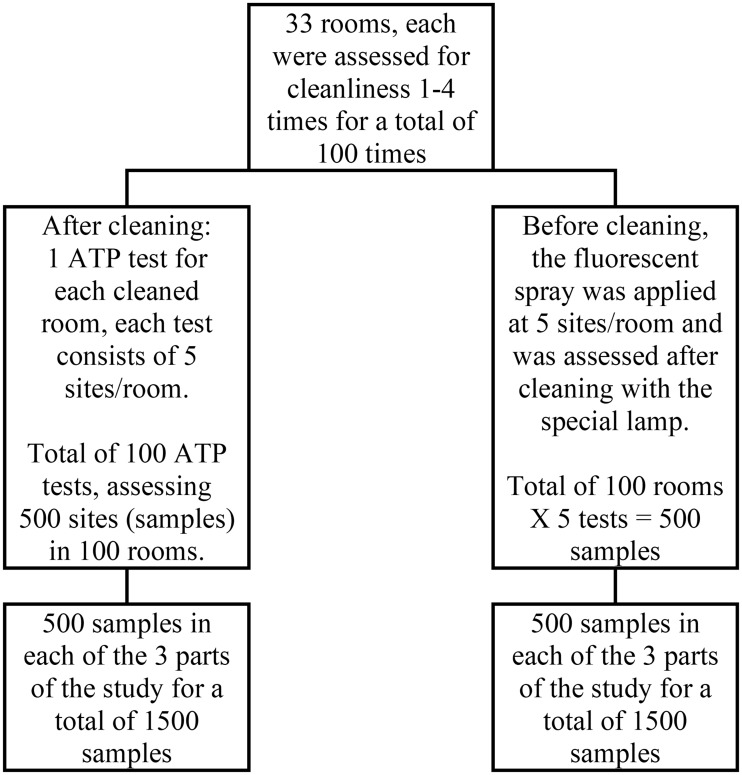
Methods: Phase 1 consisted of a 4-week baseline determination of ED patient-room cleanliness, using two means: (1) the fluorescence spray, applied before cleaning and assessed subsequently with an ultraviolet lamp. Results are expressed as % of removed spots/all spots (≥7/10 cleaned spots/room was considered clean; (2) ATP swabs obtained after cleaning, which test for presence of residual organic material; readings <45 were considered clean. Phase 2 consisted of revision and reorganization of established cleaning practices. Phase 3 consisted of adding one cleaning person in afternoon/evening shifts, for 4-weeks, during which room cleanliness was assessed as previously described.
Results: Cleanliness of the 79 patient rooms, for which fluorescence tests were available from before and after cleaning for all three phases of the study, increased from a baseline of 50% ± 35 removed spots/all spots, to 61% ± 36 after the first intervention (CI95 -0.6 - 21, P = 0.54) and to 68% ± 35 after the second intervention (CI95 5 - 31, P = 0.004, as compared to the baseline). Subanalysis showed that evening shifts improved most remarkably, from 47% ± 32 (n = 45), to 60% ± 33 (n = 49) to 76%±29 (n = 29), respectively, from baseline through the second and third phase (P = 0.001). ATP testing appeared less sensitive for assessment of cleanliness but confirmed the assessment by fluorescence for overall cleanliness (CI95 1 - 14, P = 0.018).
Conclusions: Our data demonstrate that a two-step intervention significantly improves cleaning in a busy ED.
期刊介绍:
Infection Control and Hospital Epidemiology provides original, peer-reviewed scientific articles for anyone involved with an infection control or epidemiology program in a hospital or healthcare facility. Written by infection control practitioners and epidemiologists and guided by an editorial board composed of the nation''s leaders in the field, ICHE provides a critical forum for this vital information.





 京公网安备 11010802042870号
京ICP备2023020795号-1
京公网安备 11010802042870号
京ICP备2023020795号-1

 分享
分享
 求助内容:
求助内容: 应助结果提醒方式:
 扫码关注我们
