{"title":"Techno-strain and techno-insecurity are associated with poor mental well-being in specific age and occupation groups.","authors":"Hang-Ju Yang, Yawen Cheng, Yen-Ling Liu, Wan-Ju Cheng","doi":"10.1093/joccuh/uiae079","DOIUrl":null,"url":null,"abstract":"<p><strong>Objectives: </strong>Innovative technology at work can lead to stress and has been linked with adverse work and health consequences. This study aimed to examine the association of techno-insecurity and techno-strain with mental well-being in different age and occupational groups.</p><p><strong>Methods: </strong>We used a nationally representative survey of the working population and restricted our analyses to 2814 employees who reported being engaged with new technology. Techno-insecurity and techno-strain were evaluated by a single question each. Mental health status was assessed by a 5-item scale, and burnout status was assessed by the Copenhagen Burnout Inventory. We used logistic regression analysis to examine the association of techno-insecurity and techno-strain with mental well-being, adjusting for job control, psychological demands, job insecurity, and workplace violence. We further stratified study participants by age and occupational group and examined the association in each group.</p><p><strong>Results: </strong>One-fifth of the study participants reported having techno-insecurity and techno-strain. Techno-insecurity was associated with a 1.8-fold increased risk of poor mental health and high burnout, whereas techno-strain was associated with a 2.2-fold increased risk of having poor mental health and high burnout. The associations between techno-insecurity or techno-strain and poor mental health were most profound among middle-aged workers. Among all occupational groups, the associations between techno-insecurity or techno-strain and burnout were most profound among manual workers.</p><p><strong>Conclusions: </strong>Techno-strain and techno-insecurity are emerging occupational mental health threats, particularly among middle-aged and manual workers. To promote mental health, resources provided by the organization are needed to help employees cope and work with technology.</p>","PeriodicalId":16632,"journal":{"name":"Journal of Occupational Health","volume":" ","pages":""},"PeriodicalIF":2.0000,"publicationDate":"2025-01-07","publicationTypes":"Journal Article","fieldsOfStudy":null,"isOpenAccess":false,"openAccessPdf":"https://www.ncbi.nlm.nih.gov/pmc/articles/PMC11827113/pdf/","citationCount":"0","resultStr":null,"platform":"Semanticscholar","paperid":null,"PeriodicalName":"Journal of Occupational Health","FirstCategoryId":"3","ListUrlMain":"https://doi.org/10.1093/joccuh/uiae079","RegionNum":4,"RegionCategory":"医学","ArticlePicture":[],"TitleCN":null,"AbstractTextCN":null,"PMCID":null,"EPubDate":"","PubModel":"","JCR":"Q2","JCRName":"PUBLIC, ENVIRONMENTAL & OCCUPATIONAL HEALTH","Score":null,"Total":0}
引用次数: 0
Abstract
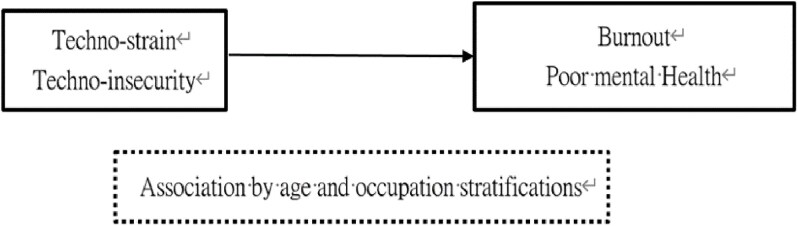
Objectives: Innovative technology at work can lead to stress and has been linked with adverse work and health consequences. This study aimed to examine the association of techno-insecurity and techno-strain with mental well-being in different age and occupational groups.
Methods: We used a nationally representative survey of the working population and restricted our analyses to 2814 employees who reported being engaged with new technology. Techno-insecurity and techno-strain were evaluated by a single question each. Mental health status was assessed by a 5-item scale, and burnout status was assessed by the Copenhagen Burnout Inventory. We used logistic regression analysis to examine the association of techno-insecurity and techno-strain with mental well-being, adjusting for job control, psychological demands, job insecurity, and workplace violence. We further stratified study participants by age and occupational group and examined the association in each group.
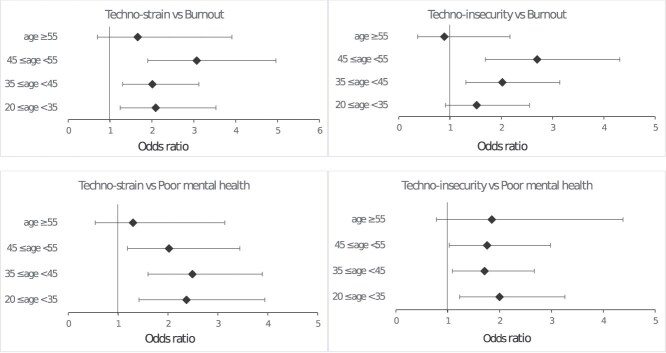
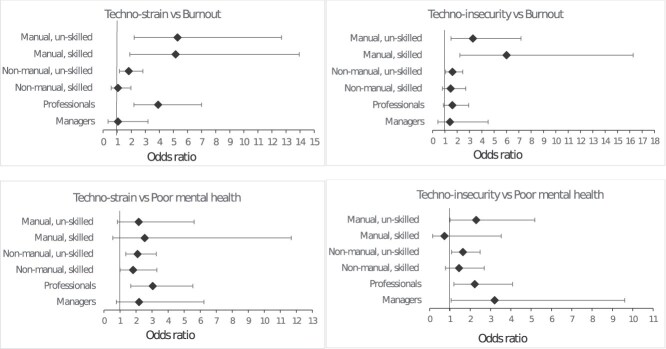
Results: One-fifth of the study participants reported having techno-insecurity and techno-strain. Techno-insecurity was associated with a 1.8-fold increased risk of poor mental health and high burnout, whereas techno-strain was associated with a 2.2-fold increased risk of having poor mental health and high burnout. The associations between techno-insecurity or techno-strain and poor mental health were most profound among middle-aged workers. Among all occupational groups, the associations between techno-insecurity or techno-strain and burnout were most profound among manual workers.
Conclusions: Techno-strain and techno-insecurity are emerging occupational mental health threats, particularly among middle-aged and manual workers. To promote mental health, resources provided by the organization are needed to help employees cope and work with technology.
期刊介绍:
The scope of the journal is broad, covering toxicology, ergonomics, psychosocial factors and other relevant health issues of workers, with special emphasis on the current developments in occupational health. The JOH also accepts various methodologies that are relevant to investigation of occupational health risk factors and exposures, such as large-scale epidemiological studies, human studies employing biological techniques and fundamental experiments on animals, and also welcomes submissions concerning occupational health practices and related issues.



 京公网安备 11010802042870号
京ICP备2023020795号-1
京公网安备 11010802042870号
京ICP备2023020795号-1

 分享
分享
 求助内容:
求助内容: 应助结果提醒方式:
 扫码关注我们
