{"title":"Exploring the potential of soapstock over a glycerol in vitamin K2 production by Bacillus subtilis natto: a comparative analysis.","authors":"Faranak Ansari, Hoda Nouri, Hamid Moghimi","doi":"10.1186/s12934-024-02629-1","DOIUrl":null,"url":null,"abstract":"<p><strong>Background: </strong>Vitamin K2 is an essential nutrient for blood coagulation and cardiovascular health and mainly produced by bacteria strain like B. subtilis. researchers have explored producing strain improvement, cultivation mode, environmental optimization, increased secretion, and using cheaper carbon and nitrogen sources in order to increase vitamin K2 productivity. This study examines the impact of varioius concentration of soapstock, which is a by-product of vegetable oil refining, as an alternative carbon source with lower pirce, in the fermentation medium instead of glycerol on the microbial synthesis of vitamin K2 using B. subtilis natto ATCC 23857.</p><p><strong>Results: </strong>The results demonstrate that when the glycerol in fermentation medium was substituted with soapstock, by 75% concentartion, the fermentation process produced a yield of 158.16 mg/L of vitamin K2 after 72 h; This was 3.8 times more than the control medium containing glycerol. When the entire culture medium was replaced with wastewater, the vitamin K2 concentration reached 21.18 mg/L, 52% of the control medium's concentration. If the carbon sources in the fermentation medium consisted of 20% soapstock and 47.4 g/L glycerol (maintaining the same final glycerol concentration as the control medium), the vitamin K2 concentration reached 35.7 mg/L or 85.8% of the control medium. The analysis of soapstock fermentation medium characteristics reveals that after fermentation with B. subtilis, the COD of soapstock fermentation medium was dramatically reduced from 259,500 mg/L to 57,830 mg/L.</p><p><strong>Conclusions: </strong>Using soapstock as an alternative carbon source for fermentation did not negatively impact the bioprocess and increased vitamin K2 production. Therefore, this research introduces an alternative carbon resource for vitamin K2 production and paves the way for the biorefinement of soapstock.</p>","PeriodicalId":18582,"journal":{"name":"Microbial Cell Factories","volume":"23 1","pages":"348"},"PeriodicalIF":4.9000,"publicationDate":"2024-12-27","publicationTypes":"Journal Article","fieldsOfStudy":null,"isOpenAccess":false,"openAccessPdf":"https://www.ncbi.nlm.nih.gov/pmc/articles/PMC11681655/pdf/","citationCount":"0","resultStr":null,"platform":"Semanticscholar","paperid":null,"PeriodicalName":"Microbial Cell Factories","FirstCategoryId":"5","ListUrlMain":"https://doi.org/10.1186/s12934-024-02629-1","RegionNum":2,"RegionCategory":"生物学","ArticlePicture":[],"TitleCN":null,"AbstractTextCN":null,"PMCID":null,"EPubDate":"","PubModel":"","JCR":"Q1","JCRName":"BIOTECHNOLOGY & APPLIED MICROBIOLOGY","Score":null,"Total":0}
引用次数: 0
Abstract
Background: Vitamin K2 is an essential nutrient for blood coagulation and cardiovascular health and mainly produced by bacteria strain like B. subtilis. researchers have explored producing strain improvement, cultivation mode, environmental optimization, increased secretion, and using cheaper carbon and nitrogen sources in order to increase vitamin K2 productivity. This study examines the impact of varioius concentration of soapstock, which is a by-product of vegetable oil refining, as an alternative carbon source with lower pirce, in the fermentation medium instead of glycerol on the microbial synthesis of vitamin K2 using B. subtilis natto ATCC 23857.
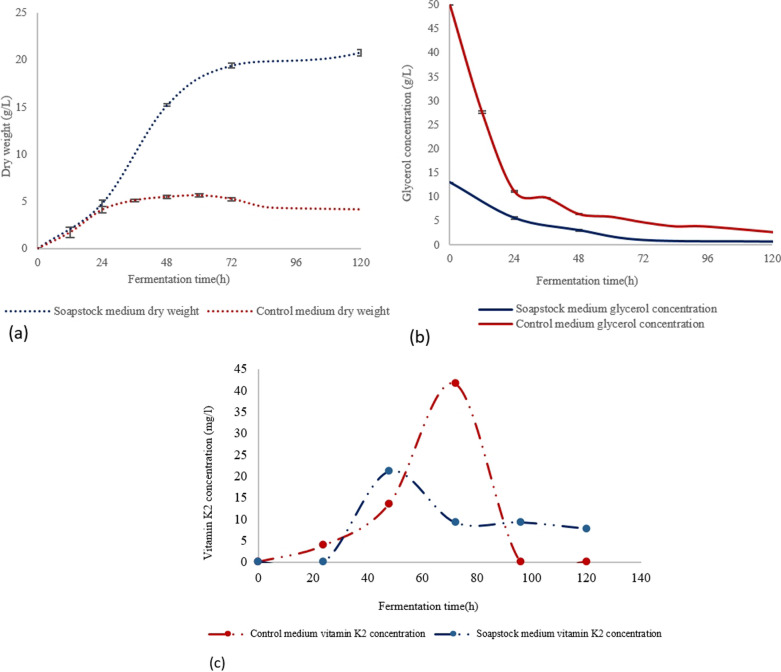
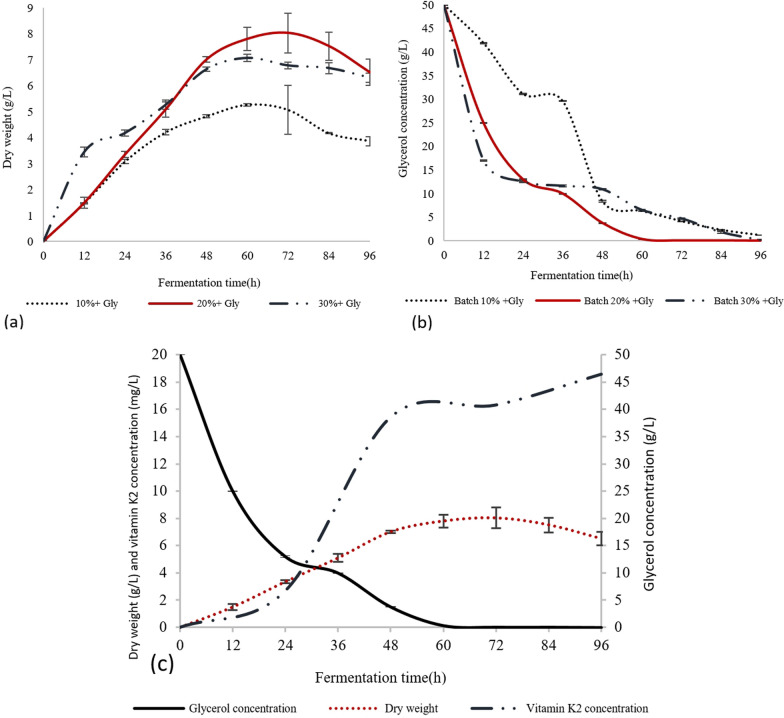
Results: The results demonstrate that when the glycerol in fermentation medium was substituted with soapstock, by 75% concentartion, the fermentation process produced a yield of 158.16 mg/L of vitamin K2 after 72 h; This was 3.8 times more than the control medium containing glycerol. When the entire culture medium was replaced with wastewater, the vitamin K2 concentration reached 21.18 mg/L, 52% of the control medium's concentration. If the carbon sources in the fermentation medium consisted of 20% soapstock and 47.4 g/L glycerol (maintaining the same final glycerol concentration as the control medium), the vitamin K2 concentration reached 35.7 mg/L or 85.8% of the control medium. The analysis of soapstock fermentation medium characteristics reveals that after fermentation with B. subtilis, the COD of soapstock fermentation medium was dramatically reduced from 259,500 mg/L to 57,830 mg/L.
Conclusions: Using soapstock as an alternative carbon source for fermentation did not negatively impact the bioprocess and increased vitamin K2 production. Therefore, this research introduces an alternative carbon resource for vitamin K2 production and paves the way for the biorefinement of soapstock.
期刊介绍:
Microbial Cell Factories is an open access peer-reviewed journal that covers any topic related to the development, use and investigation of microbial cells as producers of recombinant proteins and natural products, or as catalyzers of biological transformations of industrial interest. Microbial Cell Factories is the world leading, primary research journal fully focusing on Applied Microbiology.
The journal is divided into the following editorial sections:
-Metabolic engineering
-Synthetic biology
-Whole-cell biocatalysis
-Microbial regulations
-Recombinant protein production/bioprocessing
-Production of natural compounds
-Systems biology of cell factories
-Microbial production processes
-Cell-free systems




 京公网安备 11010802042870号
京ICP备2023020795号-1
京公网安备 11010802042870号
京ICP备2023020795号-1

 分享
分享
 求助内容:
求助内容: 应助结果提醒方式:
 扫码关注我们
