Carine den Boer, Zola Krak, Berend Terluin, Johannes C van der Wouden, Annette H Blankenstein, Henriëtte E van der Horst
{"title":"Explaining persistent physical symptoms to patients in general practice: can tests to measure central sensitisation add value? A mixed-methods study.","authors":"Carine den Boer, Zola Krak, Berend Terluin, Johannes C van der Wouden, Annette H Blankenstein, Henriëtte E van der Horst","doi":"10.1186/s12875-024-02686-w","DOIUrl":null,"url":null,"abstract":"<p><strong>Introduction: </strong>General practitioners (GPs) often face challenges in explaining to patients with persistent physical symptoms (PPS) why their symptoms persist. Providing an explanation of the central sensitisation (CS) mechanism to patients could be helpful, yet GPs do not routinely test for signs of CS in these patients. The aim of this study was to explore the value of applying a test to assess CS in enhancing explanations provided to patients.</p><p><strong>Methods: </strong>In this prospective study, 25 GPs applied three tests, selected through a Delphi study, to assess CS-related symptoms: (1) the Central Sensitisation Inventory (CSI); (2) an algometer for measuring pressure pain thresholds (PPT); and (3) a monofilament for assessing temporal summation. Following the tests, both the GP and the patient completed a short questionnaire. Subsequently, GPs shared their experiences in focus groups and interviews, while a sample of patients was interviewed individually. The questionnaires were analysed quantitatively, and the focus groups and interviews were analysed qualitatively.</p><p><strong>Results: </strong>GPs reported that all tests were feasible to perform during consultations; testing took less than 5 min in 25% of cases and between 5 and 10 min in 60% of cases. In approximately 50% of cases, an additional consultation was required to perform the test. The results of the CSI confirmed CS-related symptoms more frequently (74%) than the algometer (46%) and the monofilament (43%). Consequently, many GPs preferred the CSI. Patients did not show a preference for any specific test; two-third found the tests valuable and approximately 50% reported that the explanation of CS was clearer when a test was used.</p><p><strong>Conclusions: </strong>Testing during the consultation was feasible, although an additional consultation was required in 50% of the cases. GPs preferred the CSI because its results confirmed CS-related symptoms more frequently than those from the algometer and monofilament.</p>","PeriodicalId":72428,"journal":{"name":"BMC primary care","volume":"25 1","pages":"439"},"PeriodicalIF":2.6000,"publicationDate":"2024-12-27","publicationTypes":"Journal Article","fieldsOfStudy":null,"isOpenAccess":false,"openAccessPdf":"https://www.ncbi.nlm.nih.gov/pmc/articles/PMC11673602/pdf/","citationCount":"0","resultStr":null,"platform":"Semanticscholar","paperid":null,"PeriodicalName":"BMC primary care","FirstCategoryId":"1085","ListUrlMain":"https://doi.org/10.1186/s12875-024-02686-w","RegionNum":0,"RegionCategory":null,"ArticlePicture":[],"TitleCN":null,"AbstractTextCN":null,"PMCID":null,"EPubDate":"","PubModel":"","JCR":"Q2","JCRName":"MEDICINE, GENERAL & INTERNAL","Score":null,"Total":0}
引用次数: 0
Abstract
Introduction: General practitioners (GPs) often face challenges in explaining to patients with persistent physical symptoms (PPS) why their symptoms persist. Providing an explanation of the central sensitisation (CS) mechanism to patients could be helpful, yet GPs do not routinely test for signs of CS in these patients. The aim of this study was to explore the value of applying a test to assess CS in enhancing explanations provided to patients.
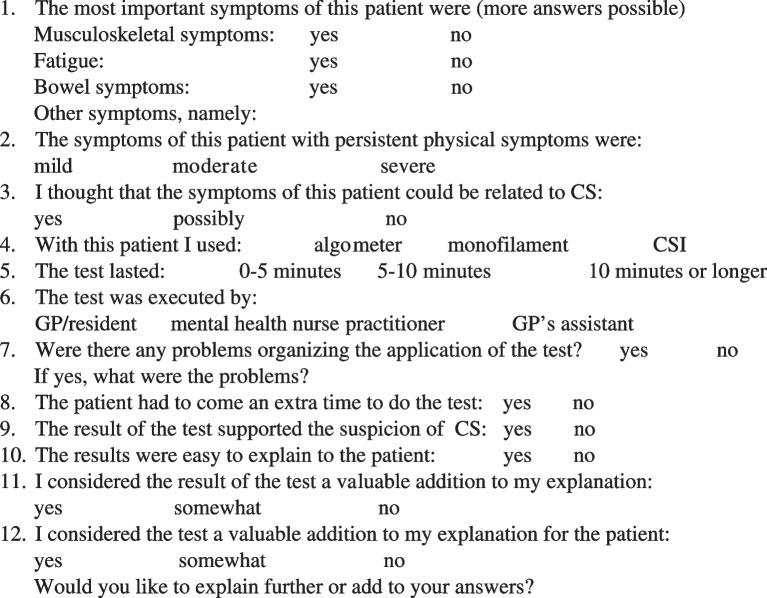
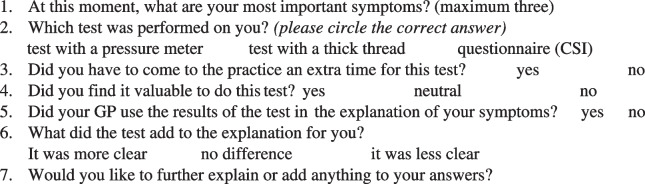
Methods: In this prospective study, 25 GPs applied three tests, selected through a Delphi study, to assess CS-related symptoms: (1) the Central Sensitisation Inventory (CSI); (2) an algometer for measuring pressure pain thresholds (PPT); and (3) a monofilament for assessing temporal summation. Following the tests, both the GP and the patient completed a short questionnaire. Subsequently, GPs shared their experiences in focus groups and interviews, while a sample of patients was interviewed individually. The questionnaires were analysed quantitatively, and the focus groups and interviews were analysed qualitatively.
Results: GPs reported that all tests were feasible to perform during consultations; testing took less than 5 min in 25% of cases and between 5 and 10 min in 60% of cases. In approximately 50% of cases, an additional consultation was required to perform the test. The results of the CSI confirmed CS-related symptoms more frequently (74%) than the algometer (46%) and the monofilament (43%). Consequently, many GPs preferred the CSI. Patients did not show a preference for any specific test; two-third found the tests valuable and approximately 50% reported that the explanation of CS was clearer when a test was used.
Conclusions: Testing during the consultation was feasible, although an additional consultation was required in 50% of the cases. GPs preferred the CSI because its results confirmed CS-related symptoms more frequently than those from the algometer and monofilament.



 京公网安备 11010802042870号
京ICP备2023020795号-1
京公网安备 11010802042870号
京ICP备2023020795号-1

 分享
分享

 求助内容:
求助内容: 应助结果提醒方式:
 扫码关注我们
