Frederique Beatrice Denijs, Hendrik Van Poppel, Arnulf Stenzl, Tiago Villanueva, Josep Maria Vilaseca, Mehmet Ungan, André Deschamps, Sarah Collen, Monique J Roobol
{"title":"PSA testing in primary care: is it time to change our practice?","authors":"Frederique Beatrice Denijs, Hendrik Van Poppel, Arnulf Stenzl, Tiago Villanueva, Josep Maria Vilaseca, Mehmet Ungan, André Deschamps, Sarah Collen, Monique J Roobol","doi":"10.1186/s12875-024-02688-8","DOIUrl":null,"url":null,"abstract":"<p><strong>Background: </strong>Historical prostate-specific antigen (PSA)-based screening studies reduced prostate cancer-related deaths but also led to overdiagnosis/overtreatment. Since then, opportunistic PSA testing has increased, and late-stage diagnoses and prostate-cancer related deaths are rising.</p><p><strong>Objectives: </strong>To review current trends regarding PSA testing in primary care and propose a collaborative approach to improve early prostate cancer detection.</p><p><strong>Discussion: </strong>Opportunistic PSA testing patterns vary among General Practitioners (GPs) and Family Doctors (FDs) based on differing guidelines, patient pressure, time constraints and personal views/preferences. However, an organised, risk-adapted strategy, as outlined by the European Association of Urology's guidelines, could facilitate the early diagnosis of significant prostate cancer whilst sparing those unlikely to experience disease-related symptoms from further tests (overdiagnosis) as well as the psychosocial consequences of a cancer diagnosis. This could be achieved by the introduction of national prostate cancer screening programmes, which has been endorsed in the European Commission's publication of the EU Cancer Screening Recommendations. In this scenario, GPs/FDs would still play an important role in supporting men throughout the decision pathway. However, as some men may still request a PSA test from their GP/FD, patient information as well as clear guidance and support to GPs/FDs are needed, including appropriate skills training to facilitate effective counselling and informed decision-making, and the use of risk calculators to inform referral decisions.</p><p><strong>Conclusion: </strong>GPs/FDs play an important role in counselling healthy men eligible to consider PSA testing. However, clear guidance, training and support is required for them to assume this role.</p>","PeriodicalId":72428,"journal":{"name":"BMC primary care","volume":"25 1","pages":"436"},"PeriodicalIF":2.6000,"publicationDate":"2024-12-26","publicationTypes":"Journal Article","fieldsOfStudy":null,"isOpenAccess":false,"openAccessPdf":"https://www.ncbi.nlm.nih.gov/pmc/articles/PMC11670451/pdf/","citationCount":"0","resultStr":null,"platform":"Semanticscholar","paperid":null,"PeriodicalName":"BMC primary care","FirstCategoryId":"1085","ListUrlMain":"https://doi.org/10.1186/s12875-024-02688-8","RegionNum":0,"RegionCategory":null,"ArticlePicture":[],"TitleCN":null,"AbstractTextCN":null,"PMCID":null,"EPubDate":"","PubModel":"","JCR":"Q2","JCRName":"MEDICINE, GENERAL & INTERNAL","Score":null,"Total":0}
引用次数: 0
Abstract
Background: Historical prostate-specific antigen (PSA)-based screening studies reduced prostate cancer-related deaths but also led to overdiagnosis/overtreatment. Since then, opportunistic PSA testing has increased, and late-stage diagnoses and prostate-cancer related deaths are rising.
Objectives: To review current trends regarding PSA testing in primary care and propose a collaborative approach to improve early prostate cancer detection.
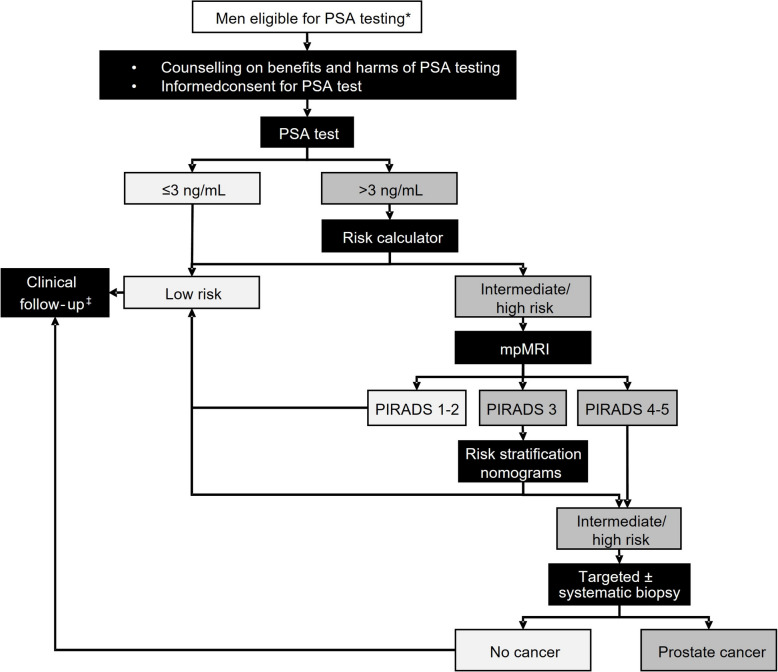
Discussion: Opportunistic PSA testing patterns vary among General Practitioners (GPs) and Family Doctors (FDs) based on differing guidelines, patient pressure, time constraints and personal views/preferences. However, an organised, risk-adapted strategy, as outlined by the European Association of Urology's guidelines, could facilitate the early diagnosis of significant prostate cancer whilst sparing those unlikely to experience disease-related symptoms from further tests (overdiagnosis) as well as the psychosocial consequences of a cancer diagnosis. This could be achieved by the introduction of national prostate cancer screening programmes, which has been endorsed in the European Commission's publication of the EU Cancer Screening Recommendations. In this scenario, GPs/FDs would still play an important role in supporting men throughout the decision pathway. However, as some men may still request a PSA test from their GP/FD, patient information as well as clear guidance and support to GPs/FDs are needed, including appropriate skills training to facilitate effective counselling and informed decision-making, and the use of risk calculators to inform referral decisions.
Conclusion: GPs/FDs play an important role in counselling healthy men eligible to consider PSA testing. However, clear guidance, training and support is required for them to assume this role.



 京公网安备 11010802042870号
京ICP备2023020795号-1
京公网安备 11010802042870号
京ICP备2023020795号-1

 分享
分享

 求助内容:
求助内容: 应助结果提醒方式:
 扫码关注我们
