Francesca Galbiati, Imen Becetti, Meghan Lauze, Anna Aulinas, Vibha Singhal, Miriam A. Bredella, Elizabeth A. Lawson, Madhusmita Misra
{"title":"Increased copeptin may reflect vasopressin-related metabolic changes after bariatric surgery","authors":"Francesca Galbiati, Imen Becetti, Meghan Lauze, Anna Aulinas, Vibha Singhal, Miriam A. Bredella, Elizabeth A. Lawson, Madhusmita Misra","doi":"10.1002/oby.24200","DOIUrl":null,"url":null,"abstract":"<div>\n \n \n <section>\n \n <h3> Objective</h3>\n \n <p>Mechanisms underlying metabolic improvement following metabolic and bariatric surgery (MBS) may provide insight into novel therapies. Vasopressin improves body composition and protects against hypoglycemia. Associations of copeptin, a stable cleavage product of vasopressin, with BMI and insulin resistance suggest an adaptive increase in vasopressin to counteract metabolic disruption. To our knowledge, no study has investigated copeptin before and after MBS in humans. This study's aim was to investigate copeptin changes following MBS and associations with metabolic parameters.</p>\n </section>\n \n <section>\n \n <h3> Methods</h3>\n \n <p>This was a 12-month longitudinal study of 64 youth (78% female; mean age 18.7 [SD 2.8] y) with obesity (mean BMI 45.6 [SD 6.8] kg/m<sup>2</sup>) undergoing MBS (<i>n</i> = 34) or nonsurgical (NS) lifestyle management (<i>n</i> = 30). Fasting copeptin, hemoglobin A1c (HbA1c), homeostatic model assessment for insulin resistance (HOMA-IR), body composition, and resting energy expenditure (REE) were assessed.</p>\n </section>\n \n <section>\n \n <h3> Results</h3>\n \n <p>Over 12 months, copeptin increased more (time-by-treatment <i>p</i> = 0.017) whereas HbA1c and adiposity decreased more after MBS than NS (<i>ps</i> ≤ 0.036). Copeptin changes correlated negatively with percentage fat mass and REE changes (rho ≤ −0.29; <i>p</i>s ≤ 0.025) in the whole group, and they correlated positively with HbA1c and HOMA-IR (rho ≥ 0.41; false discovery rate–adjusted <i>p</i> = 0.05) and negatively with REE changes (rho = −0.55; false discovery rate–adjusted <i>p</i> = 0.036) in the MBS group.</p>\n </section>\n \n <section>\n \n <h3> Conclusions</h3>\n \n <p>Increases in copeptin after weight loss in MBS compared with NS were associated with lower REE and higher HbA1c/HOMA-IR values. Vasopressin may contribute to MBS-related metabolic modifications.</p>\n </section>\n </div>","PeriodicalId":215,"journal":{"name":"Obesity","volume":"33 2","pages":"298-307"},"PeriodicalIF":4.7000,"publicationDate":"2024-12-26","publicationTypes":"Journal Article","fieldsOfStudy":null,"isOpenAccess":false,"openAccessPdf":"https://www.ncbi.nlm.nih.gov/pmc/articles/PMC11774013/pdf/","citationCount":"0","resultStr":null,"platform":"Semanticscholar","paperid":null,"PeriodicalName":"Obesity","FirstCategoryId":"3","ListUrlMain":"https://onlinelibrary.wiley.com/doi/10.1002/oby.24200","RegionNum":2,"RegionCategory":"医学","ArticlePicture":[],"TitleCN":null,"AbstractTextCN":null,"PMCID":null,"EPubDate":"","PubModel":"","JCR":"Q1","JCRName":"ENDOCRINOLOGY & METABOLISM","Score":null,"Total":0}
引用次数: 0
Abstract
Objective
Mechanisms underlying metabolic improvement following metabolic and bariatric surgery (MBS) may provide insight into novel therapies. Vasopressin improves body composition and protects against hypoglycemia. Associations of copeptin, a stable cleavage product of vasopressin, with BMI and insulin resistance suggest an adaptive increase in vasopressin to counteract metabolic disruption. To our knowledge, no study has investigated copeptin before and after MBS in humans. This study's aim was to investigate copeptin changes following MBS and associations with metabolic parameters.
Methods
This was a 12-month longitudinal study of 64 youth (78% female; mean age 18.7 [SD 2.8] y) with obesity (mean BMI 45.6 [SD 6.8] kg/m2) undergoing MBS (n = 34) or nonsurgical (NS) lifestyle management (n = 30). Fasting copeptin, hemoglobin A1c (HbA1c), homeostatic model assessment for insulin resistance (HOMA-IR), body composition, and resting energy expenditure (REE) were assessed.
Results
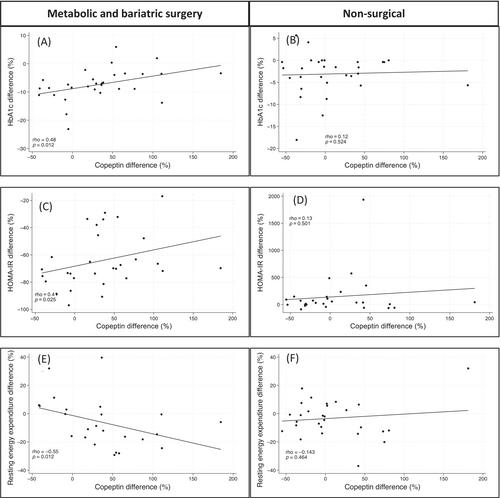
Over 12 months, copeptin increased more (time-by-treatment p = 0.017) whereas HbA1c and adiposity decreased more after MBS than NS (ps ≤ 0.036). Copeptin changes correlated negatively with percentage fat mass and REE changes (rho ≤ −0.29; ps ≤ 0.025) in the whole group, and they correlated positively with HbA1c and HOMA-IR (rho ≥ 0.41; false discovery rate–adjusted p = 0.05) and negatively with REE changes (rho = −0.55; false discovery rate–adjusted p = 0.036) in the MBS group.
Conclusions
Increases in copeptin after weight loss in MBS compared with NS were associated with lower REE and higher HbA1c/HOMA-IR values. Vasopressin may contribute to MBS-related metabolic modifications.
期刊介绍:
Obesity is the official journal of The Obesity Society and is the premier source of information for increasing knowledge, fostering translational research from basic to population science, and promoting better treatment for people with obesity. Obesity publishes important peer-reviewed research and cutting-edge reviews, commentaries, and public health and medical developments.



 京公网安备 11010802042870号
京ICP备2023020795号-1
京公网安备 11010802042870号
京ICP备2023020795号-1

 分享
分享
 求助内容:
求助内容: 应助结果提醒方式:
 扫码关注我们
