{"title":"CCfrag: scanning folding potential of coiled-coil fragments with AlphaFold.","authors":"Mikel Martinez-Goikoetxea","doi":"10.1093/bioadv/vbae195","DOIUrl":null,"url":null,"abstract":"<p><strong>Motivation: </strong>Coiled coils are a widespread structural motif consisting of multiple α-helices that wind around a central axis to bury their hydrophobic core. While AlphaFold has emerged as an effective coiled-coil modeling tool, capable of accurately predicting changes in periodicity and core geometry along coiled-coil stalks, it is not without limitations, such as the generation of spuriously bent models and the inability to effectively model globally non-canonical-coiled coils. To overcome these limitations, we investigated whether dividing full-length sequences into fragments would result in better models.</p><p><strong>Results: </strong>We developed CCfrag to leverage AlphaFold for the piece-wise modeling of coiled coils. The user can create a specification, defined by window size, length of overlap, and oligomerization state, and the program produces the files necessary to run AlphaFold predictions. The structural models and their scores are then integrated into a rich per-residue representation defined by sequence- or structure-based features. Our results suggest that removing coiled-coil sequences from their native context can improve prediction confidence and results in better models. In this article, we present various use cases of CCfrag and propose that fragment-based prediction is useful for understanding the properties of long, fibrous coiled coils by revealing local features not seen in full-length models.</p><p><strong>Availability and implementation: </strong>The program is implemented as a Python module. The code and its documentation are available at https://github.com/Mikel-MG/CCfrag.</p>","PeriodicalId":72368,"journal":{"name":"Bioinformatics advances","volume":"5 1","pages":"vbae195"},"PeriodicalIF":2.8000,"publicationDate":"2024-12-06","publicationTypes":"Journal Article","fieldsOfStudy":null,"isOpenAccess":false,"openAccessPdf":"https://www.ncbi.nlm.nih.gov/pmc/articles/PMC11676326/pdf/","citationCount":"0","resultStr":null,"platform":"Semanticscholar","paperid":null,"PeriodicalName":"Bioinformatics advances","FirstCategoryId":"1085","ListUrlMain":"https://doi.org/10.1093/bioadv/vbae195","RegionNum":0,"RegionCategory":null,"ArticlePicture":[],"TitleCN":null,"AbstractTextCN":null,"PMCID":null,"EPubDate":"2025/1/1 0:00:00","PubModel":"eCollection","JCR":"Q2","JCRName":"MATHEMATICAL & COMPUTATIONAL BIOLOGY","Score":null,"Total":0}
引用次数: 0
Abstract
Motivation: Coiled coils are a widespread structural motif consisting of multiple α-helices that wind around a central axis to bury their hydrophobic core. While AlphaFold has emerged as an effective coiled-coil modeling tool, capable of accurately predicting changes in periodicity and core geometry along coiled-coil stalks, it is not without limitations, such as the generation of spuriously bent models and the inability to effectively model globally non-canonical-coiled coils. To overcome these limitations, we investigated whether dividing full-length sequences into fragments would result in better models.
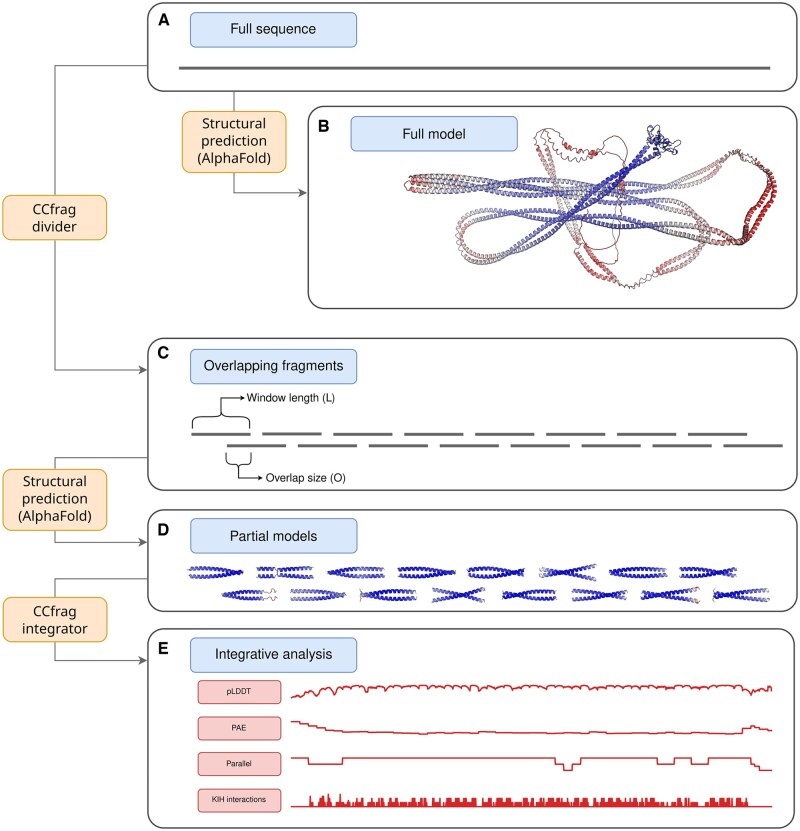
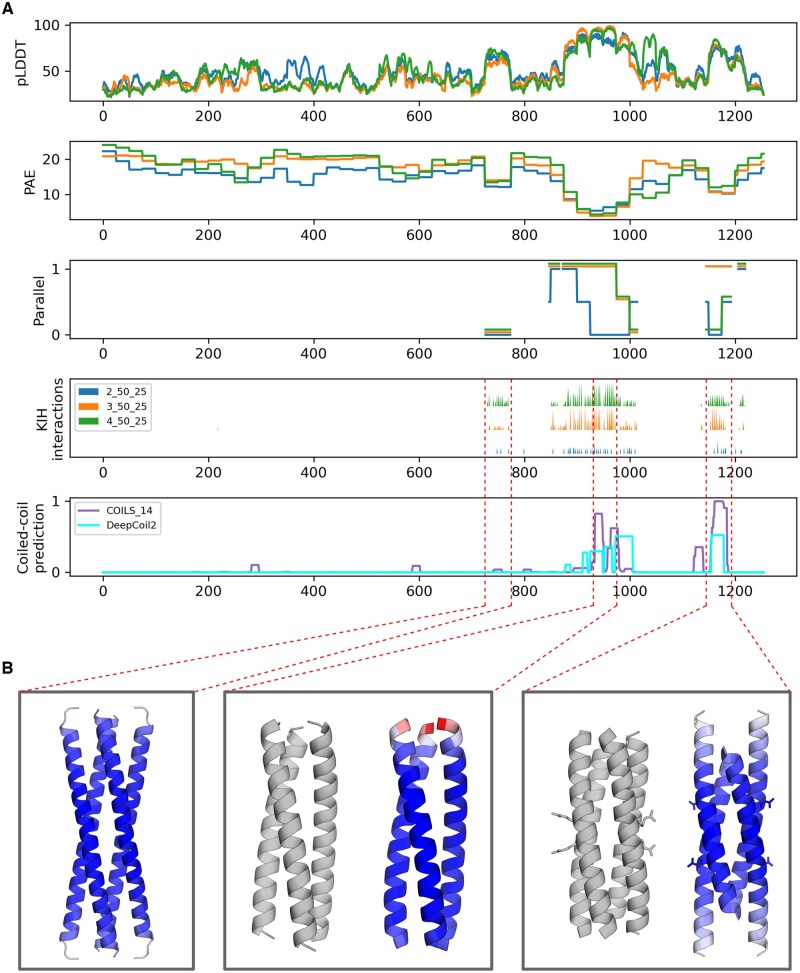
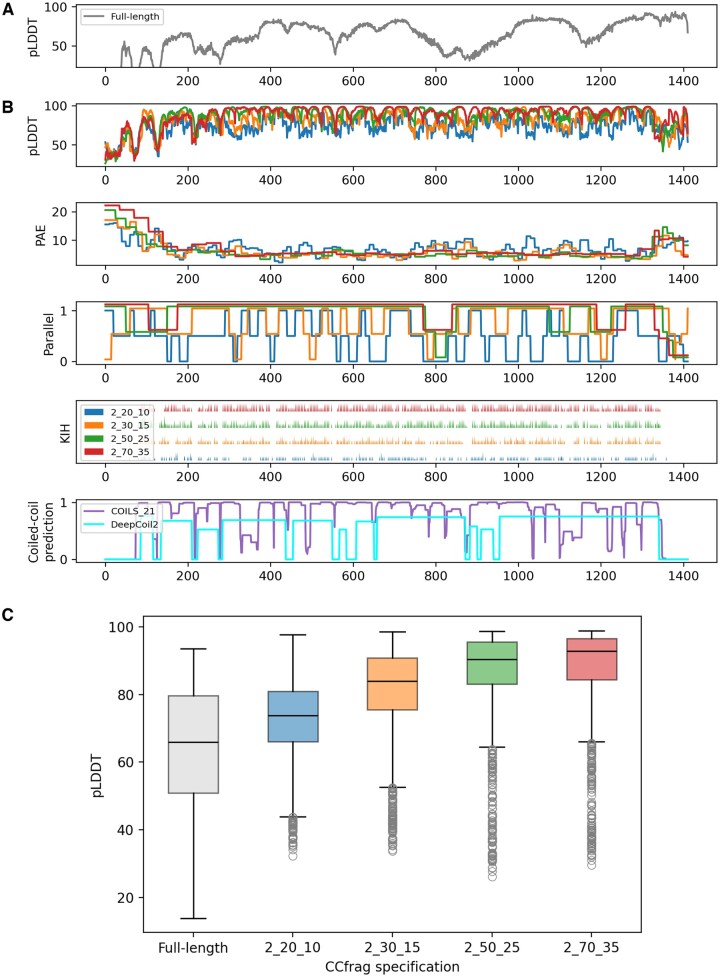
Results: We developed CCfrag to leverage AlphaFold for the piece-wise modeling of coiled coils. The user can create a specification, defined by window size, length of overlap, and oligomerization state, and the program produces the files necessary to run AlphaFold predictions. The structural models and their scores are then integrated into a rich per-residue representation defined by sequence- or structure-based features. Our results suggest that removing coiled-coil sequences from their native context can improve prediction confidence and results in better models. In this article, we present various use cases of CCfrag and propose that fragment-based prediction is useful for understanding the properties of long, fibrous coiled coils by revealing local features not seen in full-length models.
Availability and implementation: The program is implemented as a Python module. The code and its documentation are available at https://github.com/Mikel-MG/CCfrag.




 京公网安备 11010802042870号
京ICP备2023020795号-1
京公网安备 11010802042870号
京ICP备2023020795号-1

 分享
分享

 求助内容:
求助内容: 应助结果提醒方式:
 扫码关注我们
