Michael Ebiyon Ugbeye, Kehinde Adesola Alatishe, Wakeel Olaide Lawal
{"title":"Total Femur Replacement as a Salvage Procedure for Failed Distal Femur Megaprosthesis: A Case Report and Literature Reviews.","authors":"Michael Ebiyon Ugbeye, Kehinde Adesola Alatishe, Wakeel Olaide Lawal","doi":"10.4103/jwas.jwas_244_22","DOIUrl":null,"url":null,"abstract":"<p><p>Total femoral replacement (TFR) is not a common surgery and most indications are for oncological pathologies. However, there are few instances where non-oncological indications might necessitate TFR; this may be a salvage surgery for failed previous hip and/or knee surgeries with consequent significant femur bone loss. We present a 59-year-old obese woman with right thigh pain and difficulty with walking of 5 years duration. She had undergone bilateral total knee replacement 10 years earlier on account of severe knee osteoarthritis. She had a fall 3 years prior to presentation and sustained a periprosthetic fracture around the right knee which was managed with a fixed angle blade plate and screws. This was complicated by implant breakage and non-union. She subsequently had implant removal and a right distal femur replacement (DFR) surgery 2 years prior to presentation. A year after the DFR surgery, she began to experience \"start-up\" pain, instability around the knee and difficulty with walking without support. A clinical and radiologic diagnosis of aseptic loosening of the distal femur megaprosthesis was made and she was offered a revision DFR surgery which also failed due to poor cementing technique, bone loss at the proximal femur, and severe osteoporosis. Patient ended up with a right total femur replacement to salvage the limb. She had improved Lower Extremity Functional Score of 27 after 12-month follow-up. TFR is a viable salvage procedure for severely compromised femur and/or significant bone loss from multiple non-oncological surgeries of the femur.</p>","PeriodicalId":73993,"journal":{"name":"Journal of the West African College of Surgeons","volume":"15 1","pages":"83-86"},"PeriodicalIF":0.0000,"publicationDate":"2025-01-01","publicationTypes":"Journal Article","fieldsOfStudy":null,"isOpenAccess":false,"openAccessPdf":"https://www.ncbi.nlm.nih.gov/pmc/articles/PMC11676023/pdf/","citationCount":"0","resultStr":null,"platform":"Semanticscholar","paperid":null,"PeriodicalName":"Journal of the West African College of Surgeons","FirstCategoryId":"1085","ListUrlMain":"https://doi.org/10.4103/jwas.jwas_244_22","RegionNum":0,"RegionCategory":null,"ArticlePicture":[],"TitleCN":null,"AbstractTextCN":null,"PMCID":null,"EPubDate":"2024/8/2 0:00:00","PubModel":"Epub","JCR":"","JCRName":"","Score":null,"Total":0}
引用次数: 0
Abstract
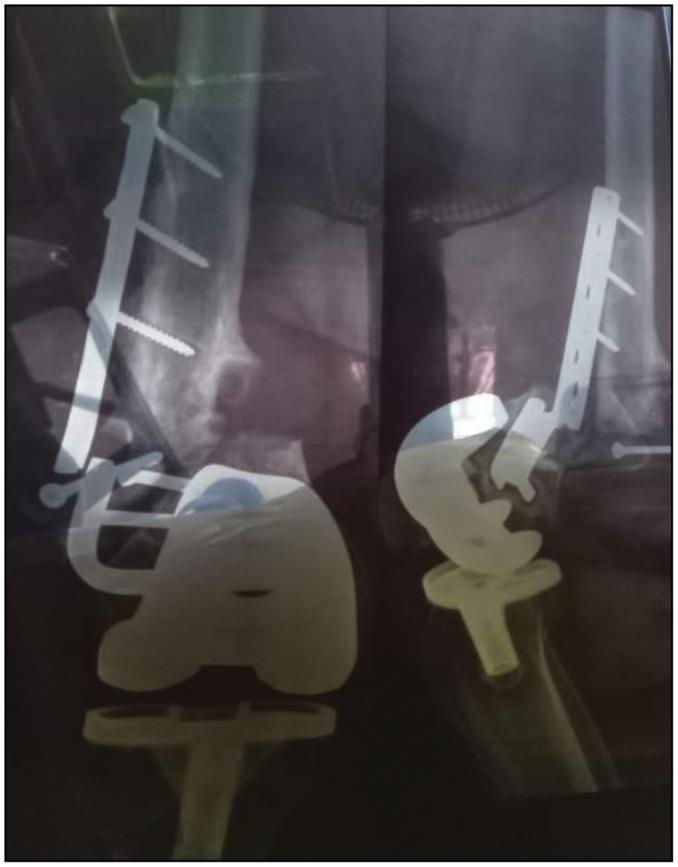
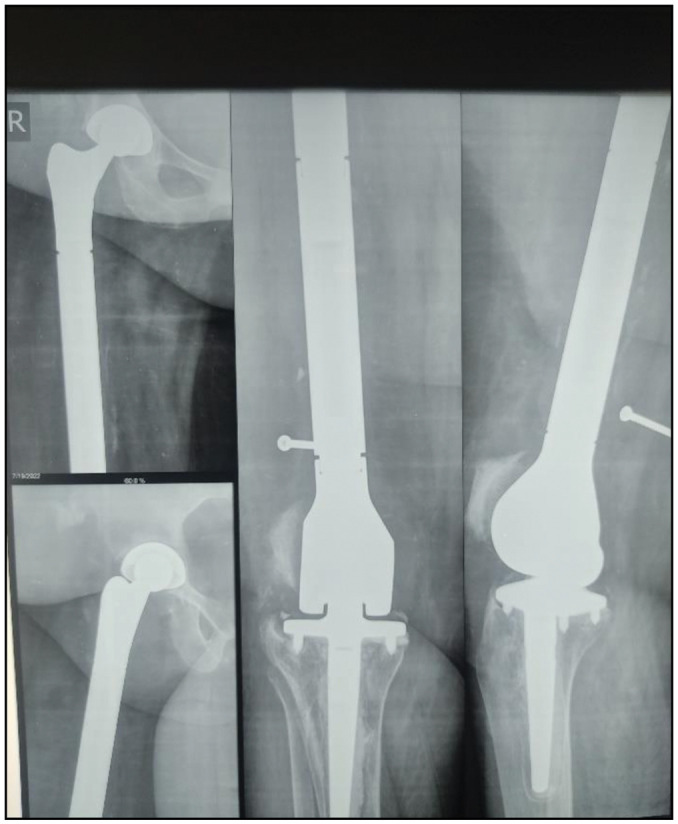
Total femoral replacement (TFR) is not a common surgery and most indications are for oncological pathologies. However, there are few instances where non-oncological indications might necessitate TFR; this may be a salvage surgery for failed previous hip and/or knee surgeries with consequent significant femur bone loss. We present a 59-year-old obese woman with right thigh pain and difficulty with walking of 5 years duration. She had undergone bilateral total knee replacement 10 years earlier on account of severe knee osteoarthritis. She had a fall 3 years prior to presentation and sustained a periprosthetic fracture around the right knee which was managed with a fixed angle blade plate and screws. This was complicated by implant breakage and non-union. She subsequently had implant removal and a right distal femur replacement (DFR) surgery 2 years prior to presentation. A year after the DFR surgery, she began to experience "start-up" pain, instability around the knee and difficulty with walking without support. A clinical and radiologic diagnosis of aseptic loosening of the distal femur megaprosthesis was made and she was offered a revision DFR surgery which also failed due to poor cementing technique, bone loss at the proximal femur, and severe osteoporosis. Patient ended up with a right total femur replacement to salvage the limb. She had improved Lower Extremity Functional Score of 27 after 12-month follow-up. TFR is a viable salvage procedure for severely compromised femur and/or significant bone loss from multiple non-oncological surgeries of the femur.



 京公网安备 11010802042870号
京ICP备2023020795号-1
京公网安备 11010802042870号
京ICP备2023020795号-1

 分享
分享

 求助内容:
求助内容: 应助结果提醒方式:
 扫码关注我们
