{"title":"Neural Architecture Search Based on Bipartite Graphs for Text Classification","authors":"Xueming Yan;Han Huang;Yaochu Jin;Zilong Wang;Zhifeng Hao","doi":"10.1109/TNNLS.2024.3514708","DOIUrl":null,"url":null,"abstract":"Neural architecture search (NAS) is crucial for text representation in natural language processing (NLP); however, much less work on NAS for text classification has been proposed compared with NAS for computer vision. Similar to NAS for vision tasks, most existing work rely on a manually designed search space defined by a directed acyclic graph (DAG), resulting in limited generalization capability and high computational complexity. In text classification, the topological order of the NAS operators is essential for enhancing generalization, which cannot be accurately represented by a DAG. To address this issue, we propose a bipartite graph-based NAS (BGNAS) for text classification, which converts a DAG into a dual graph and then into a bipartite graph. This transformation makes it possible to accurately capture the topological order using multi-bigraph matching. In addition, we formulate NAS as a problem of identifying the lower bound of a submodular function, theoretically ensuring that optimal architectures in a bipartite graph-based search space can be identified using fewer search operators. Reduction of the search space is achieved by eliminating ineffective associated matching rules among search operators with a pruning strategy. As a result, the bipartite graph-based search space becomes more compact and less dependent on complex contextual semantics of text data. Experimental results on public benchmark problems demonstrate that BGNAS achieves better performance than the state-of-the-art NAS algorithms and is computationally more efficient. We also demonstrate that the bipartite graph search space can more effectively capture contextual semantics, thereby enhancing the generalization capability.","PeriodicalId":13303,"journal":{"name":"IEEE transactions on neural networks and learning systems","volume":"36 6","pages":"10749-10763"},"PeriodicalIF":8.9000,"publicationDate":"2024-12-30","publicationTypes":"Journal Article","fieldsOfStudy":null,"isOpenAccess":false,"openAccessPdf":"","citationCount":"0","resultStr":null,"platform":"Semanticscholar","paperid":null,"PeriodicalName":"IEEE transactions on neural networks and learning systems","FirstCategoryId":"94","ListUrlMain":"https://ieeexplore.ieee.org/document/10817777/","RegionNum":1,"RegionCategory":"计算机科学","ArticlePicture":[],"TitleCN":null,"AbstractTextCN":null,"PMCID":null,"EPubDate":"","PubModel":"","JCR":"Q1","JCRName":"COMPUTER SCIENCE, ARTIFICIAL INTELLIGENCE","Score":null,"Total":0}
引用次数: 0
Abstract
Neural architecture search (NAS) is crucial for text representation in natural language processing (NLP); however, much less work on NAS for text classification has been proposed compared with NAS for computer vision. Similar to NAS for vision tasks, most existing work rely on a manually designed search space defined by a directed acyclic graph (DAG), resulting in limited generalization capability and high computational complexity. In text classification, the topological order of the NAS operators is essential for enhancing generalization, which cannot be accurately represented by a DAG. To address this issue, we propose a bipartite graph-based NAS (BGNAS) for text classification, which converts a DAG into a dual graph and then into a bipartite graph. This transformation makes it possible to accurately capture the topological order using multi-bigraph matching. In addition, we formulate NAS as a problem of identifying the lower bound of a submodular function, theoretically ensuring that optimal architectures in a bipartite graph-based search space can be identified using fewer search operators. Reduction of the search space is achieved by eliminating ineffective associated matching rules among search operators with a pruning strategy. As a result, the bipartite graph-based search space becomes more compact and less dependent on complex contextual semantics of text data. Experimental results on public benchmark problems demonstrate that BGNAS achieves better performance than the state-of-the-art NAS algorithms and is computationally more efficient. We also demonstrate that the bipartite graph search space can more effectively capture contextual semantics, thereby enhancing the generalization capability.
期刊介绍:
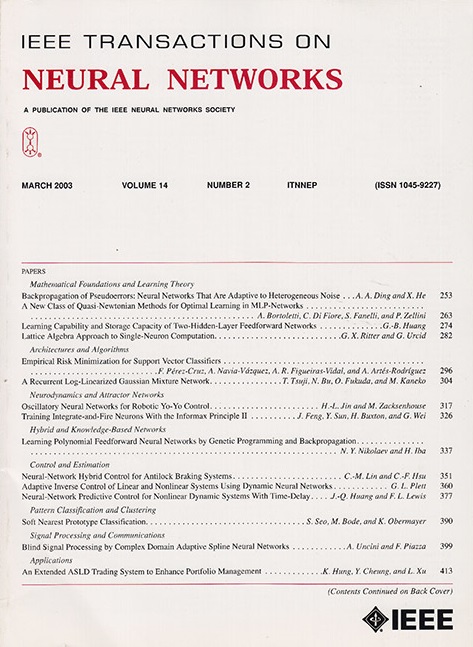
The focus of IEEE Transactions on Neural Networks and Learning Systems is to present scholarly articles discussing the theory, design, and applications of neural networks as well as other learning systems. The journal primarily highlights technical and scientific research in this domain.



 京公网安备 11010802042870号
京ICP备2023020795号-1
京公网安备 11010802042870号
京ICP备2023020795号-1

 分享
分享
 求助内容:
求助内容: 应助结果提醒方式:
 扫码关注我们
