{"title":"Chiral Molecular Carbon Imides: Shining Light on Chiral Optoelectronics","authors":"Yihan Zhang, Yujian Liu, Wei Jiang, Zhaohui Wang","doi":"10.1021/accountsmr.4c00304","DOIUrl":null,"url":null,"abstract":"Chiral molecular carbon imides (CMCIs) represent a kind of chiral π-conjugated molecules that are typically designed and synthesized by introducing helical chirality. This approach creates a stereogenic axis, rather than a traditional chiral center or chiral axis with saturated bonds, resulting in chiral conjugated helices (CCHs). CMCIs have garnered significant attention due to their flexible synthesis (annulative π-extension strategies), tailor-made structures (chiral polycyclic π-conjugated frameworks), and diverse properties (optical, electronic, magnetic, and biochemical characteristics related to chirality). Furthermore, CMCI systems exhibit unique chiroptical properties, including circular dichroism (CD) and circularly polarized luminescence (CPL), which have elevated them as emerging stars among chiral organic functional molecules. Benefiting from their large conjugation planes and excellent electron-withdrawing ability, CMCIs often display outstanding electron mobility, high electron affinity, and strong light absorption or emission capabilities, making them valuable in various organic semiconductor applications. Their unique chiroptical properties and excellent semiconducting abilities position CMCIs as key players in the emerging field of chiral optoelectronics. Additionally, the appropriate packing modes and efficient charge transfer in solid-state CCHs provide excellent platforms for applications in chiral-induced spin selectivity (CISS) and topological quantum properties.","PeriodicalId":72040,"journal":{"name":"Accounts of materials research","volume":"348 1","pages":""},"PeriodicalIF":14.7000,"publicationDate":"2024-12-30","publicationTypes":"Journal Article","fieldsOfStudy":null,"isOpenAccess":false,"openAccessPdf":"","citationCount":"0","resultStr":null,"platform":"Semanticscholar","paperid":null,"PeriodicalName":"Accounts of materials research","FirstCategoryId":"1085","ListUrlMain":"https://doi.org/10.1021/accountsmr.4c00304","RegionNum":0,"RegionCategory":null,"ArticlePicture":[],"TitleCN":null,"AbstractTextCN":null,"PMCID":null,"EPubDate":"","PubModel":"","JCR":"Q1","JCRName":"CHEMISTRY, MULTIDISCIPLINARY","Score":null,"Total":0}
引用次数: 0
Abstract
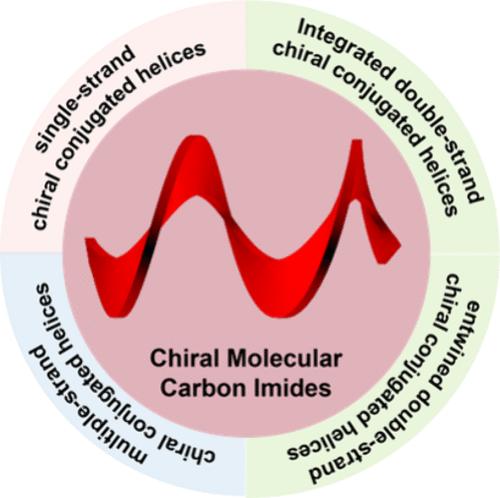
Chiral molecular carbon imides (CMCIs) represent a kind of chiral π-conjugated molecules that are typically designed and synthesized by introducing helical chirality. This approach creates a stereogenic axis, rather than a traditional chiral center or chiral axis with saturated bonds, resulting in chiral conjugated helices (CCHs). CMCIs have garnered significant attention due to their flexible synthesis (annulative π-extension strategies), tailor-made structures (chiral polycyclic π-conjugated frameworks), and diverse properties (optical, electronic, magnetic, and biochemical characteristics related to chirality). Furthermore, CMCI systems exhibit unique chiroptical properties, including circular dichroism (CD) and circularly polarized luminescence (CPL), which have elevated them as emerging stars among chiral organic functional molecules. Benefiting from their large conjugation planes and excellent electron-withdrawing ability, CMCIs often display outstanding electron mobility, high electron affinity, and strong light absorption or emission capabilities, making them valuable in various organic semiconductor applications. Their unique chiroptical properties and excellent semiconducting abilities position CMCIs as key players in the emerging field of chiral optoelectronics. Additionally, the appropriate packing modes and efficient charge transfer in solid-state CCHs provide excellent platforms for applications in chiral-induced spin selectivity (CISS) and topological quantum properties.



 京公网安备 11010802042870号
京ICP备2023020795号-1
京公网安备 11010802042870号
京ICP备2023020795号-1

 分享
分享
 求助内容:
求助内容: 应助结果提醒方式:
 扫码关注我们
