Multi-scale attention patching encoder network: a deployable model for continuous estimation of hand kinematics from surface electromyographic signals.
{"title":"Multi-scale attention patching encoder network: a deployable model for continuous estimation of hand kinematics from surface electromyographic signals.","authors":"Chuang Lin, Qiong Xiao, Penghui Zhao","doi":"10.1186/s12984-024-01525-4","DOIUrl":null,"url":null,"abstract":"<p><strong>Background: </strong>Simultaneous and proportional control (SPC) based on surface electromyographic (sEMG) signals has emerged as a research hotspot in the field of human-machine interaction (HMI). However, the existing continuous motion estimation methods mostly have an average Pearson coefficient (CC) of less than 0.85, while high-precision methods suffer from the problem of long inference time (> 200 ms) and can only estimate SPC of less than 15 hand movements, which limits their applications in HMI. To overcome these problems, we propose a smooth Multi-scale Attention Patching Encoder Network (sMAPEN).</p><p><strong>Methods: </strong>The sMAPEN consists of three modules, the Multi-scale Attention Fusion (MAF) module, the Patching Encoder (PE) module, and a smoothing layer. The MAF module adaptively captures the local spatiotemporal features at multiple scales, the PE module acquires the global spatiotemporal features of sEMG, and the smoothing layer further improves prediction stability.</p><p><strong>Results: </strong>To evaluate the performance of the model, we conducted continuous estimation of 40 subjects performing over 40 different hand movements on the Ninapro DB2. The results show that the average Pearson correlation coefficient (CC), normalized root mean square error (NRMSE), coefficient of determination (R<sup>2</sup>), and smoothness (SMOOTH) of the sMAPEN model are 0.9082, 0.0646°, 0.8163, and - 0.0017, respectively, which significantly outperforms that of the state-of-the-art methods in all metrics (p < 0.01). Furthermore, we tested the deployment performance of sMAPEN on the portable device, with a delay of only 97.93 ms.</p><p><strong>Conclusions: </strong>Our model can predict up to 40 hand movements while achieving the highest predicting accuracy compared with other methods. Besides, the lightweight design strategy brings an improvement in inference speed, which enables the model to be deployed on wearable devices. All these promotions imply that sMAPEN holds great potential in HMI.</p>","PeriodicalId":16384,"journal":{"name":"Journal of NeuroEngineering and Rehabilitation","volume":"21 1","pages":"231"},"PeriodicalIF":5.2000,"publicationDate":"2024-12-30","publicationTypes":"Journal Article","fieldsOfStudy":null,"isOpenAccess":false,"openAccessPdf":"https://www.ncbi.nlm.nih.gov/pmc/articles/PMC11684320/pdf/","citationCount":"0","resultStr":null,"platform":"Semanticscholar","paperid":null,"PeriodicalName":"Journal of NeuroEngineering and Rehabilitation","FirstCategoryId":"5","ListUrlMain":"https://doi.org/10.1186/s12984-024-01525-4","RegionNum":2,"RegionCategory":"医学","ArticlePicture":[],"TitleCN":null,"AbstractTextCN":null,"PMCID":null,"EPubDate":"","PubModel":"","JCR":"Q1","JCRName":"ENGINEERING, BIOMEDICAL","Score":null,"Total":0}
引用次数: 0
Abstract
Background: Simultaneous and proportional control (SPC) based on surface electromyographic (sEMG) signals has emerged as a research hotspot in the field of human-machine interaction (HMI). However, the existing continuous motion estimation methods mostly have an average Pearson coefficient (CC) of less than 0.85, while high-precision methods suffer from the problem of long inference time (> 200 ms) and can only estimate SPC of less than 15 hand movements, which limits their applications in HMI. To overcome these problems, we propose a smooth Multi-scale Attention Patching Encoder Network (sMAPEN).
Methods: The sMAPEN consists of three modules, the Multi-scale Attention Fusion (MAF) module, the Patching Encoder (PE) module, and a smoothing layer. The MAF module adaptively captures the local spatiotemporal features at multiple scales, the PE module acquires the global spatiotemporal features of sEMG, and the smoothing layer further improves prediction stability.
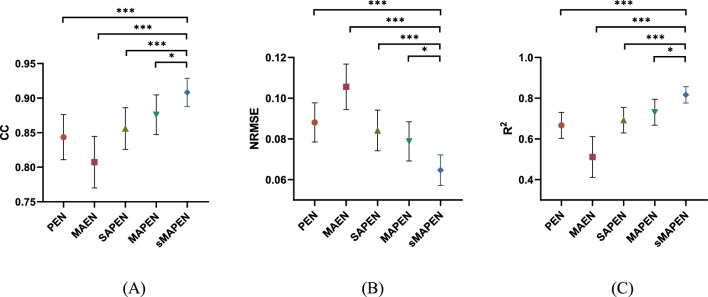
Results: To evaluate the performance of the model, we conducted continuous estimation of 40 subjects performing over 40 different hand movements on the Ninapro DB2. The results show that the average Pearson correlation coefficient (CC), normalized root mean square error (NRMSE), coefficient of determination (R2), and smoothness (SMOOTH) of the sMAPEN model are 0.9082, 0.0646°, 0.8163, and - 0.0017, respectively, which significantly outperforms that of the state-of-the-art methods in all metrics (p < 0.01). Furthermore, we tested the deployment performance of sMAPEN on the portable device, with a delay of only 97.93 ms.
Conclusions: Our model can predict up to 40 hand movements while achieving the highest predicting accuracy compared with other methods. Besides, the lightweight design strategy brings an improvement in inference speed, which enables the model to be deployed on wearable devices. All these promotions imply that sMAPEN holds great potential in HMI.
期刊介绍:
Journal of NeuroEngineering and Rehabilitation considers manuscripts on all aspects of research that result from cross-fertilization of the fields of neuroscience, biomedical engineering, and physical medicine & rehabilitation.






 京公网安备 11010802042870号
京ICP备2023020795号-1
京公网安备 11010802042870号
京ICP备2023020795号-1

 分享
分享
 求助内容:
求助内容: 应助结果提醒方式:
 扫码关注我们
