Xinmao Wang, Chao Song, Heng Liu, Lin Zhou, Letian Zhang
{"title":"Differences in severity of diffuse and focal coronary stenosis between visual and quantitative assessment.","authors":"Xinmao Wang, Chao Song, Heng Liu, Lin Zhou, Letian Zhang","doi":"10.3389/fcvm.2024.1501576","DOIUrl":null,"url":null,"abstract":"<p><strong>Background: </strong>Coronary Artery Disease (CAD) is a leading cause of mortality, with an increasing number of patients affected by coronary artery stenosis each year. Coronary angiography (CAG) is commonly employed as the definitive diagnostic tool for identifying coronary artery stenosis. Physician Visual Assessment (PVA) is often used as the primary method to determine the need for further intervention, but its subjective nature poses challenges. This study sought to evaluate the differences of severity of diffuse and focal coronary stenosis between PVA and Quantitative Coronary Angiography (QCA).</p><p><strong>Methods: </strong>293 patients with coronary artery disease (334 coronary lesions) underwent CAG and fractional flow reserve (FFR). PVA and QCA was used to quantify diameter stenosis (DS). DS ≥50% was defined as obstructive. FFR ≤0.8 was defined as myocardial ischemia.</p><p><strong>Results: </strong>The mean ± SD age of all patients was 66 ± 9 years. ΔDS between PVA and QCA was higher in diffuse lesions (16.45 ± 7.37%) than in focal lesions (14.39 ± 7.83%) (<i>P</i> = 0.04). DS<sub>PVA</sub> and DS<sub>QCA</sub> had linear negative correlation (r<sub>PVA</sub> = -0.3182, r<sub>QCA</sub> = -0.4054) with FFR in diffuse, while in focal, DS<sub>PVA</sub> and DS<sub>QCA</sub> had an even stronger linear negative correlation (r<sub>PVA</sub> = -0.4090, r<sub>QCA</sub> = -0.4861) with FFR. ROC analysis demonstrated that DS<sub>QCA</sub> had better discrimination capability for myocardial ischemia (FFR ≤ 0.80) than DS<sub>PVA</sub> in different of length stenosis.</p><p><strong>Conclusions: </strong>PVA was more likely to overestimate diameter stenosis in coronary arteries than QCA, and the severity of diffuse stenosis was more likely to be overestimated than that of focal stenosis.</p>","PeriodicalId":12414,"journal":{"name":"Frontiers in Cardiovascular Medicine","volume":"11 ","pages":"1501576"},"PeriodicalIF":2.8000,"publicationDate":"2024-12-16","publicationTypes":"Journal Article","fieldsOfStudy":null,"isOpenAccess":false,"openAccessPdf":"https://www.ncbi.nlm.nih.gov/pmc/articles/PMC11683054/pdf/","citationCount":"0","resultStr":null,"platform":"Semanticscholar","paperid":null,"PeriodicalName":"Frontiers in Cardiovascular Medicine","FirstCategoryId":"3","ListUrlMain":"https://doi.org/10.3389/fcvm.2024.1501576","RegionNum":3,"RegionCategory":"医学","ArticlePicture":[],"TitleCN":null,"AbstractTextCN":null,"PMCID":null,"EPubDate":"2024/1/1 0:00:00","PubModel":"eCollection","JCR":"Q2","JCRName":"CARDIAC & CARDIOVASCULAR SYSTEMS","Score":null,"Total":0}
引用次数: 0
Abstract
Background: Coronary Artery Disease (CAD) is a leading cause of mortality, with an increasing number of patients affected by coronary artery stenosis each year. Coronary angiography (CAG) is commonly employed as the definitive diagnostic tool for identifying coronary artery stenosis. Physician Visual Assessment (PVA) is often used as the primary method to determine the need for further intervention, but its subjective nature poses challenges. This study sought to evaluate the differences of severity of diffuse and focal coronary stenosis between PVA and Quantitative Coronary Angiography (QCA).
Methods: 293 patients with coronary artery disease (334 coronary lesions) underwent CAG and fractional flow reserve (FFR). PVA and QCA was used to quantify diameter stenosis (DS). DS ≥50% was defined as obstructive. FFR ≤0.8 was defined as myocardial ischemia.
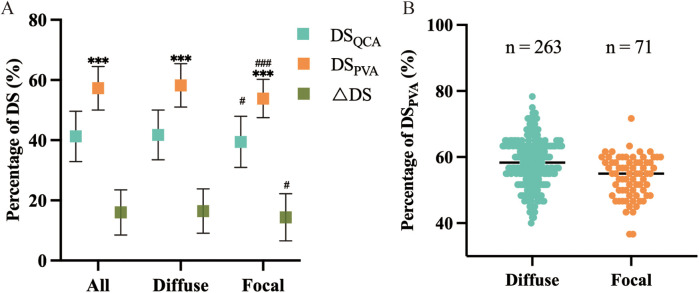
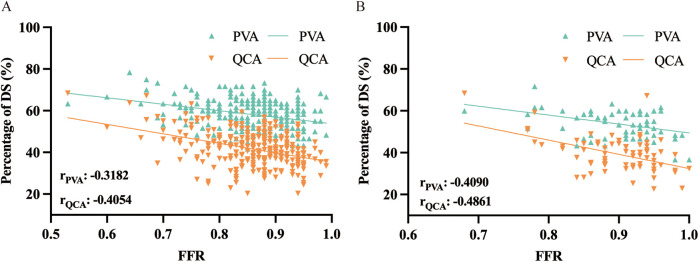
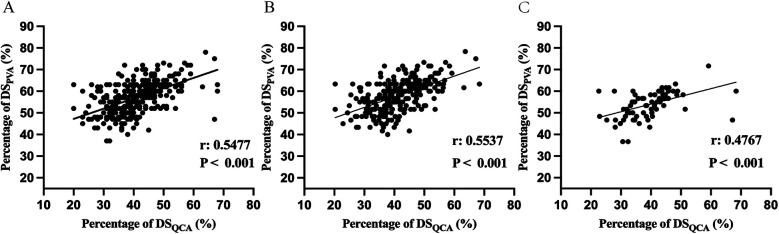
Results: The mean ± SD age of all patients was 66 ± 9 years. ΔDS between PVA and QCA was higher in diffuse lesions (16.45 ± 7.37%) than in focal lesions (14.39 ± 7.83%) (P = 0.04). DSPVA and DSQCA had linear negative correlation (rPVA = -0.3182, rQCA = -0.4054) with FFR in diffuse, while in focal, DSPVA and DSQCA had an even stronger linear negative correlation (rPVA = -0.4090, rQCA = -0.4861) with FFR. ROC analysis demonstrated that DSQCA had better discrimination capability for myocardial ischemia (FFR ≤ 0.80) than DSPVA in different of length stenosis.
Conclusions: PVA was more likely to overestimate diameter stenosis in coronary arteries than QCA, and the severity of diffuse stenosis was more likely to be overestimated than that of focal stenosis.
期刊介绍:
Frontiers? Which frontiers? Where exactly are the frontiers of cardiovascular medicine? And who should be defining these frontiers?
At Frontiers in Cardiovascular Medicine we believe it is worth being curious to foresee and explore beyond the current frontiers. In other words, we would like, through the articles published by our community journal Frontiers in Cardiovascular Medicine, to anticipate the future of cardiovascular medicine, and thus better prevent cardiovascular disorders and improve therapeutic options and outcomes of our patients.



 京公网安备 11010802042870号
京ICP备2023020795号-1
京公网安备 11010802042870号
京ICP备2023020795号-1

 分享
分享
 求助内容:
求助内容: 应助结果提醒方式:
 扫码关注我们
