Parthasarathi Bhattacharyya, Srijita Sen, Shuvam Ghosh, Debkanya Dey, Sayoni Sengupta, Sayanti Karmakar, Dipanjan Saha, Avishek Kar, Rajat Banerjee
{"title":"On-the-spot spirometry & combined salbutamol & glycopyrronium reversibility testing in obstructive airway disease: A real-world appraisal.","authors":"Parthasarathi Bhattacharyya, Srijita Sen, Shuvam Ghosh, Debkanya Dey, Sayoni Sengupta, Sayanti Karmakar, Dipanjan Saha, Avishek Kar, Rajat Banerjee","doi":"10.25259/ijmr_2404_23","DOIUrl":null,"url":null,"abstract":"<p><p>Background & objectives Spirometric glycopyrronium responsiveness, a new advent, needs to be examined at in terms of degree and frequency in different obstructive-airway diseases diagnosed in real world practise. Methods Serial and willing symptomatic affected individuals of suspected airway disease underwent a pragmatic post-consultation spirometry-protocol on the same day with salbutamol followed by glycopyrronium bromide. The diagnosis of asthma (FEV1-reversibility ≥ 200 ml + 12%), chronic obstructive pulmonary disease (COPD) (FEV1/FVC<0.7 and FEV1-reversibility <200 ml and/or 12%), and 'unclassified' (neither asthma nor COPD) were determined on post-salbutamol changes. The performances of the two classes of bronchodilators were compared on FVC, FEV1/FVC, FEV1, and FEF-25-75 while the relative frequency of significant responsiveness for salbutamol (≥200 ml) and glycopyrronium (≥100 ml) were noted. Results Fifteen hundred and eighty study participants consisting of asthma (n=329; 21%), COPD (n=641; 40%), and 'unclassified' (n=610; 39%) were included. Both salbutamol and glycopyrronium had demonstrated improvement across the spirometric parameters. The salbutamol responsiveness was statistically significant in all but COPD in terms of absolute values of FEV1, FEV1/FVC, and FEF25-75 and the glycopyrronium responsiveness was significant in all plus COPD in FVC, FEV1, and FEF25-75 values. While all the asthmatics, 9.83 per cent of 'unclassified' study participants, and none of the COPD affected individuals had significant FEV1 responsiveness to salbutamol, the glycopyrronium responsiveness for the three conditions were 38.3, 40.25 and 24.26 per cent, respectively. The combined reversibility for asthma, COPD, and unclassified were 401.5±173.9, 119.5±109.3, and 158.7±136.3 ml, respectively. Interpretation & conclusions Spirometry with serial salbutamol and glycopyrronium responsiveness may prove helpful in identifying syndromic diagnosis and choosing the bronchodilator treatment of airway diseases.</p>","PeriodicalId":13349,"journal":{"name":"Indian Journal of Medical Research","volume":"160 5","pages":"439-447"},"PeriodicalIF":2.5000,"publicationDate":"2024-11-01","publicationTypes":"Journal Article","fieldsOfStudy":null,"isOpenAccess":false,"openAccessPdf":"https://www.ncbi.nlm.nih.gov/pmc/articles/PMC11683492/pdf/","citationCount":"0","resultStr":null,"platform":"Semanticscholar","paperid":null,"PeriodicalName":"Indian Journal of Medical Research","FirstCategoryId":"3","ListUrlMain":"https://doi.org/10.25259/ijmr_2404_23","RegionNum":4,"RegionCategory":"医学","ArticlePicture":[],"TitleCN":null,"AbstractTextCN":null,"PMCID":null,"EPubDate":"","PubModel":"","JCR":"Q3","JCRName":"IMMUNOLOGY","Score":null,"Total":0}
引用次数: 0
Abstract
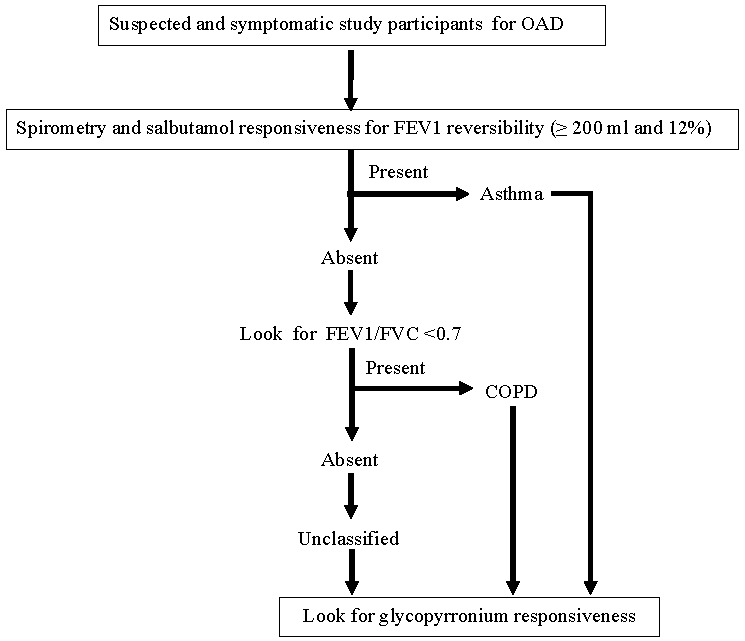
Background & objectives Spirometric glycopyrronium responsiveness, a new advent, needs to be examined at in terms of degree and frequency in different obstructive-airway diseases diagnosed in real world practise. Methods Serial and willing symptomatic affected individuals of suspected airway disease underwent a pragmatic post-consultation spirometry-protocol on the same day with salbutamol followed by glycopyrronium bromide. The diagnosis of asthma (FEV1-reversibility ≥ 200 ml + 12%), chronic obstructive pulmonary disease (COPD) (FEV1/FVC<0.7 and FEV1-reversibility <200 ml and/or 12%), and 'unclassified' (neither asthma nor COPD) were determined on post-salbutamol changes. The performances of the two classes of bronchodilators were compared on FVC, FEV1/FVC, FEV1, and FEF-25-75 while the relative frequency of significant responsiveness for salbutamol (≥200 ml) and glycopyrronium (≥100 ml) were noted. Results Fifteen hundred and eighty study participants consisting of asthma (n=329; 21%), COPD (n=641; 40%), and 'unclassified' (n=610; 39%) were included. Both salbutamol and glycopyrronium had demonstrated improvement across the spirometric parameters. The salbutamol responsiveness was statistically significant in all but COPD in terms of absolute values of FEV1, FEV1/FVC, and FEF25-75 and the glycopyrronium responsiveness was significant in all plus COPD in FVC, FEV1, and FEF25-75 values. While all the asthmatics, 9.83 per cent of 'unclassified' study participants, and none of the COPD affected individuals had significant FEV1 responsiveness to salbutamol, the glycopyrronium responsiveness for the three conditions were 38.3, 40.25 and 24.26 per cent, respectively. The combined reversibility for asthma, COPD, and unclassified were 401.5±173.9, 119.5±109.3, and 158.7±136.3 ml, respectively. Interpretation & conclusions Spirometry with serial salbutamol and glycopyrronium responsiveness may prove helpful in identifying syndromic diagnosis and choosing the bronchodilator treatment of airway diseases.
背景与目的肺活量测定法是一种新的诊断方法,在不同的阻塞性气道疾病诊断中,需要从程度和频率方面进行检查。方法连续和自愿的有症状的疑似气道疾病患者接受实用的会诊后肺活量测定方案,当天使用沙丁胺醇,随后使用溴化甘溴铵。诊断为哮喘(FEV1可逆性≥200 ml + 12%)、慢性阻塞性肺疾病(COPD) (FEV1/FVC)
期刊介绍:
The Indian Journal of Medical Research (IJMR) [ISSN 0971-5916] is one of the oldest medical Journals not only in India, but probably in Asia, as it started in the year 1913. The Journal was started as a quarterly (4 issues/year) in 1913 and made bimonthly (6 issues/year) in 1958. It became monthly (12 issues/year) in the year 1964.





 京公网安备 11010802042870号
京ICP备2023020795号-1
京公网安备 11010802042870号
京ICP备2023020795号-1

 分享
分享
 求助内容:
求助内容: 应助结果提醒方式:
 扫码关注我们
