Yoshihisa Morita, Taro Kariya, Michael Dougherty, Andrew Peters, Nicholas Ruggiero
{"title":"Potential of right ventricular function assessment with echocardiography in transcatheter aortic valve replacement.","authors":"Yoshihisa Morita, Taro Kariya, Michael Dougherty, Andrew Peters, Nicholas Ruggiero","doi":"10.1186/s13019-024-03198-5","DOIUrl":null,"url":null,"abstract":"<p><strong>Background: </strong>Right ventricular (RV) function assessment by echocardiography can be challenging due to its complex morphology. Also, increasing use of sedation rather than general anesthesia for transfemoral approach transcatheter aortic valve replacement (TAVR) reduces the need for intraoperative transesophageal echocardiography (TEE). Recent clinical studies have demonstrated the importance of 3-dimensional (3D) echocardiography and a longitudinal strain for RV function assessment. In this study, we compared RV function echocardiographic assessment methodologies in TAVR and investigated its clinical utility.</p><p><strong>Methods: </strong>This was a prospective, observational study of TAVR at a large academic hospital. Inclusion criteria were adult patients undergoing TAVR requiring intraoperative TEE between April 2023 and October 2023. Exclusion criteria include an absolute contraindication to TEE, a pacemaker, or suboptimal intraoperative echocardiography images. The primary goal is to assess the correlation of 3D RV ejection fraction (EF) with RV fraction area change (FAC), and tricuspid annular plane systolic excursion (TAPSE). The secondary goal is to assess the correlation of RV free wall longitudinal strain (FWLS) with any newly diagnosed postoperative ventricular arrhythmia, including complete atrioventricular block (CAVB) and left bundle branch block (LBBB).</p><p><strong>Results: </strong>Among 33 patients who underwent TAVR, 4 patients were excluded due to poor image quality, and 7 patients were excluded due to existing pacemaker. Thus, data for 22 patients were analyzed in this study. There was a good correlation between 3D RVEF and RV FAC (correlation coefficient 0.789. p = 0.0000482), but poor correlation between 3D RVEF and TAPSE (correlation coefficient 0.182. p = 0.444). Eight patients developed a new left or right BBB and CAVB postoperatively, and 3 patients required permanent pacemaker. Regression analysis of pre and post valve deployment showed RV free wall RVFWLS was each correlated with postoperative new BBB or CAVB (pre valve deployment: hazard ratio 1.272, 95% CI 1.075 to 1.505, p = 0.004981; post valve deployment: hazard ratio 1.134, 95% CI 1.001 to 1.286, p = 0.04846). No mortality was reported during the follow-up period, and no significant tricuspid regurgitation (more than moderate) was reported.</p><p><strong>Conclusion: </strong>3D RVEF and RV FAC showed a good correlation. Intraoperative RVFWLS has the potential to predict postoperative new occurrence of BBB or CAVB.</p>","PeriodicalId":15201,"journal":{"name":"Journal of Cardiothoracic Surgery","volume":"19 1","pages":"686"},"PeriodicalIF":1.5000,"publicationDate":"2024-12-30","publicationTypes":"Journal Article","fieldsOfStudy":null,"isOpenAccess":false,"openAccessPdf":"https://www.ncbi.nlm.nih.gov/pmc/articles/PMC11684122/pdf/","citationCount":"0","resultStr":null,"platform":"Semanticscholar","paperid":null,"PeriodicalName":"Journal of Cardiothoracic Surgery","FirstCategoryId":"3","ListUrlMain":"https://doi.org/10.1186/s13019-024-03198-5","RegionNum":4,"RegionCategory":"医学","ArticlePicture":[],"TitleCN":null,"AbstractTextCN":null,"PMCID":null,"EPubDate":"","PubModel":"","JCR":"Q3","JCRName":"CARDIAC & CARDIOVASCULAR SYSTEMS","Score":null,"Total":0}
引用次数: 0
Abstract
Background: Right ventricular (RV) function assessment by echocardiography can be challenging due to its complex morphology. Also, increasing use of sedation rather than general anesthesia for transfemoral approach transcatheter aortic valve replacement (TAVR) reduces the need for intraoperative transesophageal echocardiography (TEE). Recent clinical studies have demonstrated the importance of 3-dimensional (3D) echocardiography and a longitudinal strain for RV function assessment. In this study, we compared RV function echocardiographic assessment methodologies in TAVR and investigated its clinical utility.
Methods: This was a prospective, observational study of TAVR at a large academic hospital. Inclusion criteria were adult patients undergoing TAVR requiring intraoperative TEE between April 2023 and October 2023. Exclusion criteria include an absolute contraindication to TEE, a pacemaker, or suboptimal intraoperative echocardiography images. The primary goal is to assess the correlation of 3D RV ejection fraction (EF) with RV fraction area change (FAC), and tricuspid annular plane systolic excursion (TAPSE). The secondary goal is to assess the correlation of RV free wall longitudinal strain (FWLS) with any newly diagnosed postoperative ventricular arrhythmia, including complete atrioventricular block (CAVB) and left bundle branch block (LBBB).
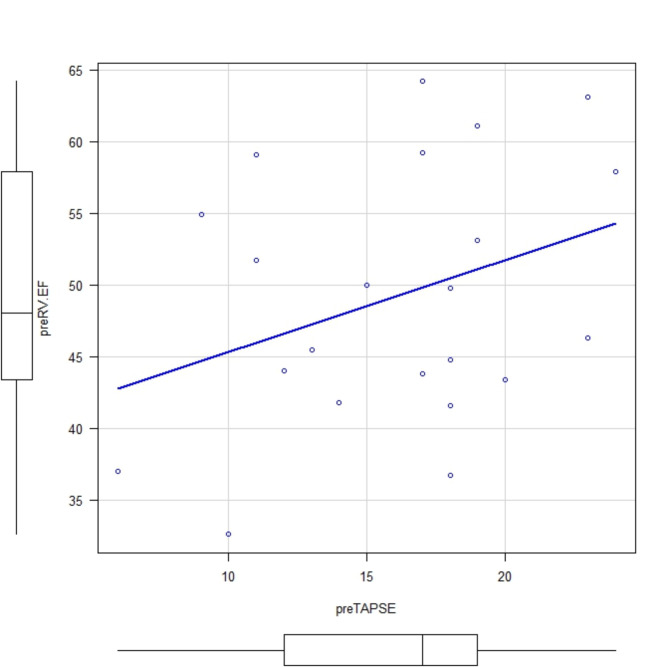
Results: Among 33 patients who underwent TAVR, 4 patients were excluded due to poor image quality, and 7 patients were excluded due to existing pacemaker. Thus, data for 22 patients were analyzed in this study. There was a good correlation between 3D RVEF and RV FAC (correlation coefficient 0.789. p = 0.0000482), but poor correlation between 3D RVEF and TAPSE (correlation coefficient 0.182. p = 0.444). Eight patients developed a new left or right BBB and CAVB postoperatively, and 3 patients required permanent pacemaker. Regression analysis of pre and post valve deployment showed RV free wall RVFWLS was each correlated with postoperative new BBB or CAVB (pre valve deployment: hazard ratio 1.272, 95% CI 1.075 to 1.505, p = 0.004981; post valve deployment: hazard ratio 1.134, 95% CI 1.001 to 1.286, p = 0.04846). No mortality was reported during the follow-up period, and no significant tricuspid regurgitation (more than moderate) was reported.
Conclusion: 3D RVEF and RV FAC showed a good correlation. Intraoperative RVFWLS has the potential to predict postoperative new occurrence of BBB or CAVB.
期刊介绍:
Journal of Cardiothoracic Surgery is an open access journal that encompasses all aspects of research in the field of Cardiology, and Cardiothoracic and Vascular Surgery. The journal publishes original scientific research documenting clinical and experimental advances in cardiac, vascular and thoracic surgery, and related fields.
Topics of interest include surgical techniques, survival rates, surgical complications and their outcomes; along with basic sciences, pediatric conditions, transplantations and clinical trials.
Journal of Cardiothoracic Surgery is of interest to cardiothoracic and vascular surgeons, cardiothoracic anaesthesiologists, cardiologists, chest physicians, and allied health professionals.





 京公网安备 11010802042870号
京ICP备2023020795号-1
京公网安备 11010802042870号
京ICP备2023020795号-1

 分享
分享
 求助内容:
求助内容: 应助结果提醒方式:
 扫码关注我们
