{"title":"Exploring the Indoor Plant-People Relationship Through Qualitative Responses.","authors":"B Le Busque, C Litchfield, C L Shaw","doi":"10.1002/pei3.70025","DOIUrl":null,"url":null,"abstract":"<p><p>Humans have a long-standing relationship with the natural world, particularly in how they engage with plants-referred to as people-plant relationships. While plants naturally live outdoors, people have been including them inside built environments for centuries. Although the benefits of indoor plants are well documented in research, there is limited exploration of individuals' subjective relationships with their indoor plants. To address this gap, we examined the perceived benefits of owning indoor plants and how people describe their relationships with them through open-ended qualitative survey items. Data were collected from 115 indoor plant owners in Australia, and the qualitative responses were analyzed using a combination of thematic analysis and qualitative segmentation. On average, participants owned 15 indoor plants and in total participants identified 11 benefits. The most common being decorative and aesthetic value, improved air quality, and calming effects. Participants fell into one of four types of relationships with their indoor plants: highly connected, engaged, limited engagement, and no relationship. This qualitative segmentation approach allowed us to achieve a key goal of exploratory qualitative research-providing new insights to inform future quantitative studies. Given that we found that not all indoor plant-people relationships are equal, and that people have varying levels of connection to their plants, future research should explore these relationship types using quantitative methods.</p>","PeriodicalId":74457,"journal":{"name":"Plant-environment interactions (Hoboken, N.J.)","volume":"5 6","pages":"e70025"},"PeriodicalIF":0.0000,"publicationDate":"2024-12-29","publicationTypes":"Journal Article","fieldsOfStudy":null,"isOpenAccess":false,"openAccessPdf":"https://www.ncbi.nlm.nih.gov/pmc/articles/PMC11683047/pdf/","citationCount":"0","resultStr":null,"platform":"Semanticscholar","paperid":null,"PeriodicalName":"Plant-environment interactions (Hoboken, N.J.)","FirstCategoryId":"1085","ListUrlMain":"https://doi.org/10.1002/pei3.70025","RegionNum":0,"RegionCategory":null,"ArticlePicture":[],"TitleCN":null,"AbstractTextCN":null,"PMCID":null,"EPubDate":"2024/12/1 0:00:00","PubModel":"eCollection","JCR":"Q3","JCRName":"Agricultural and Biological Sciences","Score":null,"Total":0}
引用次数: 0
Abstract
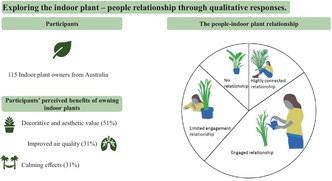
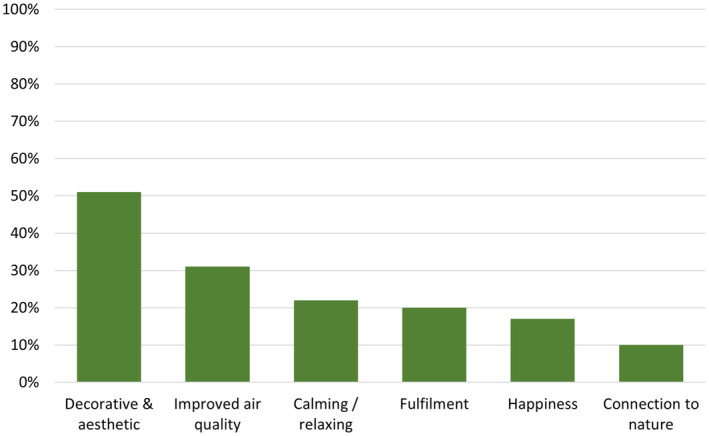
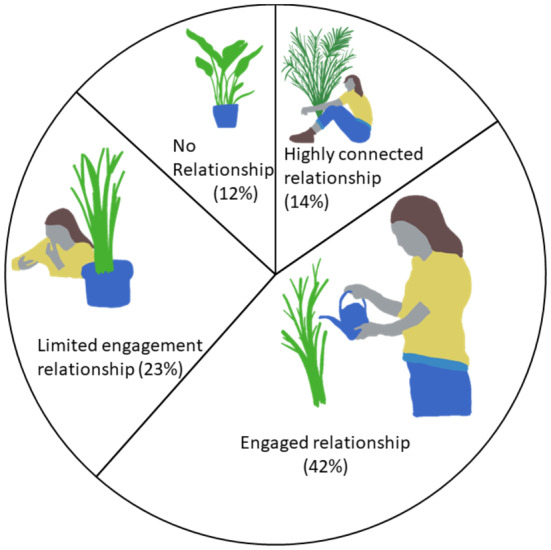
Humans have a long-standing relationship with the natural world, particularly in how they engage with plants-referred to as people-plant relationships. While plants naturally live outdoors, people have been including them inside built environments for centuries. Although the benefits of indoor plants are well documented in research, there is limited exploration of individuals' subjective relationships with their indoor plants. To address this gap, we examined the perceived benefits of owning indoor plants and how people describe their relationships with them through open-ended qualitative survey items. Data were collected from 115 indoor plant owners in Australia, and the qualitative responses were analyzed using a combination of thematic analysis and qualitative segmentation. On average, participants owned 15 indoor plants and in total participants identified 11 benefits. The most common being decorative and aesthetic value, improved air quality, and calming effects. Participants fell into one of four types of relationships with their indoor plants: highly connected, engaged, limited engagement, and no relationship. This qualitative segmentation approach allowed us to achieve a key goal of exploratory qualitative research-providing new insights to inform future quantitative studies. Given that we found that not all indoor plant-people relationships are equal, and that people have varying levels of connection to their plants, future research should explore these relationship types using quantitative methods.



 京公网安备 11010802042870号
京ICP备2023020795号-1
京公网安备 11010802042870号
京ICP备2023020795号-1

 分享
分享

 求助内容:
求助内容: 应助结果提醒方式:
 扫码关注我们
