Alisha Ayyaz, Andrew B. Foster, Levente Cseri, Gyorgy Szekely, Peter M. Budd
{"title":"Greener Synthesis of the Polymer of Intrinsic Microporosity PIM-1 for Gas Separation","authors":"Alisha Ayyaz, Andrew B. Foster, Levente Cseri, Gyorgy Szekely, Peter M. Budd","doi":"10.1021/acssuschemeng.4c08475","DOIUrl":null,"url":null,"abstract":"Polymers of intrinsic microporosity (PIMs) are studied as membranes for energy-efficient and environmentally friendly separation technologies, but greener polymerization methods are desirable for further scale up. This work aimed to synthesize the prototypical PIM (PIM-1) via a greener synthetic route by changing the solvent system to methyl-5-(dimethylamino)-2,2-dimethyl-5-oxopentanoate (MDDOP), a structural analogue of the green solvent Rhodiasolv PolarClean. Mass-based green metrics analysis was performed on MDDOP, determining atom economy, complete environmental factor, and total carbon intensity, comparing each to synthetic routes to PolarClean. Green metrics analysis found MDDOP synthesis produced less waste than PolarClean. MDDOP solvent capabilities were exemplified via PIM-1 polymerizations using 5,5′,6,6′-tetrahydroxy-3,3,3′,3′-tetramethyl-1,1′-spirobisindane (TTSBI) with either tetrafluoroterephthalonitrile (TFTPN) or tetrachloroterephthalonitrile (TCTPN), varying the temperature (120–160 °C) and reaction duration (50 min–6 h). Recovery of methanol and MDDOP post PIM-1 synthesis reduced solvent waste by 22%. Reactions using TCTPN produced polymers with higher molar masses than those produced using TFTPN. All samples showed varied topology, with evidence of branching and colloidal network. The polymer from the most successful reaction conditions (TCTPN, <i>T</i> = 140 °C, 6 h) was fabricated into thick film membranes and tested with pure gases for CO<sub>2</sub>/CH<sub>4</sub> and CO<sub>2</sub>/N<sub>2</sub> gas pairs, performing comparably with PIM-1 synthesized using conventional solvent systems.","PeriodicalId":25,"journal":{"name":"ACS Sustainable Chemistry & Engineering","volume":"71 1","pages":""},"PeriodicalIF":7.3000,"publicationDate":"2024-12-31","publicationTypes":"Journal Article","fieldsOfStudy":null,"isOpenAccess":false,"openAccessPdf":"","citationCount":"0","resultStr":null,"platform":"Semanticscholar","paperid":null,"PeriodicalName":"ACS Sustainable Chemistry & Engineering","FirstCategoryId":"92","ListUrlMain":"https://doi.org/10.1021/acssuschemeng.4c08475","RegionNum":1,"RegionCategory":"化学","ArticlePicture":[],"TitleCN":null,"AbstractTextCN":null,"PMCID":null,"EPubDate":"","PubModel":"","JCR":"Q1","JCRName":"CHEMISTRY, MULTIDISCIPLINARY","Score":null,"Total":0}
引用次数: 0
Abstract
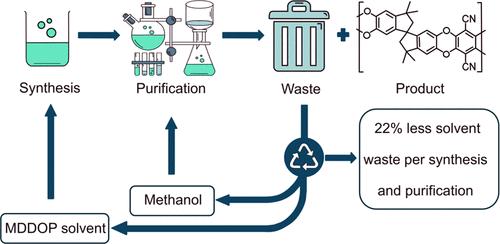
Polymers of intrinsic microporosity (PIMs) are studied as membranes for energy-efficient and environmentally friendly separation technologies, but greener polymerization methods are desirable for further scale up. This work aimed to synthesize the prototypical PIM (PIM-1) via a greener synthetic route by changing the solvent system to methyl-5-(dimethylamino)-2,2-dimethyl-5-oxopentanoate (MDDOP), a structural analogue of the green solvent Rhodiasolv PolarClean. Mass-based green metrics analysis was performed on MDDOP, determining atom economy, complete environmental factor, and total carbon intensity, comparing each to synthetic routes to PolarClean. Green metrics analysis found MDDOP synthesis produced less waste than PolarClean. MDDOP solvent capabilities were exemplified via PIM-1 polymerizations using 5,5′,6,6′-tetrahydroxy-3,3,3′,3′-tetramethyl-1,1′-spirobisindane (TTSBI) with either tetrafluoroterephthalonitrile (TFTPN) or tetrachloroterephthalonitrile (TCTPN), varying the temperature (120–160 °C) and reaction duration (50 min–6 h). Recovery of methanol and MDDOP post PIM-1 synthesis reduced solvent waste by 22%. Reactions using TCTPN produced polymers with higher molar masses than those produced using TFTPN. All samples showed varied topology, with evidence of branching and colloidal network. The polymer from the most successful reaction conditions (TCTPN, T = 140 °C, 6 h) was fabricated into thick film membranes and tested with pure gases for CO2/CH4 and CO2/N2 gas pairs, performing comparably with PIM-1 synthesized using conventional solvent systems.
期刊介绍:
ACS Sustainable Chemistry & Engineering is a prestigious weekly peer-reviewed scientific journal published by the American Chemical Society. Dedicated to advancing the principles of green chemistry and green engineering, it covers a wide array of research topics including green chemistry, green engineering, biomass, alternative energy, and life cycle assessment.
The journal welcomes submissions in various formats, including Letters, Articles, Features, and Perspectives (Reviews), that address the challenges of sustainability in the chemical enterprise and contribute to the advancement of sustainable practices. Join us in shaping the future of sustainable chemistry and engineering.



 京公网安备 11010802042870号
京ICP备2023020795号-1
京公网安备 11010802042870号
京ICP备2023020795号-1

 分享
分享
 求助内容:
求助内容: 应助结果提醒方式:
 扫码关注我们
