{"title":"Adhesive-Free, Light, and Strong Particle Board","authors":"Zhonglei Huang, Zhiru Cao, Yukai Wang, Jiayi Tang, Longhu Chen, Siwen Qian, Xue-Jun Yan, Yu Deng, Yan-Feng Chen, Mingwei Zhu","doi":"10.1021/acs.nanolett.4c05652","DOIUrl":null,"url":null,"abstract":"Wood particle boards are massively used in construction and household products. But they often raise health and environmental concerns because of the formaldehyde-based adhesives. More sustainable and high-strength particle boards are developed on a bio-based materials or their derivatives. However, their high density (heavier than that of water) greatly weakens the important light weight properties of natural wood. To address this problem, we realized adhesive-free, light, and strong particle boards assisted by plant macrofibers using big wood particles as raw materials. The challenge of strong connection among big wood particles is achieved by plant macrofibers, which serve as bridges to forming robust linkages between wood particles. The resulting particle boards have densities as low as 0.53 g cm<sup>–3</sup> (61.7 MPa) and flexural strengths as high as 114.2 MPa (0.78 g cm<sup>–3</sup>). This strategy opens a new door for the research and application of wood particle boards for sustainable development of the world.","PeriodicalId":53,"journal":{"name":"Nano Letters","volume":"33 1","pages":""},"PeriodicalIF":9.1000,"publicationDate":"2025-01-02","publicationTypes":"Journal Article","fieldsOfStudy":null,"isOpenAccess":false,"openAccessPdf":"","citationCount":"0","resultStr":null,"platform":"Semanticscholar","paperid":null,"PeriodicalName":"Nano Letters","FirstCategoryId":"88","ListUrlMain":"https://doi.org/10.1021/acs.nanolett.4c05652","RegionNum":1,"RegionCategory":"材料科学","ArticlePicture":[],"TitleCN":null,"AbstractTextCN":null,"PMCID":null,"EPubDate":"","PubModel":"","JCR":"Q1","JCRName":"CHEMISTRY, MULTIDISCIPLINARY","Score":null,"Total":0}
引用次数: 0
Abstract
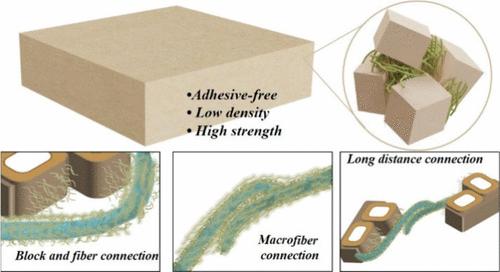
Wood particle boards are massively used in construction and household products. But they often raise health and environmental concerns because of the formaldehyde-based adhesives. More sustainable and high-strength particle boards are developed on a bio-based materials or their derivatives. However, their high density (heavier than that of water) greatly weakens the important light weight properties of natural wood. To address this problem, we realized adhesive-free, light, and strong particle boards assisted by plant macrofibers using big wood particles as raw materials. The challenge of strong connection among big wood particles is achieved by plant macrofibers, which serve as bridges to forming robust linkages between wood particles. The resulting particle boards have densities as low as 0.53 g cm–3 (61.7 MPa) and flexural strengths as high as 114.2 MPa (0.78 g cm–3). This strategy opens a new door for the research and application of wood particle boards for sustainable development of the world.
木质刨花板被大量用于建筑和家居产品。但由于甲醛基粘合剂,它们经常引起健康和环境问题。更多的可持续和高强度刨花板是在生物基材料或其衍生物上开发的。然而,它们的高密度(比水重)大大削弱了天然木材重要的轻质特性。为了解决这个问题,我们以大木颗粒为原料,在植物大纤维的辅助下,实现了无胶、轻、强的刨花板。大木颗粒之间的强连接的挑战是通过植物大纤维来实现的,它们作为木颗粒之间形成坚固连接的桥梁。所得到的刨花板密度低至0.53 g cm-3 (61.7 MPa),抗折强度高达114.2 MPa (0.78 g cm-3)。这一战略为世界可持续发展的刨花板的研究和应用打开了新的大门。
期刊介绍:
Nano Letters serves as a dynamic platform for promptly disseminating original results in fundamental, applied, and emerging research across all facets of nanoscience and nanotechnology. A pivotal criterion for inclusion within Nano Letters is the convergence of at least two different areas or disciplines, ensuring a rich interdisciplinary scope. The journal is dedicated to fostering exploration in diverse areas, including:
- Experimental and theoretical findings on physical, chemical, and biological phenomena at the nanoscale
- Synthesis, characterization, and processing of organic, inorganic, polymer, and hybrid nanomaterials through physical, chemical, and biological methodologies
- Modeling and simulation of synthetic, assembly, and interaction processes
- Realization of integrated nanostructures and nano-engineered devices exhibiting advanced performance
- Applications of nanoscale materials in living and environmental systems
Nano Letters is committed to advancing and showcasing groundbreaking research that intersects various domains, fostering innovation and collaboration in the ever-evolving field of nanoscience and nanotechnology.



 京公网安备 11010802042870号
京ICP备2023020795号-1
京公网安备 11010802042870号
京ICP备2023020795号-1

 分享
分享
 求助内容:
求助内容: 应助结果提醒方式:
 扫码关注我们
