Adverse Effects of Intraparenchymal and Peritumoral Application of Isosulfan Blue Dye in Sentinel Lymph Node Mapping in Breast Cancer: A Systematic Review and Meta-Analysis.
{"title":"Adverse Effects of Intraparenchymal and Peritumoral Application of Isosulfan Blue Dye in Sentinel Lymph Node Mapping in Breast Cancer: A Systematic Review and Meta-Analysis.","authors":"Joshua Agilinko, Aditya Borakati, Andrel Yoong, Ponnuthurai Pratheepan, Suzette Samlalsingh","doi":"10.4274/ejbh.galenos.2024.2024-8-1","DOIUrl":null,"url":null,"abstract":"<p><p>We investigate the evidence for adverse effects of intraparenchymal and peritumoral application of isosulfan blue dye in sentinel lymph node (SLN) mapping in breast cancer patients. A meta-analysis on the adverse effects of intraparenchymal and peritumoral application of isosulfan application in SLN mapping was conducted using Medline and Embase databases up to 2023. Procedure-based adverse reactions were divided into three grades: Grade I (allergic skin reactions), Grade II (hypotension) and Grade III (requiring vasopressor support). Heterogeneity was expressed with I-squared and tau statistics. Subgroup analysis was conducted for administrative route. Univariable meta-regression was performed to assess dose-response effect on adverse reactions. Sensitivity analysis was conducted using fixed effect modelling. A total of 19,183 patients were identified from eight studies. The pooled total adverse event rate after isosulfan administration was 11.65 events per 1,000 patients [95% confidence interval (CI) 7.44-18.19]. The rate of Grade I reactions was 7.96 per 1,000 (95% CI 4.08-15.46); Grade II 0.08 per 1,000 (95% CI 0.00-1.31), Grade III 1.86 per 1,000 (95% CI 0.94-3.66), with no reported mortalities. Intraparenchymal administration was associated with 15.16 events per 1,000 (95% 8.64-26.45), versus 7.04 events per 1,000 (95% CI 5.24-9.45) in peritumoral administration (p=0.02). Univariable meta-regression did not show a significant association between volume of dye infused and total adverse events (-0.164 events per mL, 95% CI -0.864 to 0.534, p=0.645). Isosulfan has low adverse event rates regardless of injection technique or volume administered. Clinicians should have a high level of confidence in its use as an agent for SLN mapping, especially when administering it peritumorally.</p>","PeriodicalId":93996,"journal":{"name":"European journal of breast health","volume":"21 1","pages":"1-8"},"PeriodicalIF":1.7000,"publicationDate":"2025-01-01","publicationTypes":"Journal Article","fieldsOfStudy":null,"isOpenAccess":false,"openAccessPdf":"https://www.ncbi.nlm.nih.gov/pmc/articles/PMC11706119/pdf/","citationCount":"0","resultStr":null,"platform":"Semanticscholar","paperid":null,"PeriodicalName":"European journal of breast health","FirstCategoryId":"1085","ListUrlMain":"https://doi.org/10.4274/ejbh.galenos.2024.2024-8-1","RegionNum":0,"RegionCategory":null,"ArticlePicture":[],"TitleCN":null,"AbstractTextCN":null,"PMCID":null,"EPubDate":"","PubModel":"","JCR":"Q4","JCRName":"ONCOLOGY","Score":null,"Total":0}
引用次数: 0
Abstract
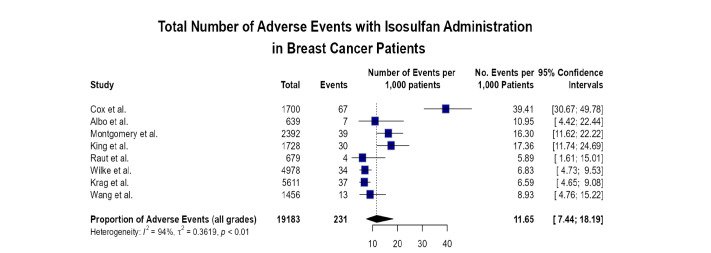
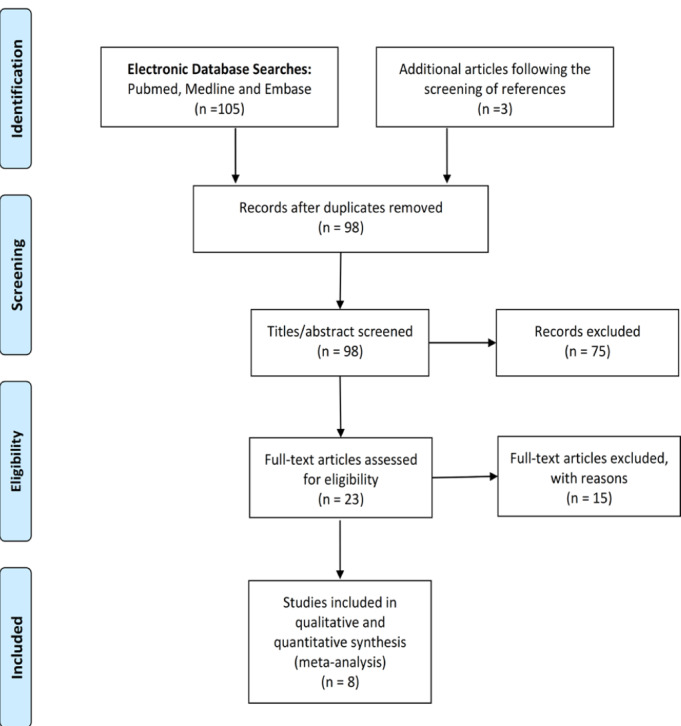
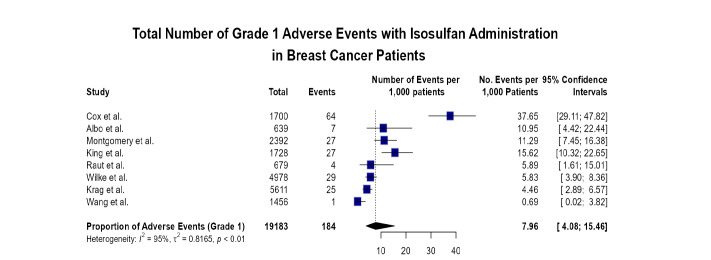
We investigate the evidence for adverse effects of intraparenchymal and peritumoral application of isosulfan blue dye in sentinel lymph node (SLN) mapping in breast cancer patients. A meta-analysis on the adverse effects of intraparenchymal and peritumoral application of isosulfan application in SLN mapping was conducted using Medline and Embase databases up to 2023. Procedure-based adverse reactions were divided into three grades: Grade I (allergic skin reactions), Grade II (hypotension) and Grade III (requiring vasopressor support). Heterogeneity was expressed with I-squared and tau statistics. Subgroup analysis was conducted for administrative route. Univariable meta-regression was performed to assess dose-response effect on adverse reactions. Sensitivity analysis was conducted using fixed effect modelling. A total of 19,183 patients were identified from eight studies. The pooled total adverse event rate after isosulfan administration was 11.65 events per 1,000 patients [95% confidence interval (CI) 7.44-18.19]. The rate of Grade I reactions was 7.96 per 1,000 (95% CI 4.08-15.46); Grade II 0.08 per 1,000 (95% CI 0.00-1.31), Grade III 1.86 per 1,000 (95% CI 0.94-3.66), with no reported mortalities. Intraparenchymal administration was associated with 15.16 events per 1,000 (95% 8.64-26.45), versus 7.04 events per 1,000 (95% CI 5.24-9.45) in peritumoral administration (p=0.02). Univariable meta-regression did not show a significant association between volume of dye infused and total adverse events (-0.164 events per mL, 95% CI -0.864 to 0.534, p=0.645). Isosulfan has low adverse event rates regardless of injection technique or volume administered. Clinicians should have a high level of confidence in its use as an agent for SLN mapping, especially when administering it peritumorally.



 京公网安备 11010802042870号
京ICP备2023020795号-1
京公网安备 11010802042870号
京ICP备2023020795号-1

 分享
分享

 求助内容:
求助内容: 应助结果提醒方式:
 扫码关注我们
