Mohammed Amjed Alsaegh, Mohammed Farooq AlSiraj, Ahmed Naji Alsadoon, Omar Soufi, Okba Mahmoud, Sudhir Rama Varma
{"title":"Assessment of glove integrity across various dental specialties in a dental school setting.","authors":"Mohammed Amjed Alsaegh, Mohammed Farooq AlSiraj, Ahmed Naji Alsadoon, Omar Soufi, Okba Mahmoud, Sudhir Rama Varma","doi":"10.3389/froh.2024.1496918","DOIUrl":null,"url":null,"abstract":"<p><strong>Objectives: </strong>This study aimed to evaluate the integrity of non-sterile, powder-free latex gloves used by dental students in various dental specialties.</p><p><strong>Materials and methods: </strong>This cross-sectional study involved dental students from Ajman University who provided gloves during various dental specialty procedures. A total of 177 pairs of latex examination powder-free gloves were included and categorized as follows: 43 pairs (24.3%) were used in operative dentistry, 30 pairs (16.9%) in oral surgery, 28 pairs (15.8%) in endodontics, 24 pairs (13.6%) in periodontics, 21 pairs (11.9%) in pedodontics, 13 pairs (7.3%) in prosthodontics, and 18 pairs (10.2%) as control gloves. After use, glove integrity was assessed with a modified water leak test.</p><p><strong>Results: </strong>Perforations were identified in 72 cases (40.7%) of gloves, distributed as follows: 22 cases (51.2%) in operative dentistry, 12 cases (40.0%) in oral surgery, 11 cases (39.3%) in endodontics, 11 cases (45.8%) in periodontics, 10 cases (47.6%) in pedodontics, 5 cases (38.5%) in prosthodontics, and 1 case (5.5%) in the control group. There were no statistically significant differences in the loss of glove integrity among different dental specialty procedures (χ<sup>2</sup> = 11.899, <i>p</i> = 0.064) or among different glove usage durations (χ<sup>2</sup> = 1.732, <i>p</i> = 0.785). However, the location of perforations in the experimental groups was statistically significant (χ<sup>2</sup> = 34.427, <i>p</i> < 0.001). The most common locations were the right thumb (<i>n</i> = 18; 13.7%) and the right index finger (<i>n</i> = 17; 13%), with no perforations in the left ring finger and only one perforation in the left little finger (<i>n</i> = 1, 0.08%). There was a statistically significant correlation between the anticipated and actual presence of defects (χ<sup>2</sup> = 32.875, <i>p</i> < 0.001).</p><p><strong>Conclusions: </strong>The study found a high rate of glove perforations during dental procedures by undergraduate students, especially in the right thumb and index finger. To reduce cross-infection risks, strict protocols like double gloving, frequent glove changes, and covering wounds with plaster are recommended.</p>","PeriodicalId":94016,"journal":{"name":"Frontiers in oral health","volume":"5 ","pages":"1496918"},"PeriodicalIF":3.1000,"publicationDate":"2024-12-18","publicationTypes":"Journal Article","fieldsOfStudy":null,"isOpenAccess":false,"openAccessPdf":"https://www.ncbi.nlm.nih.gov/pmc/articles/PMC11688468/pdf/","citationCount":"0","resultStr":null,"platform":"Semanticscholar","paperid":null,"PeriodicalName":"Frontiers in oral health","FirstCategoryId":"1085","ListUrlMain":"https://doi.org/10.3389/froh.2024.1496918","RegionNum":0,"RegionCategory":null,"ArticlePicture":[],"TitleCN":null,"AbstractTextCN":null,"PMCID":null,"EPubDate":"2024/1/1 0:00:00","PubModel":"eCollection","JCR":"Q1","JCRName":"DENTISTRY, ORAL SURGERY & MEDICINE","Score":null,"Total":0}
引用次数: 0
Abstract
Objectives: This study aimed to evaluate the integrity of non-sterile, powder-free latex gloves used by dental students in various dental specialties.
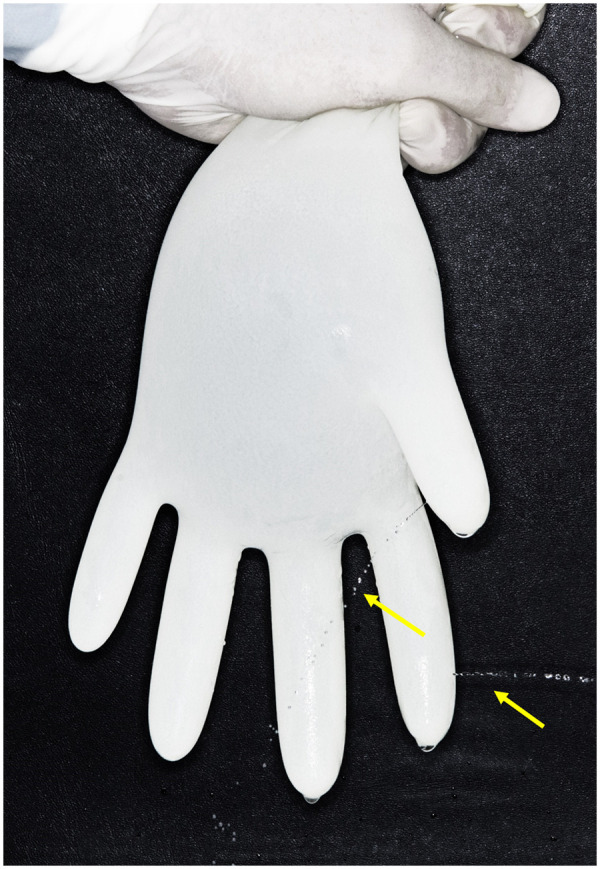
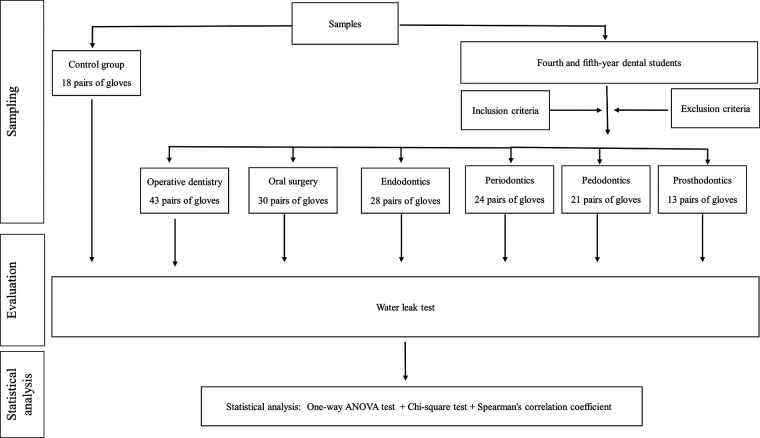
Materials and methods: This cross-sectional study involved dental students from Ajman University who provided gloves during various dental specialty procedures. A total of 177 pairs of latex examination powder-free gloves were included and categorized as follows: 43 pairs (24.3%) were used in operative dentistry, 30 pairs (16.9%) in oral surgery, 28 pairs (15.8%) in endodontics, 24 pairs (13.6%) in periodontics, 21 pairs (11.9%) in pedodontics, 13 pairs (7.3%) in prosthodontics, and 18 pairs (10.2%) as control gloves. After use, glove integrity was assessed with a modified water leak test.
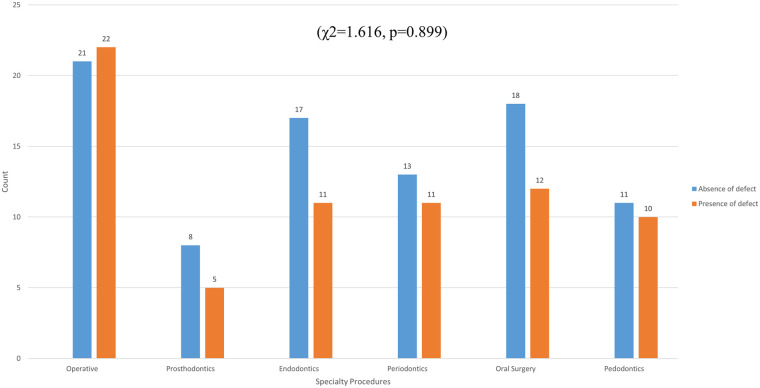
Results: Perforations were identified in 72 cases (40.7%) of gloves, distributed as follows: 22 cases (51.2%) in operative dentistry, 12 cases (40.0%) in oral surgery, 11 cases (39.3%) in endodontics, 11 cases (45.8%) in periodontics, 10 cases (47.6%) in pedodontics, 5 cases (38.5%) in prosthodontics, and 1 case (5.5%) in the control group. There were no statistically significant differences in the loss of glove integrity among different dental specialty procedures (χ2 = 11.899, p = 0.064) or among different glove usage durations (χ2 = 1.732, p = 0.785). However, the location of perforations in the experimental groups was statistically significant (χ2 = 34.427, p < 0.001). The most common locations were the right thumb (n = 18; 13.7%) and the right index finger (n = 17; 13%), with no perforations in the left ring finger and only one perforation in the left little finger (n = 1, 0.08%). There was a statistically significant correlation between the anticipated and actual presence of defects (χ2 = 32.875, p < 0.001).
Conclusions: The study found a high rate of glove perforations during dental procedures by undergraduate students, especially in the right thumb and index finger. To reduce cross-infection risks, strict protocols like double gloving, frequent glove changes, and covering wounds with plaster are recommended.



 京公网安备 11010802042870号
京ICP备2023020795号-1
京公网安备 11010802042870号
京ICP备2023020795号-1

 分享
分享

 求助内容:
求助内容: 应助结果提醒方式:
 扫码关注我们
