Xiaoyang Long, Daniel Bush, Bin Deng, Neil Burgess, Sheng-Jia Zhang
{"title":"Allocentric and egocentric spatial representations coexist in rodent medial entorhinal cortex","authors":"Xiaoyang Long, Daniel Bush, Bin Deng, Neil Burgess, Sheng-Jia Zhang","doi":"10.1038/s41467-024-54699-9","DOIUrl":null,"url":null,"abstract":"<p>Successful navigation relies on reciprocal transformations between spatial representations in world-centered (allocentric) and self-centered (egocentric) frames of reference. The neural basis of allocentric spatial representations has been extensively investigated with grid, border, and head-direction cells in the medial entorhinal cortex (MEC) forming key components of a ‘cognitive map’. Recently, egocentric spatial representations have also been identified in several brain regions, but evidence for the coexistence of neurons encoding spatial variables in each reference frame within MEC is so far lacking. Here, we report that allocentric and egocentric spatial representations are both present in rodent MEC, with neurons in deeper layers representing the egocentric bearing and distance towards the geometric center and / or boundaries of an environment. These results demonstrate a unity of spatial coding that can guide efficient navigation and suggest that MEC may be one locus of interactions between egocentric and allocentric spatial representations in the mammalian brain.</p>","PeriodicalId":19066,"journal":{"name":"Nature Communications","volume":"72 1","pages":""},"PeriodicalIF":15.7000,"publicationDate":"2025-01-03","publicationTypes":"Journal Article","fieldsOfStudy":null,"isOpenAccess":false,"openAccessPdf":"","citationCount":"0","resultStr":null,"platform":"Semanticscholar","paperid":null,"PeriodicalName":"Nature Communications","FirstCategoryId":"103","ListUrlMain":"https://doi.org/10.1038/s41467-024-54699-9","RegionNum":1,"RegionCategory":"综合性期刊","ArticlePicture":[],"TitleCN":null,"AbstractTextCN":null,"PMCID":null,"EPubDate":"","PubModel":"","JCR":"Q1","JCRName":"MULTIDISCIPLINARY SCIENCES","Score":null,"Total":0}
引用次数: 0
Abstract
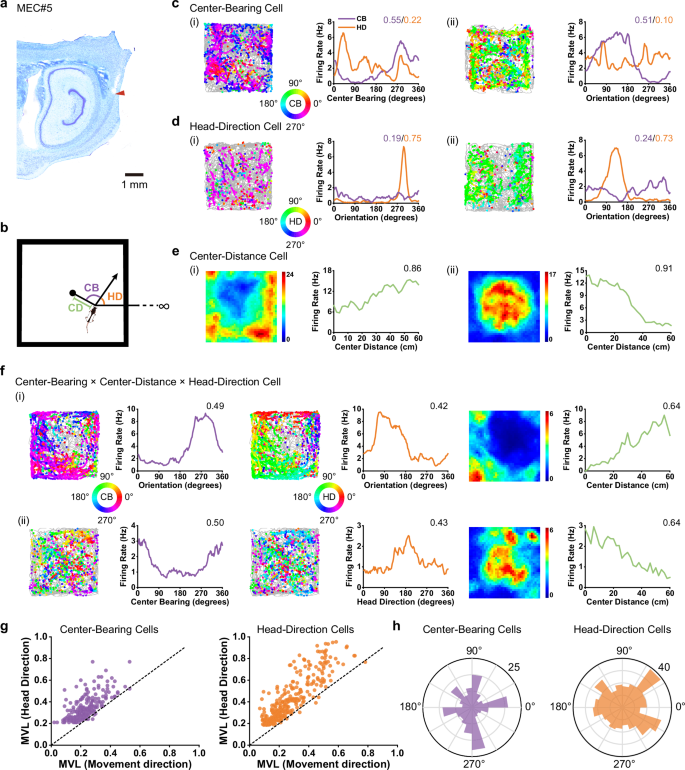
Successful navigation relies on reciprocal transformations between spatial representations in world-centered (allocentric) and self-centered (egocentric) frames of reference. The neural basis of allocentric spatial representations has been extensively investigated with grid, border, and head-direction cells in the medial entorhinal cortex (MEC) forming key components of a ‘cognitive map’. Recently, egocentric spatial representations have also been identified in several brain regions, but evidence for the coexistence of neurons encoding spatial variables in each reference frame within MEC is so far lacking. Here, we report that allocentric and egocentric spatial representations are both present in rodent MEC, with neurons in deeper layers representing the egocentric bearing and distance towards the geometric center and / or boundaries of an environment. These results demonstrate a unity of spatial coding that can guide efficient navigation and suggest that MEC may be one locus of interactions between egocentric and allocentric spatial representations in the mammalian brain.
期刊介绍:
Nature Communications, an open-access journal, publishes high-quality research spanning all areas of the natural sciences. Papers featured in the journal showcase significant advances relevant to specialists in each respective field. With a 2-year impact factor of 16.6 (2022) and a median time of 8 days from submission to the first editorial decision, Nature Communications is committed to rapid dissemination of research findings. As a multidisciplinary journal, it welcomes contributions from biological, health, physical, chemical, Earth, social, mathematical, applied, and engineering sciences, aiming to highlight important breakthroughs within each domain.




 京公网安备 11010802042870号
京ICP备2023020795号-1
京公网安备 11010802042870号
京ICP备2023020795号-1

 分享
分享
 求助内容:
求助内容: 应助结果提醒方式:
 扫码关注我们
