{"title":"Photoinduced Regiodivergent and Enantioselective Cross-Coupling of Glycine Derivatives with Hydrocarbon Feedstocks","authors":"Fuxing Yang, Longxiao Chi, Ziqi Ye, Lei Gong","doi":"10.1021/jacs.4c13321","DOIUrl":null,"url":null,"abstract":"Regiodivergent asymmetric synthesis represents a transformative strategy for the efficient generation of structurally diverse chiral products from a single set of starting materials, significantly enriching their enantiomeric composition. However, the design of radical-mediated regiodivergent and enantioselective reactions that can accommodate a wide range of functional groups and substrates has posed significant challenges. The obstacles primarily lie in switching the regioselectivity and achieving high enantiodiscrimination, especially when dealing with high-energy intermediates. To address these issues, we have developed a new catalytic system that integrates photoinduced hydrogen atom transfer (HAT) and chiral copper catalysis, involving the fine-tuning of chiral ligands, additives, and other reaction parameters. The strategy facilitates regiodivergent and enantioselective cross-couplings between <i>N</i>-aryl glycine ester/amide derivatives and abundant hydrocarbon feedstocks through strong C(sp<sup>3</sup>)–H bond activation. This approach allows for the controlled and stereoselective formation of C(sp<sup>3</sup>)–C(sp<sup>3</sup>) and C(sp<sup>3</sup>)–N bonds, yielding a rich variety of C- or N-alkylated glycine esters and amides with commendable yields (up to 92% yield), exclusive regioselectivities (typically >20:1 rr), and high enantioselectivities (up to 96% ee). Our methodology not only provides a promising avenue for the stereoselective incorporation of alkyl functionalities onto specific sites of biologically significant molecules but also offers a practical approach for regioselectivity switching while simultaneously achieving high asymmetric induction within photochemical reactions.","PeriodicalId":49,"journal":{"name":"Journal of the American Chemical Society","volume":"23 1","pages":""},"PeriodicalIF":15.6000,"publicationDate":"2025-01-02","publicationTypes":"Journal Article","fieldsOfStudy":null,"isOpenAccess":false,"openAccessPdf":"","citationCount":"0","resultStr":null,"platform":"Semanticscholar","paperid":null,"PeriodicalName":"Journal of the American Chemical Society","FirstCategoryId":"92","ListUrlMain":"https://doi.org/10.1021/jacs.4c13321","RegionNum":1,"RegionCategory":"化学","ArticlePicture":[],"TitleCN":null,"AbstractTextCN":null,"PMCID":null,"EPubDate":"","PubModel":"","JCR":"Q1","JCRName":"CHEMISTRY, MULTIDISCIPLINARY","Score":null,"Total":0}
引用次数: 0
Abstract
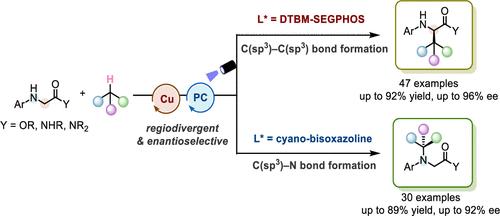
Regiodivergent asymmetric synthesis represents a transformative strategy for the efficient generation of structurally diverse chiral products from a single set of starting materials, significantly enriching their enantiomeric composition. However, the design of radical-mediated regiodivergent and enantioselective reactions that can accommodate a wide range of functional groups and substrates has posed significant challenges. The obstacles primarily lie in switching the regioselectivity and achieving high enantiodiscrimination, especially when dealing with high-energy intermediates. To address these issues, we have developed a new catalytic system that integrates photoinduced hydrogen atom transfer (HAT) and chiral copper catalysis, involving the fine-tuning of chiral ligands, additives, and other reaction parameters. The strategy facilitates regiodivergent and enantioselective cross-couplings between N-aryl glycine ester/amide derivatives and abundant hydrocarbon feedstocks through strong C(sp3)–H bond activation. This approach allows for the controlled and stereoselective formation of C(sp3)–C(sp3) and C(sp3)–N bonds, yielding a rich variety of C- or N-alkylated glycine esters and amides with commendable yields (up to 92% yield), exclusive regioselectivities (typically >20:1 rr), and high enantioselectivities (up to 96% ee). Our methodology not only provides a promising avenue for the stereoselective incorporation of alkyl functionalities onto specific sites of biologically significant molecules but also offers a practical approach for regioselectivity switching while simultaneously achieving high asymmetric induction within photochemical reactions.
期刊介绍:
The flagship journal of the American Chemical Society, known as the Journal of the American Chemical Society (JACS), has been a prestigious publication since its establishment in 1879. It holds a preeminent position in the field of chemistry and related interdisciplinary sciences. JACS is committed to disseminating cutting-edge research papers, covering a wide range of topics, and encompasses approximately 19,000 pages of Articles, Communications, and Perspectives annually. With a weekly publication frequency, JACS plays a vital role in advancing the field of chemistry by providing essential research.



 京公网安备 11010802042870号
京ICP备2023020795号-1
京公网安备 11010802042870号
京ICP备2023020795号-1

 分享
分享
 求助内容:
求助内容: 应助结果提醒方式:
 扫码关注我们
