{"title":"Bioearth recovered from landfill mining of old dumpsites: a potential resource or reservoir of toxic pollutants","authors":"Saranya Kuppusamy, Kanmani Sellappa","doi":"10.1007/s11356-024-35705-5","DOIUrl":null,"url":null,"abstract":"<div><p>Landfill biomining is indeed a promising eco-friendly approach to sustainably manage and reclaim old dumpsites. Soil like fractions of < 8–10 mm size, also known as bioearth or good earth constitute a substantial part of the legacy waste. Detailed characterization is necessary to meet regulatory standards for the safe use of bioearth and minimize its environmental and human health impacts upon reuse. In this study, bioearth recovered from six different dumpsites of Tamil Nadu, India, constituted 1.2 to 9.1% of total organic carbon that can improve soil structure, water retention, and nutrient supply. Macronutrients which are regarded as main factors for plant growth namely nitrogen, phosphorous, and potassium ranged 800 to 9800 mg kg<sup>−1</sup>, 700 to 2800 mg kg<sup>−1</sup>, and 3100 to 5900 mg kg<sup>−1</sup>, respectively, and highlighted the suitability of bioearth for use as soil amendment upon nutrient enrichment. However, the presence of heavy metals like Cu (15.9 to 254.4 mg kg<sup>−1</sup>), Ni (34.5 to 62.1 mg kg<sup>−1</sup>), Cr (48.2 to 152.3 mg kg<sup>−1</sup>), Pb (58.5 to 123.7 mg kg<sup>−1</sup>), and Zn (75.4 to 464.2 mg kg<sup>−1</sup>), with Cr and Ni levels beyond the regulatory standards, higher pollution (<i>I</i><sub>geo</sub>, 0.6 to 3.6; EF, 0.1 to 5.5), and ecological risk indicator values (<i>E</i><sub><i>r</i></sub>, 4.4 to 91.5; ERI, 67.6 to 224.3) suggested its unsuitability for certain types in reuses, especially in agricultural applications where it could pose risks to biota. Nevertheless, the human health risk indicator values (HQ and HI < 1) for bioearth showed that the current levels of metals are within the safe limits for human exposure. Pearson’s correlation and principal component analysis uncovered close relationship between bioearth physicochemical properties and heavy metals. The current study highlights that bioearth from landfill mining presents an attractive option for reuse, the high levels of metals necessitate proper treatment like phytoremediation, chemical stabilization, thermal treatment, or soil washing before it can be safely utilized offsite. This ensures compliance with environmental and health safety standards, making the bioearth suitable for applications such as agriculture, landscaping, and land reclamation.</p></div>","PeriodicalId":545,"journal":{"name":"Environmental Science and Pollution Research","volume":"32 4","pages":"1746 - 1765"},"PeriodicalIF":5.8000,"publicationDate":"2025-01-02","publicationTypes":"Journal Article","fieldsOfStudy":null,"isOpenAccess":false,"openAccessPdf":"https://link.springer.com/content/pdf/10.1007/s11356-024-35705-5.pdf","citationCount":"0","resultStr":null,"platform":"Semanticscholar","paperid":null,"PeriodicalName":"Environmental Science and Pollution Research","FirstCategoryId":"93","ListUrlMain":"https://link.springer.com/article/10.1007/s11356-024-35705-5","RegionNum":3,"RegionCategory":"环境科学与生态学","ArticlePicture":[],"TitleCN":null,"AbstractTextCN":null,"PMCID":null,"EPubDate":"","PubModel":"","JCR":"0","JCRName":"ENVIRONMENTAL SCIENCES","Score":null,"Total":0}
引用次数: 0
Abstract
Landfill biomining is indeed a promising eco-friendly approach to sustainably manage and reclaim old dumpsites. Soil like fractions of < 8–10 mm size, also known as bioearth or good earth constitute a substantial part of the legacy waste. Detailed characterization is necessary to meet regulatory standards for the safe use of bioearth and minimize its environmental and human health impacts upon reuse. In this study, bioearth recovered from six different dumpsites of Tamil Nadu, India, constituted 1.2 to 9.1% of total organic carbon that can improve soil structure, water retention, and nutrient supply. Macronutrients which are regarded as main factors for plant growth namely nitrogen, phosphorous, and potassium ranged 800 to 9800 mg kg−1, 700 to 2800 mg kg−1, and 3100 to 5900 mg kg−1, respectively, and highlighted the suitability of bioearth for use as soil amendment upon nutrient enrichment. However, the presence of heavy metals like Cu (15.9 to 254.4 mg kg−1), Ni (34.5 to 62.1 mg kg−1), Cr (48.2 to 152.3 mg kg−1), Pb (58.5 to 123.7 mg kg−1), and Zn (75.4 to 464.2 mg kg−1), with Cr and Ni levels beyond the regulatory standards, higher pollution (Igeo, 0.6 to 3.6; EF, 0.1 to 5.5), and ecological risk indicator values (Er, 4.4 to 91.5; ERI, 67.6 to 224.3) suggested its unsuitability for certain types in reuses, especially in agricultural applications where it could pose risks to biota. Nevertheless, the human health risk indicator values (HQ and HI < 1) for bioearth showed that the current levels of metals are within the safe limits for human exposure. Pearson’s correlation and principal component analysis uncovered close relationship between bioearth physicochemical properties and heavy metals. The current study highlights that bioearth from landfill mining presents an attractive option for reuse, the high levels of metals necessitate proper treatment like phytoremediation, chemical stabilization, thermal treatment, or soil washing before it can be safely utilized offsite. This ensures compliance with environmental and health safety standards, making the bioearth suitable for applications such as agriculture, landscaping, and land reclamation.
期刊介绍:
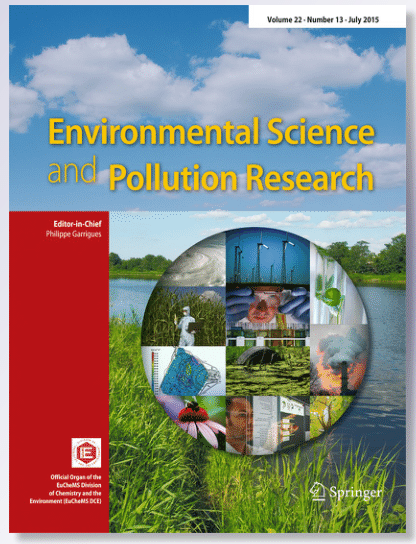
Environmental Science and Pollution Research (ESPR) serves the international community in all areas of Environmental Science and related subjects with emphasis on chemical compounds. This includes:
- Terrestrial Biology and Ecology
- Aquatic Biology and Ecology
- Atmospheric Chemistry
- Environmental Microbiology/Biobased Energy Sources
- Phytoremediation and Ecosystem Restoration
- Environmental Analyses and Monitoring
- Assessment of Risks and Interactions of Pollutants in the Environment
- Conservation Biology and Sustainable Agriculture
- Impact of Chemicals/Pollutants on Human and Animal Health
It reports from a broad interdisciplinary outlook.



 京公网安备 11010802042870号
京ICP备2023020795号-1
京公网安备 11010802042870号
京ICP备2023020795号-1

 分享
分享
 求助内容:
求助内容: 应助结果提醒方式:
 扫码关注我们
