{"title":"Identification of biomarkers for chronic lymphocytic leukemia risk: a proteome-wide Mendelian randomization study.","authors":"Changyu Jin, Zehong Lu, Yuzhan Chen, Huijie Hu, Miao Zhou, Yanli Zhang, Guifang Ouyang, Tongyu Li, Lixia Sheng","doi":"10.1007/s12672-024-01699-2","DOIUrl":null,"url":null,"abstract":"<p><strong>Background: </strong>Chronic lymphocytic leukemia (CLL) is a common hematologic malignancy. Although previous research has explored associations between plasma proteins and CLL, the causal relationships remain unclear. This study used Mendelian randomization (MR) to investigate the causal relationship between 7156 plasma proteins and CLL risk.</p><p><strong>Methods: </strong>A two-sample MR analysis assessed the impact of specific plasma proteins on CLL risk, using data from the Finngen Proteomics project (analyzing 828 participants) and the UK Biobank. Additional analyses included colocalization, phenomenon-wide MR, and protein-protein interaction networks.</p><p><strong>Results: </strong>The study identified nine plasma proteins significantly associated with CLL risk. Increased levels of Peptidyl-prolyl cis-trans isomerase E (PPIE) (OR = 1.66, 95% CI 1.22-2.27, P = 0.001) were associated with an increased risk of developing CLL, whereas Protein O-Mannosyltransferase 2 (POMGNT2) (OR = 0.62, 95% CI 0.41-0.91, P = 0.017) and C-C Motif Chemokine Ligand 14(CCL14) (OR = 0.80, 95% CI 0.67-0.94, P = 0.010) were associated with a reduced risk of CLL. Colocalization analysis suggested that PPIE may share pathogenic variants with CLL (PP.H4 = 0.758). Phenomenon-wide MR analysis of PPIE also indicated associations with other clinical features, including rheumatic diseases and type 2 diabetes. Protein-protein interaction and drug-gene interaction analyses highlighted CDC5L and SNW1 as potential therapeutic targets.</p><p><strong>Conclusion: </strong>This study identifies nine plasma proteins linked to CLL risk, with PPIE offering new insights into the disease's pathogenesis. Further research is needed to validate these findings and explore their potential as therapeutic targets.</p>","PeriodicalId":11148,"journal":{"name":"Discover. Oncology","volume":"16 1","pages":"2"},"PeriodicalIF":2.9000,"publicationDate":"2025-01-03","publicationTypes":"Journal Article","fieldsOfStudy":null,"isOpenAccess":false,"openAccessPdf":"https://www.ncbi.nlm.nih.gov/pmc/articles/PMC11699013/pdf/","citationCount":"0","resultStr":null,"platform":"Semanticscholar","paperid":null,"PeriodicalName":"Discover. Oncology","FirstCategoryId":"3","ListUrlMain":"https://doi.org/10.1007/s12672-024-01699-2","RegionNum":4,"RegionCategory":"医学","ArticlePicture":[],"TitleCN":null,"AbstractTextCN":null,"PMCID":null,"EPubDate":"","PubModel":"","JCR":"Q3","JCRName":"ENDOCRINOLOGY & METABOLISM","Score":null,"Total":0}
引用次数: 0
Abstract
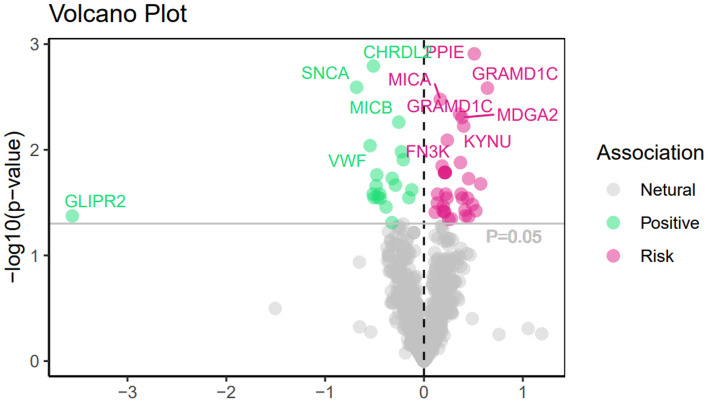
Background: Chronic lymphocytic leukemia (CLL) is a common hematologic malignancy. Although previous research has explored associations between plasma proteins and CLL, the causal relationships remain unclear. This study used Mendelian randomization (MR) to investigate the causal relationship between 7156 plasma proteins and CLL risk.
Methods: A two-sample MR analysis assessed the impact of specific plasma proteins on CLL risk, using data from the Finngen Proteomics project (analyzing 828 participants) and the UK Biobank. Additional analyses included colocalization, phenomenon-wide MR, and protein-protein interaction networks.
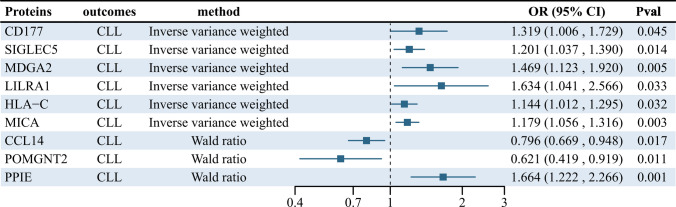
Results: The study identified nine plasma proteins significantly associated with CLL risk. Increased levels of Peptidyl-prolyl cis-trans isomerase E (PPIE) (OR = 1.66, 95% CI 1.22-2.27, P = 0.001) were associated with an increased risk of developing CLL, whereas Protein O-Mannosyltransferase 2 (POMGNT2) (OR = 0.62, 95% CI 0.41-0.91, P = 0.017) and C-C Motif Chemokine Ligand 14(CCL14) (OR = 0.80, 95% CI 0.67-0.94, P = 0.010) were associated with a reduced risk of CLL. Colocalization analysis suggested that PPIE may share pathogenic variants with CLL (PP.H4 = 0.758). Phenomenon-wide MR analysis of PPIE also indicated associations with other clinical features, including rheumatic diseases and type 2 diabetes. Protein-protein interaction and drug-gene interaction analyses highlighted CDC5L and SNW1 as potential therapeutic targets.
Conclusion: This study identifies nine plasma proteins linked to CLL risk, with PPIE offering new insights into the disease's pathogenesis. Further research is needed to validate these findings and explore their potential as therapeutic targets.





 京公网安备 11010802042870号
京ICP备2023020795号-1
京公网安备 11010802042870号
京ICP备2023020795号-1

 分享
分享
 求助内容:
求助内容: 应助结果提醒方式:
 扫码关注我们
