Yurou Chen, Fan Yu, Fanzhuang Rong, Furong Lv, Fajin Lv, Jia Li
{"title":"Analysis of spatial patellofemoral alignment using novel three-dimensional measurements based on weight-bearing cone-beam CT.","authors":"Yurou Chen, Fan Yu, Fanzhuang Rong, Furong Lv, Fajin Lv, Jia Li","doi":"10.1186/s13244-024-01883-6","DOIUrl":null,"url":null,"abstract":"<p><strong>Objectives: </strong>To propose a reliable and standard 3D assessment method to analyze the effect of weight-bearing (WB) status on the location of patella and clarify the diagnostic performance of 3D parameters for recurrent patellar dislocation (RPD) in WB and non-weight-bearing (NWB) conditions.</p><p><strong>Methods: </strong>Sixty-five knees of RPD patients and 99 knees of controls were included. Eight landmarks, two lines and a coordinate system were defined on 3D bone models of knees based on weight-bearing CT and non-weight-bearing CT. The shift and tilt of patella in three orthogonal axes (X<sub>shift</sub>, Y<sub>shift</sub>, Z<sub>shift</sub>, X<sub>tilt</sub>, Y<sub>tilt</sub>, Z<sub>tilt</sub>) were evaluated.</p><p><strong>Results: </strong>X<sub>shift</sub> and Y<sub>shift</sub> were significantly higher, Z<sub>shift</sub>, X<sub>tilt</sub> and Y<sub>tilt</sub> were significantly lower in WB condition than NWB condition (p < 0.001, p < 0.001, p = 0.001, p = 0.002, p = 0.010). In both WB and NWB conditions, X<sub>shift</sub>, Y<sub>shift</sub> and Z<sub>tilt</sub> were significantly higher, and X<sub>tilt</sub> was significantly lower in the RPD group than the control group (WB/NWB: p < 0.001/p = 0.002, p < 0.001/p = 0.001, p < 0.001/p < 0.001, p < 0.001/p = 0.009). In WB condition, Z<sub>shift</sub> and Y<sub>tilt</sub> were significantly higher in the RPD group than the control group (p = 0.011, p < 0.001). Z<sub>tilt</sub> had the best diagnostic performance for RPD in both WB and NWB conditions, with AUC of 0.887 (95% CI: 0.828, 0.946) and 0.885 (95% CI: 0.822, 0.947), respectively.</p><p><strong>Conclusions: </strong>The 3D measurement method reliably and comprehensively reflected the relative spatial position relationship of the patellofemoral joint. It can be applied to the 3D preoperative planning of patellofemoral procedures. In addition, patellofemoral evaluation under the WB condition was essential to detect subtle underlying risk factors for RPD, with axial lateral patellar tilt being the best predictor.</p><p><strong>Critical relevance statement: </strong>This 3D measurement method under weight-bearing conditions contributes to comprehensively describing the relative spatial position of the patellofemoral joint in a standardized way and can be applied to preoperative evaluation for recurrent patellar dislocation.</p><p><strong>Key points: </strong>Patellofemoral alignment is a 3D problem, and the accuracy of 2D parameters has been questioned. 3D measurement was reliable and comprehensively reflected relative spatial relationships of the patellofemoral joint. 3D measurements under weight-bearing condition help preoperative evaluation for RPD.</p>","PeriodicalId":13639,"journal":{"name":"Insights into Imaging","volume":"16 1","pages":"1"},"PeriodicalIF":4.5000,"publicationDate":"2025-01-02","publicationTypes":"Journal Article","fieldsOfStudy":null,"isOpenAccess":false,"openAccessPdf":"https://www.ncbi.nlm.nih.gov/pmc/articles/PMC11695510/pdf/","citationCount":"0","resultStr":null,"platform":"Semanticscholar","paperid":null,"PeriodicalName":"Insights into Imaging","FirstCategoryId":"3","ListUrlMain":"https://doi.org/10.1186/s13244-024-01883-6","RegionNum":2,"RegionCategory":"医学","ArticlePicture":[],"TitleCN":null,"AbstractTextCN":null,"PMCID":null,"EPubDate":"","PubModel":"","JCR":"Q1","JCRName":"RADIOLOGY, NUCLEAR MEDICINE & MEDICAL IMAGING","Score":null,"Total":0}
引用次数: 0
Abstract
Objectives: To propose a reliable and standard 3D assessment method to analyze the effect of weight-bearing (WB) status on the location of patella and clarify the diagnostic performance of 3D parameters for recurrent patellar dislocation (RPD) in WB and non-weight-bearing (NWB) conditions.
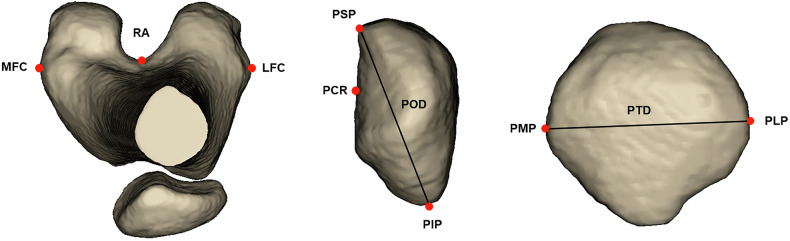
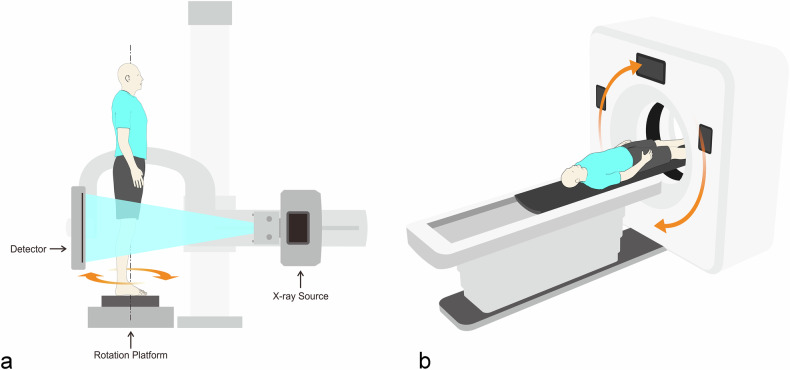
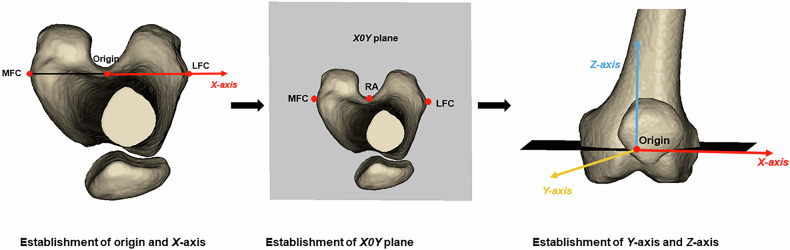
Methods: Sixty-five knees of RPD patients and 99 knees of controls were included. Eight landmarks, two lines and a coordinate system were defined on 3D bone models of knees based on weight-bearing CT and non-weight-bearing CT. The shift and tilt of patella in three orthogonal axes (Xshift, Yshift, Zshift, Xtilt, Ytilt, Ztilt) were evaluated.
Results: Xshift and Yshift were significantly higher, Zshift, Xtilt and Ytilt were significantly lower in WB condition than NWB condition (p < 0.001, p < 0.001, p = 0.001, p = 0.002, p = 0.010). In both WB and NWB conditions, Xshift, Yshift and Ztilt were significantly higher, and Xtilt was significantly lower in the RPD group than the control group (WB/NWB: p < 0.001/p = 0.002, p < 0.001/p = 0.001, p < 0.001/p < 0.001, p < 0.001/p = 0.009). In WB condition, Zshift and Ytilt were significantly higher in the RPD group than the control group (p = 0.011, p < 0.001). Ztilt had the best diagnostic performance for RPD in both WB and NWB conditions, with AUC of 0.887 (95% CI: 0.828, 0.946) and 0.885 (95% CI: 0.822, 0.947), respectively.
Conclusions: The 3D measurement method reliably and comprehensively reflected the relative spatial position relationship of the patellofemoral joint. It can be applied to the 3D preoperative planning of patellofemoral procedures. In addition, patellofemoral evaluation under the WB condition was essential to detect subtle underlying risk factors for RPD, with axial lateral patellar tilt being the best predictor.
Critical relevance statement: This 3D measurement method under weight-bearing conditions contributes to comprehensively describing the relative spatial position of the patellofemoral joint in a standardized way and can be applied to preoperative evaluation for recurrent patellar dislocation.
Key points: Patellofemoral alignment is a 3D problem, and the accuracy of 2D parameters has been questioned. 3D measurement was reliable and comprehensively reflected relative spatial relationships of the patellofemoral joint. 3D measurements under weight-bearing condition help preoperative evaluation for RPD.
期刊介绍:
Insights into Imaging (I³) is a peer-reviewed open access journal published under the brand SpringerOpen. All content published in the journal is freely available online to anyone, anywhere!
I³ continuously updates scientific knowledge and progress in best-practice standards in radiology through the publication of original articles and state-of-the-art reviews and opinions, along with recommendations and statements from the leading radiological societies in Europe.
Founded by the European Society of Radiology (ESR), I³ creates a platform for educational material, guidelines and recommendations, and a forum for topics of controversy.
A balanced combination of review articles, original papers, short communications from European radiological congresses and information on society matters makes I³ an indispensable source for current information in this field.
I³ is owned by the ESR, however authors retain copyright to their article according to the Creative Commons Attribution License (see Copyright and License Agreement). All articles can be read, redistributed and reused for free, as long as the author of the original work is cited properly.
The open access fees (article-processing charges) for this journal are kindly sponsored by ESR for all Members.
The journal went open access in 2012, which means that all articles published since then are freely available online.



 京公网安备 11010802042870号
京ICP备2023020795号-1
京公网安备 11010802042870号
京ICP备2023020795号-1

 分享
分享
 求助内容:
求助内容: 应助结果提醒方式:
 扫码关注我们
