Yin Wang , Zhengguo Xia , Wengting Wang , Jingsong Zhang , Chao Hu , Fan Wang , Fei Zhu , Lin sen Fang , Jun Wang , Xiaojing Li
{"title":"FoxC1 activates Notch3 signaling to promote the inflammatory phenotype of keloid fibroblasts and aggravates keloid","authors":"Yin Wang , Zhengguo Xia , Wengting Wang , Jingsong Zhang , Chao Hu , Fan Wang , Fei Zhu , Lin sen Fang , Jun Wang , Xiaojing Li","doi":"10.1016/j.yexcr.2024.114402","DOIUrl":null,"url":null,"abstract":"<div><div>Keloids are disfiguring proliferative scars, and their pathological mechanisms are still unclear. We have previously established that FoxC1 plays a significant role in rheumatoid arthritis and osteoarthritis, but its molecular mechanisms in pathological scar formation remain elusive. In this study, we analyzed keloid tissue characteristics using HE staining and immunohistochemistry, revealing abnormal expression of FoxC1 and Notch3 in keloids. Lentiviral modulation of FoxC1 and Notch3 demonstrated that they promote the expression of α-SMA, fibronectin, collagen I, and Hes-1, enhancing the proliferation, migration, invasion, and cytokine production of keloid fibroblasts (KFs) while inhibiting apoptosis. Co-immunoprecipitation (CO-IP), dual-luciferase reporter assays, and chromatin immunoprecipitation (ChIP) confirmed that FoxC1 can directly bind to the Notch3 promoter and enhance its transcription. Additionally, in vivo, overexpression of FoxC1 and Notch3 promoted keloid formation. In summary, our research highlights the critical regulatory role of FoxC1 in keloid formation through Notch3 activation, potentially offering new therapeutic targets for preventing scar formation.</div></div>","PeriodicalId":12227,"journal":{"name":"Experimental cell research","volume":"444 2","pages":"Article 114402"},"PeriodicalIF":3.5000,"publicationDate":"2025-01-15","publicationTypes":"Journal Article","fieldsOfStudy":null,"isOpenAccess":false,"openAccessPdf":"","citationCount":"0","resultStr":null,"platform":"Semanticscholar","paperid":null,"PeriodicalName":"Experimental cell research","FirstCategoryId":"3","ListUrlMain":"https://www.sciencedirect.com/science/article/pii/S0014482724004932","RegionNum":3,"RegionCategory":"生物学","ArticlePicture":[],"TitleCN":null,"AbstractTextCN":null,"PMCID":null,"EPubDate":"2025/1/1 0:00:00","PubModel":"Epub","JCR":"Q3","JCRName":"CELL BIOLOGY","Score":null,"Total":0}
引用次数: 0
Abstract
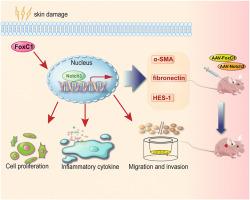
Keloids are disfiguring proliferative scars, and their pathological mechanisms are still unclear. We have previously established that FoxC1 plays a significant role in rheumatoid arthritis and osteoarthritis, but its molecular mechanisms in pathological scar formation remain elusive. In this study, we analyzed keloid tissue characteristics using HE staining and immunohistochemistry, revealing abnormal expression of FoxC1 and Notch3 in keloids. Lentiviral modulation of FoxC1 and Notch3 demonstrated that they promote the expression of α-SMA, fibronectin, collagen I, and Hes-1, enhancing the proliferation, migration, invasion, and cytokine production of keloid fibroblasts (KFs) while inhibiting apoptosis. Co-immunoprecipitation (CO-IP), dual-luciferase reporter assays, and chromatin immunoprecipitation (ChIP) confirmed that FoxC1 can directly bind to the Notch3 promoter and enhance its transcription. Additionally, in vivo, overexpression of FoxC1 and Notch3 promoted keloid formation. In summary, our research highlights the critical regulatory role of FoxC1 in keloid formation through Notch3 activation, potentially offering new therapeutic targets for preventing scar formation.
期刊介绍:
Our scope includes but is not limited to areas such as: Chromosome biology; Chromatin and epigenetics; DNA repair; Gene regulation; Nuclear import-export; RNA processing; Non-coding RNAs; Organelle biology; The cytoskeleton; Intracellular trafficking; Cell-cell and cell-matrix interactions; Cell motility and migration; Cell proliferation; Cellular differentiation; Signal transduction; Programmed cell death.



 京公网安备 11010802042870号
京ICP备2023020795号-1
京公网安备 11010802042870号
京ICP备2023020795号-1

 分享
分享
 求助内容:
求助内容: 应助结果提醒方式:
 扫码关注我们
