Roberto Galea MD , Juan Perich Krsnik MD , Tommaso Bini MD , Konstantina Chalkou PhD , Antanas Gasys MD , Nicolas Brugger MD , Raouf Madhkour MD , David Julian Seiffge MD , Laurent Roten MD , George C.M. Siontis MD, PhD , Lorenz Räber MD, PhD
{"title":"Single vs dual antiplatelet therapy after left atrial appendage closure: A propensity score matching analysis","authors":"Roberto Galea MD , Juan Perich Krsnik MD , Tommaso Bini MD , Konstantina Chalkou PhD , Antanas Gasys MD , Nicolas Brugger MD , Raouf Madhkour MD , David Julian Seiffge MD , Laurent Roten MD , George C.M. Siontis MD, PhD , Lorenz Räber MD, PhD","doi":"10.1016/j.hrthm.2024.12.007","DOIUrl":null,"url":null,"abstract":"<div><h3>Background</h3><div>Dual antiplatelet therapy and oral anticoagulation in combination with aspirin represent recommended treatment regimens after left atrial appendage closure (LAAC). As most patients receiving LAAC have high bleeding risk, less aggressive antithrombotic treatments are needed, such as single antiplatelet therapy.</div></div><div><h3>Objective</h3><div>We sought to compare both ischemic and bleeding outcomes in patients receiving single antiplatelet therapy (SAPT) or dual antiplatelet therapy (DAPT) after successful LAAC.</div></div><div><h3>Methods</h3><div>Data on consecutive patients undergoing percutaneous LAAC between 2009 and 2023 were prospectively collected including 1-year follow-up. Propensity score matching was performed for patients discharged under SAPT and DAPT. The primary end point was the 1-year composite of cardiovascular death, stroke, systemic embolism, or device-related thrombosis (DRT). The secondary end points included major bleeding and DRT.</div></div><div><h3>Results</h3><div>Of 1033 patients discharged with antiplatelet therapy, 154 patients receiving SAPT were compared with 230 matched patients receiving DAPT. The primary end point was similar between the study groups (SAPT 11.0% vs DAPT 8.3%; rate ratio, 1.14; 95% confidence interval [CI], 0.83–1.55; <em>P</em> = .420). Consistently, we found no difference in terms of both major bleeding (SAPT 9.7% vs DAPT 12.6%; hazard ratio, 0.77; 95% CI, 0.43–1.39; <em>P</em> = .387) and DRT (2.6% vs 1.1%; rate ratio, 1.47; 95% CI, 0.89–2.43; <em>P</em> = .130) between the SAPT and DAPT groups.</div></div><div><h3>Conclusion</h3><div>In this propensity score matching analysis of a single-center LAAC cohort, ischemic and bleeding outcomes did not differ at 1 year for patients discharged with SAPT or DAPT. These results have to be confirmed in an adequately powered randomized clinical trial.</div></div>","PeriodicalId":12886,"journal":{"name":"Heart rhythm","volume":"22 4","pages":"Pages 971-978"},"PeriodicalIF":5.7000,"publicationDate":"2025-04-01","publicationTypes":"Journal Article","fieldsOfStudy":null,"isOpenAccess":false,"openAccessPdf":"","citationCount":"0","resultStr":null,"platform":"Semanticscholar","paperid":null,"PeriodicalName":"Heart rhythm","FirstCategoryId":"3","ListUrlMain":"https://www.sciencedirect.com/science/article/pii/S1547527124036440","RegionNum":2,"RegionCategory":"医学","ArticlePicture":[],"TitleCN":null,"AbstractTextCN":null,"PMCID":null,"EPubDate":"2025/1/3 0:00:00","PubModel":"Epub","JCR":"Q1","JCRName":"CARDIAC & CARDIOVASCULAR SYSTEMS","Score":null,"Total":0}
引用次数: 0
Abstract
Background
Dual antiplatelet therapy and oral anticoagulation in combination with aspirin represent recommended treatment regimens after left atrial appendage closure (LAAC). As most patients receiving LAAC have high bleeding risk, less aggressive antithrombotic treatments are needed, such as single antiplatelet therapy.
Objective
We sought to compare both ischemic and bleeding outcomes in patients receiving single antiplatelet therapy (SAPT) or dual antiplatelet therapy (DAPT) after successful LAAC.
Methods
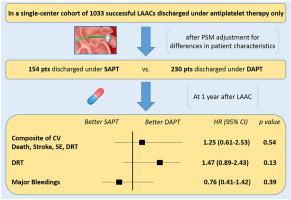
Data on consecutive patients undergoing percutaneous LAAC between 2009 and 2023 were prospectively collected including 1-year follow-up. Propensity score matching was performed for patients discharged under SAPT and DAPT. The primary end point was the 1-year composite of cardiovascular death, stroke, systemic embolism, or device-related thrombosis (DRT). The secondary end points included major bleeding and DRT.
Results
Of 1033 patients discharged with antiplatelet therapy, 154 patients receiving SAPT were compared with 230 matched patients receiving DAPT. The primary end point was similar between the study groups (SAPT 11.0% vs DAPT 8.3%; rate ratio, 1.14; 95% confidence interval [CI], 0.83–1.55; P = .420). Consistently, we found no difference in terms of both major bleeding (SAPT 9.7% vs DAPT 12.6%; hazard ratio, 0.77; 95% CI, 0.43–1.39; P = .387) and DRT (2.6% vs 1.1%; rate ratio, 1.47; 95% CI, 0.89–2.43; P = .130) between the SAPT and DAPT groups.
Conclusion
In this propensity score matching analysis of a single-center LAAC cohort, ischemic and bleeding outcomes did not differ at 1 year for patients discharged with SAPT or DAPT. These results have to be confirmed in an adequately powered randomized clinical trial.
期刊介绍:
HeartRhythm, the official Journal of the Heart Rhythm Society and the Cardiac Electrophysiology Society, is a unique journal for fundamental discovery and clinical applicability.
HeartRhythm integrates the entire cardiac electrophysiology (EP) community from basic and clinical academic researchers, private practitioners, engineers, allied professionals, industry, and trainees, all of whom are vital and interdependent members of our EP community.
The Heart Rhythm Society is the international leader in science, education, and advocacy for cardiac arrhythmia professionals and patients, and the primary information resource on heart rhythm disorders. Its mission is to improve the care of patients by promoting research, education, and optimal health care policies and standards.




 京公网安备 11010802042870号
京ICP备2023020795号-1
京公网安备 11010802042870号
京ICP备2023020795号-1

 分享
分享
 求助内容:
求助内容: 应助结果提醒方式:
 扫码关注我们
