Francesco Tumino, Sergio Tosoni, Paolo D’Agosta, Valeria Russo, Carlo E. Bottani, Andrea Li Bassi, Carlo S. Casari
{"title":"Surface-Sensitive Raman Response of Metal-Supported Monolayer MoS2","authors":"Francesco Tumino, Sergio Tosoni, Paolo D’Agosta, Valeria Russo, Carlo E. Bottani, Andrea Li Bassi, Carlo S. Casari","doi":"10.1021/acs.jpcc.4c06548","DOIUrl":null,"url":null,"abstract":"The Raman spectrum of monolayer (ML) MoS<sub>2</sub> is remarkably affected by the interaction with metals. In this work, we studied ML-MoS<sub>2</sub> supported by the Ag(111) and Ag(110) surfaces by using a combined experimental and theoretical approach. The MoS<sub>2</sub> layer was directly grown on atomically clean Ag(111) and Ag(110) surfaces by pulsed laser deposition, followed by in situ thermal annealing under ultrahigh vacuum conditions. The morphology and structure of the two systems were characterized in situ by scanning tunneling microscopy, providing atomic-scale information on the relation between the MoS<sub>2</sub> lattice and the underlying surface. Raman spectroscopy revealed differences between the two MoS<sub>2</sub>–metal interfaces, especially concerning the behavior of the out-of-plane <i></i><span style=\"color: inherit;\"></span><span data-mathml='<math xmlns=\"http://www.w3.org/1998/Math/MathML\" display=\"inline\"><msubsup><mrow><mi>A</mi></mrow><mrow><mn>1</mn></mrow><mrow><mo mathsize=\"8pt\">&#x2032;</mo></mrow></msubsup></math>' role=\"presentation\" style=\"position: relative;\" tabindex=\"0\"><nobr aria-hidden=\"true\"><span style=\"width: 1.253em; display: inline-block;\"><span style=\"display: inline-block; position: relative; width: 1.139em; height: 0px; font-size: 110%;\"><span style=\"position: absolute; clip: rect(1.253em, 1001.14em, 2.56em, -999.997em); top: -2.156em; left: 0em;\"><span><span><span style=\"display: inline-block; position: relative; width: 1.139em; height: 0px;\"><span style=\"position: absolute; clip: rect(3.128em, 1000.68em, 4.151em, -999.997em); top: -3.974em; left: 0em;\"><span><span style=\"font-family: STIXMathJax_Normal-italic;\">𝐴</span></span><span style=\"display: inline-block; width: 0px; height: 3.98em;\"></span></span><span style=\"position: absolute; clip: rect(3.469em, 1000.29em, 4.151em, -999.997em); top: -4.372em; left: 0.741em;\"><span><span style=\"font-size: 63.6%; font-family: STIXMathJax_Variants;\">′</span></span><span style=\"display: inline-block; width: 0px; height: 3.98em;\"></span></span><span style=\"position: absolute; clip: rect(3.355em, 1000.46em, 4.151em, -999.997em); top: -3.747em; left: 0.741em;\"><span><span style=\"font-size: 70.7%; font-family: STIXMathJax_Main;\">1</span></span><span style=\"display: inline-block; width: 0px; height: 3.98em;\"></span></span></span></span></span><span style=\"display: inline-block; width: 0px; height: 2.162em;\"></span></span></span><span style=\"display: inline-block; overflow: hidden; vertical-align: -0.309em; border-left: 0px solid; width: 0px; height: 1.253em;\"></span></span></nobr><span role=\"presentation\"><math display=\"inline\" xmlns=\"http://www.w3.org/1998/Math/MathML\"><msubsup><mrow><mi>A</mi></mrow><mrow><mn>1</mn></mrow><mrow><mo mathsize=\"8pt\">′</mo></mrow></msubsup></math></span></span><script type=\"math/mml\"><math display=\"inline\"><msubsup><mrow><mi>A</mi></mrow><mrow><mn>1</mn></mrow><mrow><mo mathsize=\"8pt\">′</mo></mrow></msubsup></math></script> vibrational mode, which splits into two contributions on Ag(110). The metal-induced effects on MoS<sub>2</sub> vibrational modes are further evidenced by transferring MoS<sub>2</sub> onto a more inert substrate (SiO<sub>2</sub>/Si), where the MoS<sub>2</sub> Raman response displays a more “freestanding-like” behavior. The experimental data were interpreted with the support of ab initio calculations of the vibrational modes, which provided insight into the effect of interface properties, such as strain and out-of-plane distortion. Our results highlight the influence of the interaction with metals on MoS<sub>2</sub> vibrational properties and show the high sensitivity of MoS<sub>2</sub> Raman modes to the surface structure of the supporting metal.","PeriodicalId":61,"journal":{"name":"The Journal of Physical Chemistry C","volume":"7 1","pages":""},"PeriodicalIF":3.2000,"publicationDate":"2025-01-06","publicationTypes":"Journal Article","fieldsOfStudy":null,"isOpenAccess":false,"openAccessPdf":"","citationCount":"0","resultStr":null,"platform":"Semanticscholar","paperid":null,"PeriodicalName":"The Journal of Physical Chemistry C","FirstCategoryId":"1","ListUrlMain":"https://doi.org/10.1021/acs.jpcc.4c06548","RegionNum":3,"RegionCategory":"化学","ArticlePicture":[],"TitleCN":null,"AbstractTextCN":null,"PMCID":null,"EPubDate":"","PubModel":"","JCR":"Q2","JCRName":"CHEMISTRY, PHYSICAL","Score":null,"Total":0}
引用次数: 0
Abstract
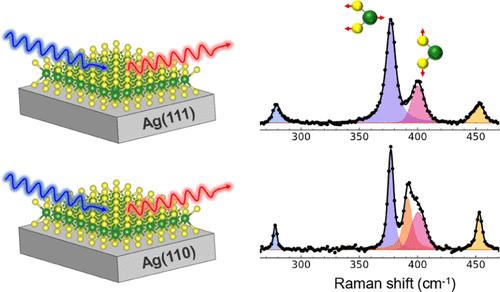
The Raman spectrum of monolayer (ML) MoS2 is remarkably affected by the interaction with metals. In this work, we studied ML-MoS2 supported by the Ag(111) and Ag(110) surfaces by using a combined experimental and theoretical approach. The MoS2 layer was directly grown on atomically clean Ag(111) and Ag(110) surfaces by pulsed laser deposition, followed by in situ thermal annealing under ultrahigh vacuum conditions. The morphology and structure of the two systems were characterized in situ by scanning tunneling microscopy, providing atomic-scale information on the relation between the MoS2 lattice and the underlying surface. Raman spectroscopy revealed differences between the two MoS2–metal interfaces, especially concerning the behavior of the out-of-plane 𝐴′1 vibrational mode, which splits into two contributions on Ag(110). The metal-induced effects on MoS2 vibrational modes are further evidenced by transferring MoS2 onto a more inert substrate (SiO2/Si), where the MoS2 Raman response displays a more “freestanding-like” behavior. The experimental data were interpreted with the support of ab initio calculations of the vibrational modes, which provided insight into the effect of interface properties, such as strain and out-of-plane distortion. Our results highlight the influence of the interaction with metals on MoS2 vibrational properties and show the high sensitivity of MoS2 Raman modes to the surface structure of the supporting metal.
期刊介绍:
The Journal of Physical Chemistry A/B/C is devoted to reporting new and original experimental and theoretical basic research of interest to physical chemists, biophysical chemists, and chemical physicists.



 京公网安备 11010802042870号
京ICP备2023020795号-1
京公网安备 11010802042870号
京ICP备2023020795号-1

 分享
分享
 求助内容:
求助内容: 应助结果提醒方式:
 扫码关注我们
