Long Shi, Yuzhu Yang, Jia Song, Lin Yang, Zhongde Dai, Lu Yao and Wenju Jiang
{"title":"A carbon quantum dot (CQD) modified-CuZn bimetallic catalyst for efficient electrocatalytic CO2 reduction†","authors":"Long Shi, Yuzhu Yang, Jia Song, Lin Yang, Zhongde Dai, Lu Yao and Wenju Jiang","doi":"10.1039/D4TA07252A","DOIUrl":null,"url":null,"abstract":"<p >The development of highly selective and active catalysts for electrochemical carbon dioxide reduction (CO<small><sub>2</sub></small>ER) is essential for its practical application. In the current work, carbon quantum dot (CQD)-modified CuZn bimetallic electrodes were successfully synthesized by a one-step hydrothermal method. The obtained catalysts were thoroughly characterized and the performance of the catalysts was compared using LSV, EIS, CV, ESCA, Tafel, and DFT calculations. It is found that the Cu<small><sub>1</sub></small>Zn<small><sub>2</sub></small> catalyst with 1.5 wt% CQDs exhibited the highest Faraday efficiency (FE, 92.5%) for CO at 1.3 V (<em>vs.</em> RHE), and the current densities were enhanced by a factor of 5.21 and 4.13 compared to that of the single ZnO and CuO catalysts. Meanwhile, it also showed good stability within 24 h, and the FE<small><sub>CO</sub></small> of the catalyst could be maintained above 80% after 24 h, which shows its potential in practical applications.</p>","PeriodicalId":82,"journal":{"name":"Journal of Materials Chemistry A","volume":" 7","pages":" 5068-5080"},"PeriodicalIF":9.5000,"publicationDate":"2025-01-06","publicationTypes":"Journal Article","fieldsOfStudy":null,"isOpenAccess":false,"openAccessPdf":"","citationCount":"0","resultStr":null,"platform":"Semanticscholar","paperid":null,"PeriodicalName":"Journal of Materials Chemistry A","FirstCategoryId":"88","ListUrlMain":"https://pubs.rsc.org/en/content/articlelanding/2025/ta/d4ta07252a","RegionNum":2,"RegionCategory":"材料科学","ArticlePicture":[],"TitleCN":null,"AbstractTextCN":null,"PMCID":null,"EPubDate":"","PubModel":"","JCR":"Q1","JCRName":"CHEMISTRY, PHYSICAL","Score":null,"Total":0}
引用次数: 0
Abstract
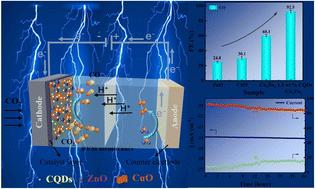
The development of highly selective and active catalysts for electrochemical carbon dioxide reduction (CO2ER) is essential for its practical application. In the current work, carbon quantum dot (CQD)-modified CuZn bimetallic electrodes were successfully synthesized by a one-step hydrothermal method. The obtained catalysts were thoroughly characterized and the performance of the catalysts was compared using LSV, EIS, CV, ESCA, Tafel, and DFT calculations. It is found that the Cu1Zn2 catalyst with 1.5 wt% CQDs exhibited the highest Faraday efficiency (FE, 92.5%) for CO at 1.3 V (vs. RHE), and the current densities were enhanced by a factor of 5.21 and 4.13 compared to that of the single ZnO and CuO catalysts. Meanwhile, it also showed good stability within 24 h, and the FECO of the catalyst could be maintained above 80% after 24 h, which shows its potential in practical applications.
期刊介绍:
The Journal of Materials Chemistry A, B & C covers a wide range of high-quality studies in the field of materials chemistry, with each section focusing on specific applications of the materials studied. Journal of Materials Chemistry A emphasizes applications in energy and sustainability, including topics such as artificial photosynthesis, batteries, and fuel cells. Journal of Materials Chemistry B focuses on applications in biology and medicine, while Journal of Materials Chemistry C covers applications in optical, magnetic, and electronic devices. Example topic areas within the scope of Journal of Materials Chemistry A include catalysis, green/sustainable materials, sensors, and water treatment, among others.



 京公网安备 11010802042870号
京ICP备2023020795号-1
京公网安备 11010802042870号
京ICP备2023020795号-1

 分享
分享
 求助内容:
求助内容: 应助结果提醒方式:
 扫码关注我们
