{"title":"Prototype analysis of a low-power, small-scale wearable medical device.","authors":"Pablo Dutra da Silva, Pedro Bertemes Filho","doi":"10.2478/joeb-2024-0020","DOIUrl":null,"url":null,"abstract":"<p><p>Wearable and portable devices are gaining significant popularity across consumer electronics as well as in medical and industrial fields. To ensure that these devices are both comfortable and appealing to users, they need to have low battery consumption and be compact in both size and weight. The EGluco project is focused on developing a wearable device for non-invasive blood glucose monitoring. This multi-sensor device incorporates electrical bioimpedance spectroscopy as one of its measurement techniques. One of the earlier versions of the device was deemed unsuitable as a wearable due to its large size and high power consumption. To make the device more suitable for wearability, the previous hardware was assessed, and a new design was proposed that simplified the system's power supply and reduced the operating voltage. This article presents two of these designs: an improved Howland current source with a supply voltage of 3.3 V, an output current of 250 <i>μA</i>, and the ability to conduct bioimpedance analysis up to 1 MHz using pulsed DIBS (Discrete Interval Binary Sequence) signals, and an instrumentation amplifier with the same supply voltage as the current source, a voltage gain of four, and a slew rate of 150 <i>V/μs</i>. By simplifying the power supply and implementing other changes, the device's size was reduced to a single 5 × 5 cm circuit board, compared to the previous configuration of four separate boards connected by cables.</p>","PeriodicalId":38125,"journal":{"name":"Journal of Electrical Bioimpedance","volume":"15 1","pages":"169-176"},"PeriodicalIF":0.0000,"publicationDate":"2025-01-04","publicationTypes":"Journal Article","fieldsOfStudy":null,"isOpenAccess":false,"openAccessPdf":"https://www.ncbi.nlm.nih.gov/pmc/articles/PMC11699846/pdf/","citationCount":"0","resultStr":null,"platform":"Semanticscholar","paperid":null,"PeriodicalName":"Journal of Electrical Bioimpedance","FirstCategoryId":"1085","ListUrlMain":"https://doi.org/10.2478/joeb-2024-0020","RegionNum":0,"RegionCategory":null,"ArticlePicture":[],"TitleCN":null,"AbstractTextCN":null,"PMCID":null,"EPubDate":"2024/1/1 0:00:00","PubModel":"eCollection","JCR":"Q3","JCRName":"Biochemistry, Genetics and Molecular Biology","Score":null,"Total":0}
引用次数: 0
Abstract
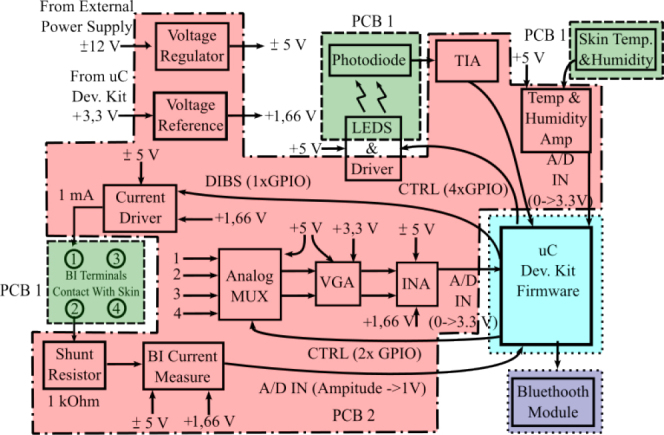
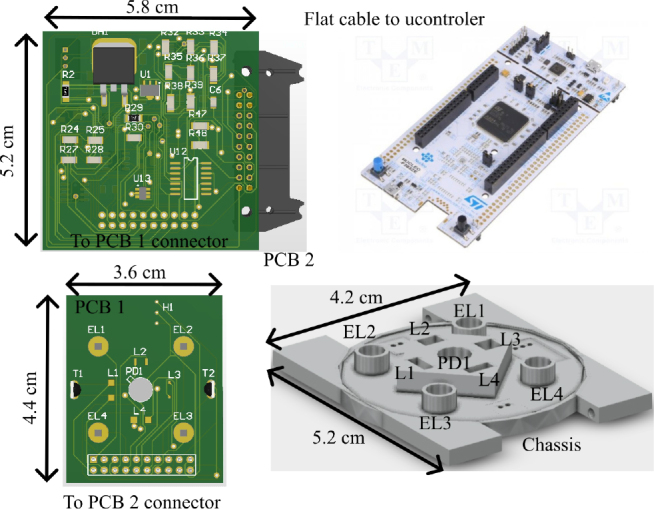
Wearable and portable devices are gaining significant popularity across consumer electronics as well as in medical and industrial fields. To ensure that these devices are both comfortable and appealing to users, they need to have low battery consumption and be compact in both size and weight. The EGluco project is focused on developing a wearable device for non-invasive blood glucose monitoring. This multi-sensor device incorporates electrical bioimpedance spectroscopy as one of its measurement techniques. One of the earlier versions of the device was deemed unsuitable as a wearable due to its large size and high power consumption. To make the device more suitable for wearability, the previous hardware was assessed, and a new design was proposed that simplified the system's power supply and reduced the operating voltage. This article presents two of these designs: an improved Howland current source with a supply voltage of 3.3 V, an output current of 250 μA, and the ability to conduct bioimpedance analysis up to 1 MHz using pulsed DIBS (Discrete Interval Binary Sequence) signals, and an instrumentation amplifier with the same supply voltage as the current source, a voltage gain of four, and a slew rate of 150 V/μs. By simplifying the power supply and implementing other changes, the device's size was reduced to a single 5 × 5 cm circuit board, compared to the previous configuration of four separate boards connected by cables.





 京公网安备 11010802042870号
京ICP备2023020795号-1
京公网安备 11010802042870号
京ICP备2023020795号-1

 分享
分享
 求助内容:
求助内容: 应助结果提醒方式:
 扫码关注我们
