Beverly G. Tchang, Michael G. Knight, Kasper Adelborg, Jennifer N. Clements, Aske Thorn Iversen, Andrea Traina
{"title":"Effect of semaglutide 2.4 mg on use of antihypertensive and lipid-lowering treatment in five randomized controlled STEP trials","authors":"Beverly G. Tchang, Michael G. Knight, Kasper Adelborg, Jennifer N. Clements, Aske Thorn Iversen, Andrea Traina","doi":"10.1002/oby.24202","DOIUrl":null,"url":null,"abstract":"<div>\n \n \n <section>\n \n <h3> Objective</h3>\n \n <p>The objective of this study was to assess antihypertensive and lipid-lowering treatment changes in participants receiving semaglutide 2.4 mg versus placebo across pooled populations from five Semaglutide Treatment Effect in People with Obesity (STEP) trials.</p>\n </section>\n \n <section>\n \n <h3> Methods</h3>\n \n <p>Efficacy and safety of semaglutide 2.4 mg were evaluated in the STEP clinical trials. In this post hoc analysis, STEP 1, 3, 6, and 8 (which included people with overweight or obesity) and, separately, STEP 2 and 6 (which included people with overweight or obesity and type 2 diabetes) were pooled for analysis. Changes in antihypertensive or lipid-lowering treatment intensity from randomization to end of treatment were evaluated.</p>\n </section>\n \n <section>\n \n <h3> Results</h3>\n \n <p>In both pooled samples, a higher proportion of participants in the semaglutide 2.4 mg group versus placebo underwent antihypertensive or lipid-lowering treatment intensity reduction by end of treatment. A smaller proportion underwent antihypertensive or lipid-lowering treatment intensification by end of treatment in the semaglutide 2.4 mg group of both samples versus placebo. In participants receiving antihypertensive or lipid-lowering medications in both samples, greater numeric reductions in body weight were observed in the semaglutide 2.4 mg group versus placebo.</p>\n </section>\n \n <section>\n \n <h3> Conclusions</h3>\n \n <p>These results support a relationship between semaglutide 2.4 mg treatment of overweight and obesity and reduced need for antihypertensive and lipid-lowering treatment, facilitating treatment intensity reduction/discontinuation and abating treatment intensification.</p>\n \n <div>\n <figure>\n <div><picture>\n <source></source></picture><p></p>\n </div>\n </figure>\n </div>\n </section>\n </div>","PeriodicalId":215,"journal":{"name":"Obesity","volume":"33 2","pages":"267-277"},"PeriodicalIF":4.7000,"publicationDate":"2025-01-05","publicationTypes":"Journal Article","fieldsOfStudy":null,"isOpenAccess":false,"openAccessPdf":"https://www.ncbi.nlm.nih.gov/pmc/articles/PMC11774009/pdf/","citationCount":"0","resultStr":null,"platform":"Semanticscholar","paperid":null,"PeriodicalName":"Obesity","FirstCategoryId":"3","ListUrlMain":"https://onlinelibrary.wiley.com/doi/10.1002/oby.24202","RegionNum":2,"RegionCategory":"医学","ArticlePicture":[],"TitleCN":null,"AbstractTextCN":null,"PMCID":null,"EPubDate":"","PubModel":"","JCR":"Q1","JCRName":"ENDOCRINOLOGY & METABOLISM","Score":null,"Total":0}
引用次数: 0
Abstract
Objective
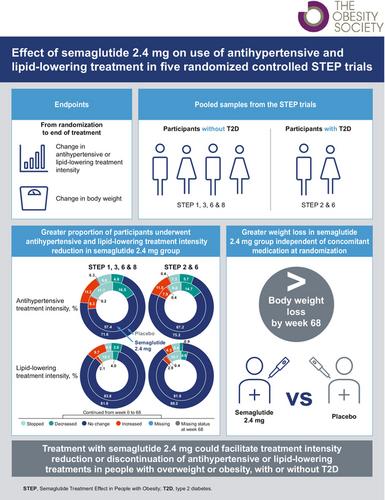
The objective of this study was to assess antihypertensive and lipid-lowering treatment changes in participants receiving semaglutide 2.4 mg versus placebo across pooled populations from five Semaglutide Treatment Effect in People with Obesity (STEP) trials.
Methods
Efficacy and safety of semaglutide 2.4 mg were evaluated in the STEP clinical trials. In this post hoc analysis, STEP 1, 3, 6, and 8 (which included people with overweight or obesity) and, separately, STEP 2 and 6 (which included people with overweight or obesity and type 2 diabetes) were pooled for analysis. Changes in antihypertensive or lipid-lowering treatment intensity from randomization to end of treatment were evaluated.
Results
In both pooled samples, a higher proportion of participants in the semaglutide 2.4 mg group versus placebo underwent antihypertensive or lipid-lowering treatment intensity reduction by end of treatment. A smaller proportion underwent antihypertensive or lipid-lowering treatment intensification by end of treatment in the semaglutide 2.4 mg group of both samples versus placebo. In participants receiving antihypertensive or lipid-lowering medications in both samples, greater numeric reductions in body weight were observed in the semaglutide 2.4 mg group versus placebo.
Conclusions
These results support a relationship between semaglutide 2.4 mg treatment of overweight and obesity and reduced need for antihypertensive and lipid-lowering treatment, facilitating treatment intensity reduction/discontinuation and abating treatment intensification.
期刊介绍:
Obesity is the official journal of The Obesity Society and is the premier source of information for increasing knowledge, fostering translational research from basic to population science, and promoting better treatment for people with obesity. Obesity publishes important peer-reviewed research and cutting-edge reviews, commentaries, and public health and medical developments.



 京公网安备 11010802042870号
京ICP备2023020795号-1
京公网安备 11010802042870号
京ICP备2023020795号-1

 分享
分享
 求助内容:
求助内容: 应助结果提醒方式:
 扫码关注我们
