Multidimensional analysis of the flavor characteristics of yellow peach at different ripening stages: Chemical composition profiling and sensory evaluation
Huayu Liu , Minghao Zhang , Mingshen Su , Wenfang Zeng , Shouchuang Wang , Jihong Du , Huijuan Zhou , Xiaofeng Yang , Xianan Zhang , Xiongwei Li , Zhengwen Ye
{"title":"Multidimensional analysis of the flavor characteristics of yellow peach at different ripening stages: Chemical composition profiling and sensory evaluation","authors":"Huayu Liu , Minghao Zhang , Mingshen Su , Wenfang Zeng , Shouchuang Wang , Jihong Du , Huijuan Zhou , Xiaofeng Yang , Xianan Zhang , Xiongwei Li , Zhengwen Ye","doi":"10.1016/j.foodchem.2025.142772","DOIUrl":null,"url":null,"abstract":"<div><div>The flavor evolution of yellow peaches during ripening was investigated using a gas chromatography-mass spectrometer (GC–MS), metabolomics, and electronic sensoristic techniques. Of the 41 volatiles quantified, 13 increased the intensity of the aroma based on the odor activity values (OAVs). Additionally, 142 non-volatile compounds were identified. Metabolic pathway analysis indicated that the formation of xanthophyll esters, due to substrate competition, resulted in a reduction of carotenoid-derived volatiles. Electronic nose (E-nose) analysis revealed that the key sensor W1C-associated volatiles had a green aroma, while W1S and W2S-associated volatiles showed a fruity aroma. Electronic tongue (E-tongue) analysis revealed that L-norleucine, L-isoleucine, isoleucine, L-tyrosine, L-valine, 4-Hydroxybenzaldehyde, cinnamic acid, and rutin positively correlated with umami and sweetness. Conversely, <em>cis</em>-aconitic acid and (−)-epigallocatechin positively correlated with sourness or astringency. Moreover, 20 volatiles, including γ-decalactone, linalool, and (Z)-3-hexenyl acetate, were positively correlated with umami or sweetness, while 7 volatiles were positively correlated with sourness or astringency.</div></div>","PeriodicalId":318,"journal":{"name":"Food Chemistry","volume":"471 ","pages":"Article 142772"},"PeriodicalIF":9.8000,"publicationDate":"2025-04-15","publicationTypes":"Journal Article","fieldsOfStudy":null,"isOpenAccess":false,"openAccessPdf":"","citationCount":"0","resultStr":null,"platform":"Semanticscholar","paperid":null,"PeriodicalName":"Food Chemistry","FirstCategoryId":"97","ListUrlMain":"https://www.sciencedirect.com/science/article/pii/S0308814625000226","RegionNum":1,"RegionCategory":"农林科学","ArticlePicture":[],"TitleCN":null,"AbstractTextCN":null,"PMCID":null,"EPubDate":"2025/1/7 0:00:00","PubModel":"Epub","JCR":"Q1","JCRName":"CHEMISTRY, APPLIED","Score":null,"Total":0}
引用次数: 0
Abstract
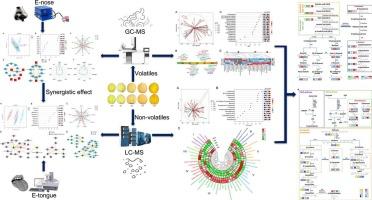
The flavor evolution of yellow peaches during ripening was investigated using a gas chromatography-mass spectrometer (GC–MS), metabolomics, and electronic sensoristic techniques. Of the 41 volatiles quantified, 13 increased the intensity of the aroma based on the odor activity values (OAVs). Additionally, 142 non-volatile compounds were identified. Metabolic pathway analysis indicated that the formation of xanthophyll esters, due to substrate competition, resulted in a reduction of carotenoid-derived volatiles. Electronic nose (E-nose) analysis revealed that the key sensor W1C-associated volatiles had a green aroma, while W1S and W2S-associated volatiles showed a fruity aroma. Electronic tongue (E-tongue) analysis revealed that L-norleucine, L-isoleucine, isoleucine, L-tyrosine, L-valine, 4-Hydroxybenzaldehyde, cinnamic acid, and rutin positively correlated with umami and sweetness. Conversely, cis-aconitic acid and (−)-epigallocatechin positively correlated with sourness or astringency. Moreover, 20 volatiles, including γ-decalactone, linalool, and (Z)-3-hexenyl acetate, were positively correlated with umami or sweetness, while 7 volatiles were positively correlated with sourness or astringency.
期刊介绍:
Food Chemistry publishes original research papers dealing with the advancement of the chemistry and biochemistry of foods or the analytical methods/ approach used. All papers should focus on the novelty of the research carried out.




 京公网安备 11010802042870号
京ICP备2023020795号-1
京公网安备 11010802042870号
京ICP备2023020795号-1

 分享
分享
 求助内容:
求助内容: 应助结果提醒方式:
 扫码关注我们
