Jing-Zan Zhang , Lin Zhang , Xin Ding , Min Wu , De-Jie Zhang , Yujie Wu , Mingyao Liu , Chen-Chen Li , Zhengfang Yi , Wen-Wei Qiu
{"title":"Design, synthesis and biological evaluation of bisnoralcohol derivatives as novel IRF4 inhibitors for the treatment of multiple myeloma","authors":"Jing-Zan Zhang , Lin Zhang , Xin Ding , Min Wu , De-Jie Zhang , Yujie Wu , Mingyao Liu , Chen-Chen Li , Zhengfang Yi , Wen-Wei Qiu","doi":"10.1016/j.ejmech.2025.117240","DOIUrl":null,"url":null,"abstract":"<div><div>Interferon regulatory factor 4 (IRF4) is specifically overexpressed in multiple myeloma (MM) and mediates MM progression and survival, making it an emerging target for MM treatment. However, no chemical entity with a defined structure capable of directly binding to and inhibiting IRF4 has been reported. We screened our small library of steroid analogs and identified bisnoralcohol (BA) derivative <strong>18</strong> as a novel hit compound capable of inhibiting IRF4, with an IC<sub>50</sub> of 13.46 μM. Based on <strong>18</strong>, a series of BA derivatives was synthesized and evaluated for their inhibitory effects on IRF4 and antiproliferative activities against MM cell lines. Among these compounds, <strong>41</strong> (<strong>SH514</strong>) exhibited the highest potency, with an IC<sub>50</sub> value of 2.63 μM for inhibiting IRF4, and IC<sub>50</sub> values of 0.08 μM and 0.11 μM for inhibiting the proliferation of IRF4-high-expressing NCI–H929 and MM.1R MM cells, respectively. <strong>SH514</strong> can bind to the IRF4-DBD domain with a KD of 1.28 μM. <strong>SH514</strong> selectively and potently inhibits IRF4-high-expressing MM cells over IRF4-low-expressing MM cells. Mechanistic studies demonstrated that <strong>SH514</strong> suppresses the downstream genes of IRF4, including CCNC, CANX, E2F5, CMYC, HK2, and Blimp1, and inhibited the expression of cell cycle-related proteins CDC2, Cyclin B1, Cyclin D1, Cyclin E1, and CMYC in MM cells. <em>In vivo</em>, <strong>SH514</strong> effectively inhibited the proliferation of MM tumors, showing much better antitumor efficacy than the clinical drug lenalidomide, and exhibited no significant toxicity. Thus, these IRF4 inhibitors could serve as promising leads for the development of novel anti-multiple myeloma agents.</div></div>","PeriodicalId":314,"journal":{"name":"European Journal of Medicinal Chemistry","volume":"285 ","pages":"Article 117240"},"PeriodicalIF":5.9000,"publicationDate":"2025-01-06","publicationTypes":"Journal Article","fieldsOfStudy":null,"isOpenAccess":false,"openAccessPdf":"","citationCount":"0","resultStr":null,"platform":"Semanticscholar","paperid":null,"PeriodicalName":"European Journal of Medicinal Chemistry","FirstCategoryId":"3","ListUrlMain":"https://www.sciencedirect.com/science/article/pii/S0223523425000054","RegionNum":2,"RegionCategory":"医学","ArticlePicture":[],"TitleCN":null,"AbstractTextCN":null,"PMCID":null,"EPubDate":"","PubModel":"","JCR":"Q1","JCRName":"CHEMISTRY, MEDICINAL","Score":null,"Total":0}
引用次数: 0
Abstract
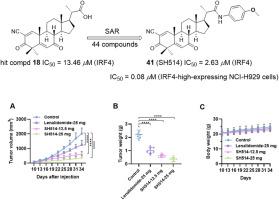
Interferon regulatory factor 4 (IRF4) is specifically overexpressed in multiple myeloma (MM) and mediates MM progression and survival, making it an emerging target for MM treatment. However, no chemical entity with a defined structure capable of directly binding to and inhibiting IRF4 has been reported. We screened our small library of steroid analogs and identified bisnoralcohol (BA) derivative 18 as a novel hit compound capable of inhibiting IRF4, with an IC50 of 13.46 μM. Based on 18, a series of BA derivatives was synthesized and evaluated for their inhibitory effects on IRF4 and antiproliferative activities against MM cell lines. Among these compounds, 41 (SH514) exhibited the highest potency, with an IC50 value of 2.63 μM for inhibiting IRF4, and IC50 values of 0.08 μM and 0.11 μM for inhibiting the proliferation of IRF4-high-expressing NCI–H929 and MM.1R MM cells, respectively. SH514 can bind to the IRF4-DBD domain with a KD of 1.28 μM. SH514 selectively and potently inhibits IRF4-high-expressing MM cells over IRF4-low-expressing MM cells. Mechanistic studies demonstrated that SH514 suppresses the downstream genes of IRF4, including CCNC, CANX, E2F5, CMYC, HK2, and Blimp1, and inhibited the expression of cell cycle-related proteins CDC2, Cyclin B1, Cyclin D1, Cyclin E1, and CMYC in MM cells. In vivo, SH514 effectively inhibited the proliferation of MM tumors, showing much better antitumor efficacy than the clinical drug lenalidomide, and exhibited no significant toxicity. Thus, these IRF4 inhibitors could serve as promising leads for the development of novel anti-multiple myeloma agents.
期刊介绍:
The European Journal of Medicinal Chemistry is a global journal that publishes studies on all aspects of medicinal chemistry. It provides a medium for publication of original papers and also welcomes critical review papers.
A typical paper would report on the organic synthesis, characterization and pharmacological evaluation of compounds. Other topics of interest are drug design, QSAR, molecular modeling, drug-receptor interactions, molecular aspects of drug metabolism, prodrug synthesis and drug targeting. The journal expects manuscripts to present the rational for a study, provide insight into the design of compounds or understanding of mechanism, or clarify the targets.




 京公网安备 11010802042870号
京ICP备2023020795号-1
京公网安备 11010802042870号
京ICP备2023020795号-1

 分享
分享
 求助内容:
求助内容: 应助结果提醒方式:
 扫码关注我们
