Jan Budaj, Klaus Bernhard, David Jones, James Munday
{"title":"A swarm of dusty objects in orbit around the central star of planetary nebula WeSb 1","authors":"Jan Budaj, Klaus Bernhard, David Jones, James Munday","doi":"10.1038/s41550-024-02446-x","DOIUrl":null,"url":null,"abstract":"Exoplanets and smaller bodies have been detected orbiting different kind of stars. However, we do not know of any such objects in planetary nebulae, the short-lived stage of stellar evolution between the asymptotic giant branch and white dwarf phases. The planetary activity (destruction and formation) may be accompanied by dust clouds. Hence, we searched for dust occultation events in planetary nebulae using archival photometric data. We show that the central star of PN WeSb 1 features numerous dimming events with typical durations of a few days to weeks that are up to 3 mag deep. This variability is mainly stochastic with an indication of a 400 d period. The occultations are almost grey, indicating dust grains larger than about 0.1 μm. Based on our follow-up observations, we argue that the central star is a wide binary and that these events are most probably caused by debris from disintegrated small rocky bodies that escaped from the former asymptotic giant branch star to find safe harbour around the companion star. The latter star dominates the optical spectrum enabling us to see the eclipses. This means that planetary systems are present and undergo violent evolution during the planetary nebula stage. Numerous eclipses have been observed towards the binary central star of planetary nebula WeSb 1, probably caused by debris from disintegrated rocky bodies. This finding suggests that planetary systems undergo a violent evolution during the planetary nebula stage.","PeriodicalId":18778,"journal":{"name":"Nature Astronomy","volume":"9 3","pages":"380-392"},"PeriodicalIF":14.3000,"publicationDate":"2025-01-08","publicationTypes":"Journal Article","fieldsOfStudy":null,"isOpenAccess":false,"openAccessPdf":"","citationCount":"0","resultStr":null,"platform":"Semanticscholar","paperid":null,"PeriodicalName":"Nature Astronomy","FirstCategoryId":"101","ListUrlMain":"https://www.nature.com/articles/s41550-024-02446-x","RegionNum":1,"RegionCategory":"物理与天体物理","ArticlePicture":[],"TitleCN":null,"AbstractTextCN":null,"PMCID":null,"EPubDate":"","PubModel":"","JCR":"Q1","JCRName":"ASTRONOMY & ASTROPHYSICS","Score":null,"Total":0}
引用次数: 0
Abstract
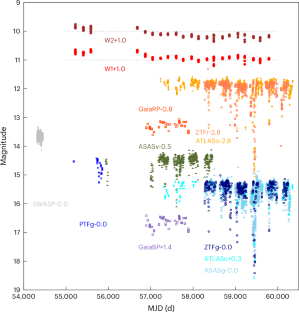
Exoplanets and smaller bodies have been detected orbiting different kind of stars. However, we do not know of any such objects in planetary nebulae, the short-lived stage of stellar evolution between the asymptotic giant branch and white dwarf phases. The planetary activity (destruction and formation) may be accompanied by dust clouds. Hence, we searched for dust occultation events in planetary nebulae using archival photometric data. We show that the central star of PN WeSb 1 features numerous dimming events with typical durations of a few days to weeks that are up to 3 mag deep. This variability is mainly stochastic with an indication of a 400 d period. The occultations are almost grey, indicating dust grains larger than about 0.1 μm. Based on our follow-up observations, we argue that the central star is a wide binary and that these events are most probably caused by debris from disintegrated small rocky bodies that escaped from the former asymptotic giant branch star to find safe harbour around the companion star. The latter star dominates the optical spectrum enabling us to see the eclipses. This means that planetary systems are present and undergo violent evolution during the planetary nebula stage. Numerous eclipses have been observed towards the binary central star of planetary nebula WeSb 1, probably caused by debris from disintegrated rocky bodies. This finding suggests that planetary systems undergo a violent evolution during the planetary nebula stage.
Nature AstronomyPhysics and Astronomy-Astronomy and Astrophysics
CiteScore
19.50
自引率
2.80%
发文量
252
期刊介绍:
Nature Astronomy, the oldest science, has played a significant role in the history of Nature. Throughout the years, pioneering discoveries such as the first quasar, exoplanet, and understanding of spiral nebulae have been reported in the journal. With the introduction of Nature Astronomy, the field now receives expanded coverage, welcoming research in astronomy, astrophysics, and planetary science. The primary objective is to encourage closer collaboration among researchers in these related areas.
Similar to other journals under the Nature brand, Nature Astronomy boasts a devoted team of professional editors, ensuring fairness and rigorous peer-review processes. The journal maintains high standards in copy-editing and production, ensuring timely publication and editorial independence.
In addition to original research, Nature Astronomy publishes a wide range of content, including Comments, Reviews, News and Views, Features, and Correspondence. This diverse collection covers various disciplines within astronomy and includes contributions from a diverse range of voices.




 京公网安备 11010802042870号
京ICP备2023020795号-1
京公网安备 11010802042870号
京ICP备2023020795号-1

 分享
分享
 求助内容:
求助内容: 应助结果提醒方式:
 扫码关注我们
