{"title":"A Survey on Intelligent Network Operations and Performance Optimization Based on Large Language Models","authors":"Sifan Long;Jingjing Tan;Bomin Mao;Fengxiao Tang;Yangfan Li;Ming Zhao;Nei Kato","doi":"10.1109/COMST.2025.3526606","DOIUrl":null,"url":null,"abstract":"As Large Language Models (LLMs) have achieved significant success in handling multi-modal tasks such as text, images, videos, and sounds, particularly showcasing emergent capabilities in natural language tasks, they hold great potential for network operations that similarly involve vast amounts of text data, fault data, and log files. This paper focuses on the development of LLMs, detailing their fundamental principles and application scenarios across different domains. It highlights the remarkable capabilities of LLMs in tasks such as fault diagnosis, causal inference, and intelligent question answering, and applies these abilities to the field of network operations. Moreover, the paper reviews some of the key issues and technical barriers faced by intelligent networks, such as efficiently monitoring networks in real-time and providing timely alerts when necessary. In addition to examining the utilization of LLM in network operations, this paper introduces a framework for intelligent network operations and performance optimization, leveraging LLM. The objective of this framework is to bolster network robustness and furnish users with exceptional, personalized network services. Ultimately, we conclude by delineating the challenges encountered in LLM-based intelligent network operations and performance optimization, while presenting potential solutions to overcome these hurdles and propel the comprehensive deployment of LLM-driven network intelligence.","PeriodicalId":55029,"journal":{"name":"IEEE Communications Surveys and Tutorials","volume":"27 6","pages":"3915-3949"},"PeriodicalIF":34.4000,"publicationDate":"2025-01-07","publicationTypes":"Journal Article","fieldsOfStudy":null,"isOpenAccess":false,"openAccessPdf":"","citationCount":"0","resultStr":null,"platform":"Semanticscholar","paperid":null,"PeriodicalName":"IEEE Communications Surveys and Tutorials","FirstCategoryId":"94","ListUrlMain":"https://ieeexplore.ieee.org/document/10829820/","RegionNum":1,"RegionCategory":"计算机科学","ArticlePicture":[],"TitleCN":null,"AbstractTextCN":null,"PMCID":null,"EPubDate":"","PubModel":"","JCR":"Q1","JCRName":"COMPUTER SCIENCE, INFORMATION SYSTEMS","Score":null,"Total":0}
引用次数: 0
Abstract
As Large Language Models (LLMs) have achieved significant success in handling multi-modal tasks such as text, images, videos, and sounds, particularly showcasing emergent capabilities in natural language tasks, they hold great potential for network operations that similarly involve vast amounts of text data, fault data, and log files. This paper focuses on the development of LLMs, detailing their fundamental principles and application scenarios across different domains. It highlights the remarkable capabilities of LLMs in tasks such as fault diagnosis, causal inference, and intelligent question answering, and applies these abilities to the field of network operations. Moreover, the paper reviews some of the key issues and technical barriers faced by intelligent networks, such as efficiently monitoring networks in real-time and providing timely alerts when necessary. In addition to examining the utilization of LLM in network operations, this paper introduces a framework for intelligent network operations and performance optimization, leveraging LLM. The objective of this framework is to bolster network robustness and furnish users with exceptional, personalized network services. Ultimately, we conclude by delineating the challenges encountered in LLM-based intelligent network operations and performance optimization, while presenting potential solutions to overcome these hurdles and propel the comprehensive deployment of LLM-driven network intelligence.
期刊介绍:
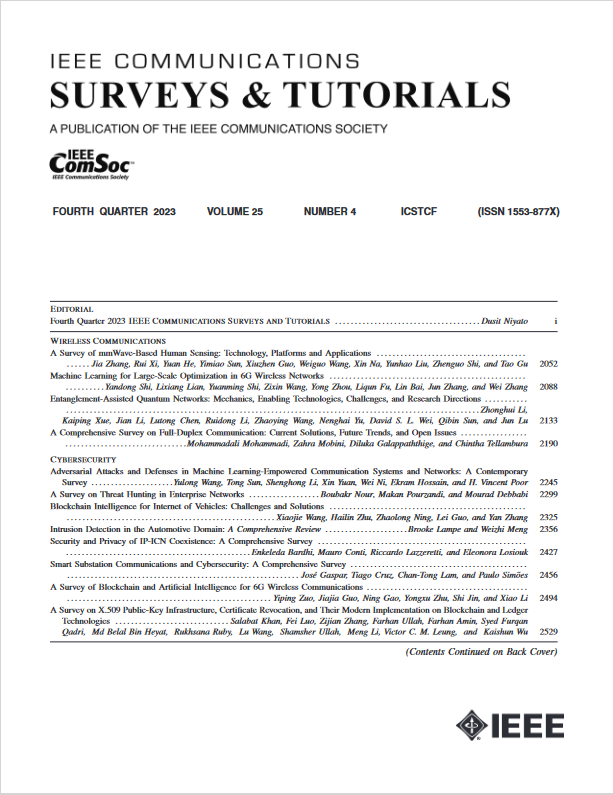
IEEE Communications Surveys & Tutorials is an online journal published by the IEEE Communications Society for tutorials and surveys covering all aspects of the communications field. Telecommunications technology is progressing at a rapid pace, and the IEEE Communications Society is committed to providing researchers and other professionals the information and tools to stay abreast. IEEE Communications Surveys and Tutorials focuses on integrating and adding understanding to the existing literature on communications, putting results in context. Whether searching for in-depth information about a familiar area or an introduction into a new area, IEEE Communications Surveys & Tutorials aims to be the premier source of peer-reviewed, comprehensive tutorials and surveys, and pointers to further sources. IEEE Communications Surveys & Tutorials publishes only articles exclusively written for IEEE Communications Surveys & Tutorials and go through a rigorous review process before their publication in the quarterly issues.
A tutorial article in the IEEE Communications Surveys & Tutorials should be designed to help the reader to become familiar with and learn something specific about a chosen topic. In contrast, the term survey, as applied here, is defined to mean a survey of the literature. A survey article in IEEE Communications Surveys & Tutorials should provide a comprehensive review of developments in a selected area, covering its development from its inception to its current state and beyond, and illustrating its development through liberal citations from the literature. Both tutorials and surveys should be tutorial in nature and should be written in a style comprehensible to readers outside the specialty of the article.



 京公网安备 11010802042870号
京ICP备2023020795号-1
京公网安备 11010802042870号
京ICP备2023020795号-1

 分享
分享
 求助内容:
求助内容: 应助结果提醒方式:
 扫码关注我们
