Jannik Mehmel, Carlos M. Jimenez-Muñoz, Filip Rivic, Vera Krewald and Rolf Schäfer
{"title":"Magnetism of transition-metal-doped tetrel nanoclusters: multi-reference character and spin–orbit effects in Sn12TM (TM = Cr, Mn, Fe)†","authors":"Jannik Mehmel, Carlos M. Jimenez-Muñoz, Filip Rivic, Vera Krewald and Rolf Schäfer","doi":"10.1039/D4NR03920C","DOIUrl":null,"url":null,"abstract":"<p >The magnetic behavior of endohedrally transition-metal-doped tetrel clusters Sn<small><sub>12</sub></small>TM (TM = Cr, Mn, Fe) was investigated using a combined experimental and theoretical approach. Based on an improved experimental setup, the magnetic deflection was measured over a wide temperature range of <em>T</em><small><sub>nozzle</sub></small> = 16–240 K. From a Curie analysis of the experimentally observed single-sided shift at high nozzle temperatures, the spin multiplicities and <em>g</em>-factors were determined. It was observed that all three nanoclusters analyzed are paramagnetic, with Sn<small><sub>12</sub></small>Mn being a sextet with <em>g</em> = 2.1 ± 0.1, while Sn<small><sub>12</sub></small>Cr is a quintet with the same <em>g</em>-factor and Sn<small><sub>12</sub></small>Fe is also a quintet but with a higher <em>g</em>-factor of 2.4 ± 0.1. In order to better understand the interplay between geometric and electronic structures and their influence on magnetism, a global geometry optimization was carried out, followed by a quantum-chemical analysis of the electronic structure using density functional theory (DFT) and wavefunction methods. The multi-reference calculations proved particularly important for Sn<small><sub>12</sub></small>Fe because DFT fails to correctly predict the value of the <em>g</em>-factor. To describe the electronic ground state of Sn<small><sub>12</sub></small>Fe, two reference configurations must be taken into account. A charge transfer from the Sn ligands to Fe manifests in very low-lying electronic excitations. These charge transfer excitations lead to a significant increase in the <em>g</em>-factor compared to the value of the free electron due to the large spin–orbit coupling constant of Sn. As a result, in contrast to Sn<small><sub>12</sub></small>Mn and Sn<small><sub>12</sub></small>Cr, the spin density of Sn<small><sub>12</sub></small>Fe is strongly delocalized over the entire cluster framework.</p>","PeriodicalId":92,"journal":{"name":"Nanoscale","volume":" 7","pages":" 3849-3860"},"PeriodicalIF":5.1000,"publicationDate":"2025-01-08","publicationTypes":"Journal Article","fieldsOfStudy":null,"isOpenAccess":false,"openAccessPdf":"","citationCount":"0","resultStr":null,"platform":"Semanticscholar","paperid":null,"PeriodicalName":"Nanoscale","FirstCategoryId":"88","ListUrlMain":"https://pubs.rsc.org/en/content/articlelanding/2025/nr/d4nr03920c","RegionNum":3,"RegionCategory":"材料科学","ArticlePicture":[],"TitleCN":null,"AbstractTextCN":null,"PMCID":null,"EPubDate":"","PubModel":"","JCR":"Q1","JCRName":"CHEMISTRY, MULTIDISCIPLINARY","Score":null,"Total":0}
引用次数: 0
Abstract
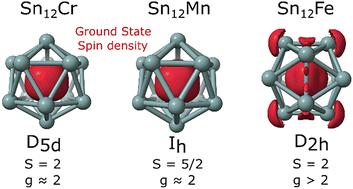
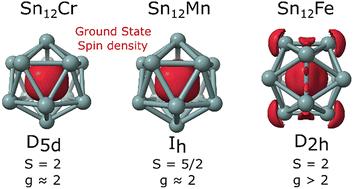
The magnetic behavior of endohedrally transition-metal-doped tetrel clusters Sn12TM (TM = Cr, Mn, Fe) was investigated using a combined experimental and theoretical approach. Based on an improved experimental setup, the magnetic deflection was measured over a wide temperature range of Tnozzle = 16–240 K. From a Curie analysis of the experimentally observed single-sided shift at high nozzle temperatures, the spin multiplicities and g-factors were determined. It was observed that all three nanoclusters analyzed are paramagnetic, with Sn12Mn being a sextet with g = 2.1 ± 0.1, while Sn12Cr is a quintet with the same g-factor and Sn12Fe is also a quintet but with a higher g-factor of 2.4 ± 0.1. In order to better understand the interplay between geometric and electronic structures and their influence on magnetism, a global geometry optimization was carried out, followed by a quantum-chemical analysis of the electronic structure using density functional theory (DFT) and wavefunction methods. The multi-reference calculations proved particularly important for Sn12Fe because DFT fails to correctly predict the value of the g-factor. To describe the electronic ground state of Sn12Fe, two reference configurations must be taken into account. A charge transfer from the Sn ligands to Fe manifests in very low-lying electronic excitations. These charge transfer excitations lead to a significant increase in the g-factor compared to the value of the free electron due to the large spin–orbit coupling constant of Sn. As a result, in contrast to Sn12Mn and Sn12Cr, the spin density of Sn12Fe is strongly delocalized over the entire cluster framework.
期刊介绍:
Nanoscale is a high-impact international journal, publishing high-quality research across nanoscience and nanotechnology. Nanoscale publishes a full mix of research articles on experimental and theoretical work, including reviews, communications, and full papers.Highly interdisciplinary, this journal appeals to scientists, researchers and professionals interested in nanoscience and nanotechnology, quantum materials and quantum technology, including the areas of physics, chemistry, biology, medicine, materials, energy/environment, information technology, detection science, healthcare and drug discovery, and electronics.




 京公网安备 11010802042870号
京ICP备2023020795号-1
京公网安备 11010802042870号
京ICP备2023020795号-1

 分享
分享
 求助内容:
求助内容: 应助结果提醒方式:
 扫码关注我们
