{"title":"S100P is a ferroptosis suppressor to facilitate hepatocellular carcinoma development by rewiring lipid metabolism","authors":"Min Yang, Weiwei Cui, Xiaoting Lv, Gaozhong Xiong, Caiyu Sun, Haocheng Xuan, Wei Ma, Xiuling Cui, Yeping Cheng, Lihui Han, Bo Chu","doi":"10.1038/s41467-024-55785-8","DOIUrl":null,"url":null,"abstract":"<p>Ferroptosis is a newly identified programmed cell death induced by iron-driven lipid peroxidation and implicated as a potential approach for tumor treatment. However, emerging evidence indicates that hepatocellular carcinoma (HCC) cells are generally resistant to ferroptosis and the underlying molecular mechanism is poorly understood. Here, our study confirms that S100 calcium binding protein P (S100P), which is significantly up-regulated in ferroptosis-resistant HCC cells, efficiently inhibits ferroptosis. Mechanistically, S100P facilitates lysosomal degradation of acetyl-CoA carboxylase alpha (ACC1), which is indispensable for de novo biosynthesis of lipids. Loss of S100P elevates the expression of ACC1 and promotes ferroptotic sensitivity of HCC cells. S100P-mediated ACC1 degradation relies on RAB5C, which directs ACC1 to lysosome via P62-dependent selective autophagy. Knockdown of <i>RAB5C</i> or <i>P62</i> abrogates S100P-induced lysosomal degradation of ACC1 and restores resistance of HCC cells to ferroptosis. Our work reveals an alternative anti-ferroptosis pathway and suggests S100P as a promising druggable target for ferroptosis-related therapy of HCC.</p>","PeriodicalId":19066,"journal":{"name":"Nature Communications","volume":"23 1","pages":""},"PeriodicalIF":15.7000,"publicationDate":"2025-01-08","publicationTypes":"Journal Article","fieldsOfStudy":null,"isOpenAccess":false,"openAccessPdf":"","citationCount":"0","resultStr":null,"platform":"Semanticscholar","paperid":null,"PeriodicalName":"Nature Communications","FirstCategoryId":"103","ListUrlMain":"https://doi.org/10.1038/s41467-024-55785-8","RegionNum":1,"RegionCategory":"综合性期刊","ArticlePicture":[],"TitleCN":null,"AbstractTextCN":null,"PMCID":null,"EPubDate":"","PubModel":"","JCR":"Q1","JCRName":"MULTIDISCIPLINARY SCIENCES","Score":null,"Total":0}
引用次数: 0
Abstract
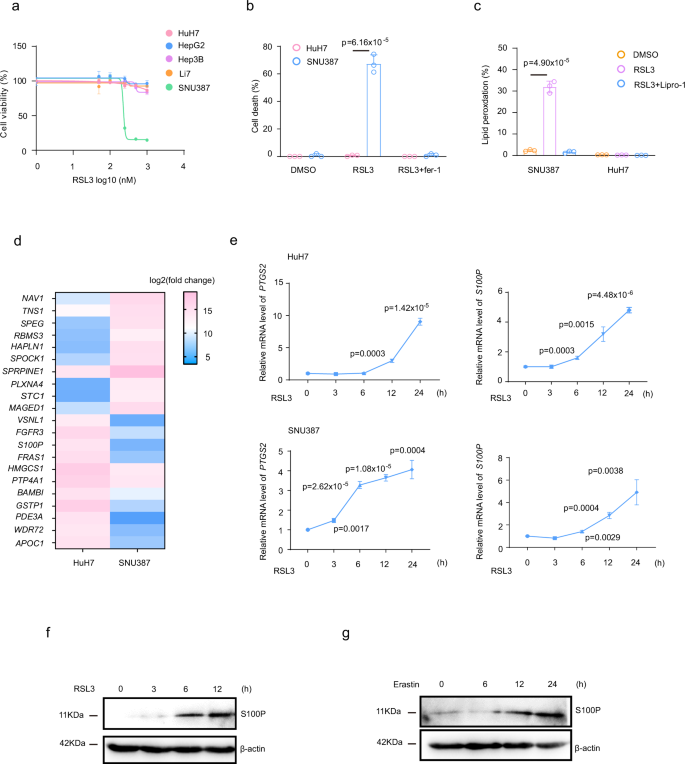
Ferroptosis is a newly identified programmed cell death induced by iron-driven lipid peroxidation and implicated as a potential approach for tumor treatment. However, emerging evidence indicates that hepatocellular carcinoma (HCC) cells are generally resistant to ferroptosis and the underlying molecular mechanism is poorly understood. Here, our study confirms that S100 calcium binding protein P (S100P), which is significantly up-regulated in ferroptosis-resistant HCC cells, efficiently inhibits ferroptosis. Mechanistically, S100P facilitates lysosomal degradation of acetyl-CoA carboxylase alpha (ACC1), which is indispensable for de novo biosynthesis of lipids. Loss of S100P elevates the expression of ACC1 and promotes ferroptotic sensitivity of HCC cells. S100P-mediated ACC1 degradation relies on RAB5C, which directs ACC1 to lysosome via P62-dependent selective autophagy. Knockdown of RAB5C or P62 abrogates S100P-induced lysosomal degradation of ACC1 and restores resistance of HCC cells to ferroptosis. Our work reveals an alternative anti-ferroptosis pathway and suggests S100P as a promising druggable target for ferroptosis-related therapy of HCC.
期刊介绍:
Nature Communications, an open-access journal, publishes high-quality research spanning all areas of the natural sciences. Papers featured in the journal showcase significant advances relevant to specialists in each respective field. With a 2-year impact factor of 16.6 (2022) and a median time of 8 days from submission to the first editorial decision, Nature Communications is committed to rapid dissemination of research findings. As a multidisciplinary journal, it welcomes contributions from biological, health, physical, chemical, Earth, social, mathematical, applied, and engineering sciences, aiming to highlight important breakthroughs within each domain.



 京公网安备 11010802042870号
京ICP备2023020795号-1
京公网安备 11010802042870号
京ICP备2023020795号-1

 分享
分享
 求助内容:
求助内容: 应助结果提醒方式:
 扫码关注我们
