Philipp Martschin , Timo Prölß , Andreas Hutzler , Simon Thiele , Jochen Kerres
{"title":"Preparation of a new class of phosphonated hydrocarbon polymers based on polysulfone†","authors":"Philipp Martschin , Timo Prölß , Andreas Hutzler , Simon Thiele , Jochen Kerres","doi":"10.1039/d4py01289e","DOIUrl":null,"url":null,"abstract":"<div><div>The membrane is the heart of an electrochemical cell. Nowadays, PFSA-based materials, <em>e.g.</em>, Nafion®, are state-of-the-art in large-scale energy applications. However, PFSAs are relatively expensive and give rise to concerns regarding toxic intermediates in the production process. Moreover, their recyclability and their biodegradability are questionable. Thus, there is a strong need to develop alternative materials with comparable or better properties. This study presents a new class of phosphonated hydrocarbon polymers based on commercially available polysulfone Udel (PSU) synthesized by a lithiation reaction. The modified PSUs were subsequently phosphonated by a Michaelis–Arbuzov reaction. All synthesized polymers/ionomers were further characterized by NMR, DSC, TGA, GPC, TEM, and titration. Moreover, the first blend membranes could be produced out of the new class of PSU derivatives. In summary, four different polymers were synthesized, of which three were successfully phosphonated. Starting from the phosphonated species, three different acid-acid blend membranes were manufactured with sufficient ionic conductivity. These novel phosphonic acid group-containing materials are promising candidates for membranes or ionomers in electrochemical applications, like (HT)-PEMFCs, (HT)-PEMWEs, or redox flow batteries.</div></div>","PeriodicalId":100,"journal":{"name":"Polymer Chemistry","volume":"16 7","pages":"Pages 879-890"},"PeriodicalIF":3.9000,"publicationDate":"2024-12-24","publicationTypes":"Journal Article","fieldsOfStudy":null,"isOpenAccess":false,"openAccessPdf":"","citationCount":"0","resultStr":null,"platform":"Semanticscholar","paperid":null,"PeriodicalName":"Polymer Chemistry","FirstCategoryId":"92","ListUrlMain":"https://www.sciencedirect.com/org/science/article/pii/S1759995425000178","RegionNum":2,"RegionCategory":"化学","ArticlePicture":[],"TitleCN":null,"AbstractTextCN":null,"PMCID":null,"EPubDate":"","PubModel":"","JCR":"Q2","JCRName":"POLYMER SCIENCE","Score":null,"Total":0}
引用次数: 0
Abstract
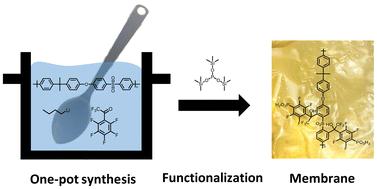
The membrane is the heart of an electrochemical cell. Nowadays, PFSA-based materials, e.g., Nafion®, are state-of-the-art in large-scale energy applications. However, PFSAs are relatively expensive and give rise to concerns regarding toxic intermediates in the production process. Moreover, their recyclability and their biodegradability are questionable. Thus, there is a strong need to develop alternative materials with comparable or better properties. This study presents a new class of phosphonated hydrocarbon polymers based on commercially available polysulfone Udel (PSU) synthesized by a lithiation reaction. The modified PSUs were subsequently phosphonated by a Michaelis–Arbuzov reaction. All synthesized polymers/ionomers were further characterized by NMR, DSC, TGA, GPC, TEM, and titration. Moreover, the first blend membranes could be produced out of the new class of PSU derivatives. In summary, four different polymers were synthesized, of which three were successfully phosphonated. Starting from the phosphonated species, three different acid-acid blend membranes were manufactured with sufficient ionic conductivity. These novel phosphonic acid group-containing materials are promising candidates for membranes or ionomers in electrochemical applications, like (HT)-PEMFCs, (HT)-PEMWEs, or redox flow batteries.
期刊介绍:
Polymer Chemistry welcomes submissions in all areas of polymer science that have a strong focus on macromolecular chemistry. Manuscripts may cover a broad range of fields, yet no direct application focus is required.



 京公网安备 11010802042870号
京ICP备2023020795号-1
京公网安备 11010802042870号
京ICP备2023020795号-1

 分享
分享
 求助内容:
求助内容: 应助结果提醒方式:
 扫码关注我们
