{"title":"MUL-VR: Multi-UAV Collaborative Layered Visual Perception and Transmission for Virtual Reality","authors":"Xiao-Wei Tang;Yi Huang;Yunmei Shi;Qingqing Wu","doi":"10.1109/TWC.2024.3524275","DOIUrl":null,"url":null,"abstract":"Nowadays, unmanned aerial vehicles (UAVs) are deployed to perceive high-definition visuals of ground targets (GTs) for environment reconstruction of virtual reality (VR) by leveraging their high flexibility. Inspired by the classic scalable video coding method, we develop a novel multi-UAV collaborative layered visual perception and transmission scheme for VR named MUL-VR, wherein GTs are divided into multiple overlapped clusters and multiple UAVs are deployed to collaboratively perceive visuals from these clusters. Specifically, our proposed formulation entails maximizing user’s quality of experience (QoE) by optimizing cluster radii, UAV horizontal coordinates, and bandwidth allocation strategy subject to the constraints on visual quality, transmission delay and available bandwidth. To address this issue, we formulate the investigated MUL-VR scheme into an intractable optimization problem, which, however, is difficult to solve due to the non-convexity of the objective function and constraints, as well as the intricate coupling of the variables. To tackle this challenging problem, we first propose an efficient alternating algorithm, which decomposes the original optimization problem into three subproblems, and then derive the optimal closed-form solution to each subproblem. Consequently, the final solution can be obtained by iteratively optimizing the variables associated with each subproblem, while holding the variables in the other two subproblems fixed, until the convergence condition is satisfied. Simulation results demonstrate that the proposed scheme can effectively improve the user’s QoE and enhance the robustness of the system, yielding superior performance compared to other benchmarks. Specifically, compared to the classic K-Means based scheme, the proposed scheme offers a 25.9% enhancement in terms of QoE when the preference coefficient <inline-formula> <tex-math>$\\varepsilon = 0.1$ </tex-math></inline-formula> and such performance gain progressively expands as <inline-formula> <tex-math>$\\varepsilon $ </tex-math></inline-formula> increases.","PeriodicalId":13431,"journal":{"name":"IEEE Transactions on Wireless Communications","volume":"24 4","pages":"2734-2749"},"PeriodicalIF":10.3000,"publicationDate":"2025-01-08","publicationTypes":"Journal Article","fieldsOfStudy":null,"isOpenAccess":false,"openAccessPdf":"","citationCount":"0","resultStr":null,"platform":"Semanticscholar","paperid":null,"PeriodicalName":"IEEE Transactions on Wireless Communications","FirstCategoryId":"94","ListUrlMain":"https://ieeexplore.ieee.org/document/10834514/","RegionNum":1,"RegionCategory":"计算机科学","ArticlePicture":[],"TitleCN":null,"AbstractTextCN":null,"PMCID":null,"EPubDate":"","PubModel":"","JCR":"Q1","JCRName":"ENGINEERING, ELECTRICAL & ELECTRONIC","Score":null,"Total":0}
引用次数: 0
Abstract
Nowadays, unmanned aerial vehicles (UAVs) are deployed to perceive high-definition visuals of ground targets (GTs) for environment reconstruction of virtual reality (VR) by leveraging their high flexibility. Inspired by the classic scalable video coding method, we develop a novel multi-UAV collaborative layered visual perception and transmission scheme for VR named MUL-VR, wherein GTs are divided into multiple overlapped clusters and multiple UAVs are deployed to collaboratively perceive visuals from these clusters. Specifically, our proposed formulation entails maximizing user’s quality of experience (QoE) by optimizing cluster radii, UAV horizontal coordinates, and bandwidth allocation strategy subject to the constraints on visual quality, transmission delay and available bandwidth. To address this issue, we formulate the investigated MUL-VR scheme into an intractable optimization problem, which, however, is difficult to solve due to the non-convexity of the objective function and constraints, as well as the intricate coupling of the variables. To tackle this challenging problem, we first propose an efficient alternating algorithm, which decomposes the original optimization problem into three subproblems, and then derive the optimal closed-form solution to each subproblem. Consequently, the final solution can be obtained by iteratively optimizing the variables associated with each subproblem, while holding the variables in the other two subproblems fixed, until the convergence condition is satisfied. Simulation results demonstrate that the proposed scheme can effectively improve the user’s QoE and enhance the robustness of the system, yielding superior performance compared to other benchmarks. Specifically, compared to the classic K-Means based scheme, the proposed scheme offers a 25.9% enhancement in terms of QoE when the preference coefficient $\varepsilon = 0.1$ and such performance gain progressively expands as $\varepsilon $ increases.
期刊介绍:
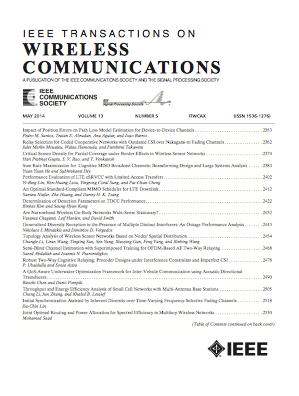
The IEEE Transactions on Wireless Communications is a prestigious publication that showcases cutting-edge advancements in wireless communications. It welcomes both theoretical and practical contributions in various areas. The scope of the Transactions encompasses a wide range of topics, including modulation and coding, detection and estimation, propagation and channel characterization, and diversity techniques. The journal also emphasizes the physical and link layer communication aspects of network architectures and protocols.
The journal is open to papers on specific topics or non-traditional topics related to specific application areas. This includes simulation tools and methodologies, orthogonal frequency division multiplexing, MIMO systems, and wireless over optical technologies.
Overall, the IEEE Transactions on Wireless Communications serves as a platform for high-quality manuscripts that push the boundaries of wireless communications and contribute to advancements in the field.




 京公网安备 11010802042870号
京ICP备2023020795号-1
京公网安备 11010802042870号
京ICP备2023020795号-1

 分享
分享
 求助内容:
求助内容: 应助结果提醒方式:
 扫码关注我们
