{"title":"Efficient Initial Access Based on DRL-Empowered Beam Sweeping","authors":"Jingze Che;Zhaoyang Zhang;Yuzhi Yang;Zhaohui Yang","doi":"10.1109/TWC.2024.3524305","DOIUrl":null,"url":null,"abstract":"Initial access (IA) is a procedure of establishing an initial connection between the base station (BS) and the users. In the fifth generation (5G) mobile communication system, the IA procedure includes beam management, which determines the beam pairs for random access (RA) and data transmission by beam sweeping. The existing beam sweeping method in the 3-rd generation partnership project (3GPP) standard mainly uses a predefined uniform beamforming codebook and sweeps the beams progressively, which is time-consuming and highly inflexible. In this paper, inspired by the fact that the highly non-uniform environment and user distribution mean part of the beam sweeping might be less beneficial, we propose a novel learning-based IA framework for the BS to optimize the beam sweeping patterns. Specifically, we resort to the deep reinforcement learning (DRL) approach to implicitly obtain the unknown environment and user distribution properties by continuously interacting with the environment, and then make decisions based on the rewards achieved by past actions. The simulation results show that our proposed scheme can save much time compared with the new radio (NR) and optimization methods under different datasets and conditions, which greatly improves the beam sweeping efficiency.","PeriodicalId":13431,"journal":{"name":"IEEE Transactions on Wireless Communications","volume":"24 4","pages":"2750-2765"},"PeriodicalIF":10.7000,"publicationDate":"2025-01-08","publicationTypes":"Journal Article","fieldsOfStudy":null,"isOpenAccess":false,"openAccessPdf":"","citationCount":"0","resultStr":null,"platform":"Semanticscholar","paperid":null,"PeriodicalName":"IEEE Transactions on Wireless Communications","FirstCategoryId":"94","ListUrlMain":"https://ieeexplore.ieee.org/document/10834506/","RegionNum":1,"RegionCategory":"计算机科学","ArticlePicture":[],"TitleCN":null,"AbstractTextCN":null,"PMCID":null,"EPubDate":"","PubModel":"","JCR":"Q1","JCRName":"ENGINEERING, ELECTRICAL & ELECTRONIC","Score":null,"Total":0}
引用次数: 0
Abstract
Initial access (IA) is a procedure of establishing an initial connection between the base station (BS) and the users. In the fifth generation (5G) mobile communication system, the IA procedure includes beam management, which determines the beam pairs for random access (RA) and data transmission by beam sweeping. The existing beam sweeping method in the 3-rd generation partnership project (3GPP) standard mainly uses a predefined uniform beamforming codebook and sweeps the beams progressively, which is time-consuming and highly inflexible. In this paper, inspired by the fact that the highly non-uniform environment and user distribution mean part of the beam sweeping might be less beneficial, we propose a novel learning-based IA framework for the BS to optimize the beam sweeping patterns. Specifically, we resort to the deep reinforcement learning (DRL) approach to implicitly obtain the unknown environment and user distribution properties by continuously interacting with the environment, and then make decisions based on the rewards achieved by past actions. The simulation results show that our proposed scheme can save much time compared with the new radio (NR) and optimization methods under different datasets and conditions, which greatly improves the beam sweeping efficiency.
期刊介绍:
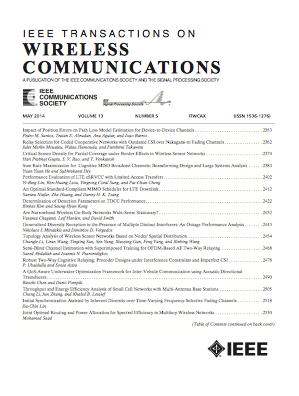
The IEEE Transactions on Wireless Communications is a prestigious publication that showcases cutting-edge advancements in wireless communications. It welcomes both theoretical and practical contributions in various areas. The scope of the Transactions encompasses a wide range of topics, including modulation and coding, detection and estimation, propagation and channel characterization, and diversity techniques. The journal also emphasizes the physical and link layer communication aspects of network architectures and protocols.
The journal is open to papers on specific topics or non-traditional topics related to specific application areas. This includes simulation tools and methodologies, orthogonal frequency division multiplexing, MIMO systems, and wireless over optical technologies.
Overall, the IEEE Transactions on Wireless Communications serves as a platform for high-quality manuscripts that push the boundaries of wireless communications and contribute to advancements in the field.



 京公网安备 11010802042870号
京ICP备2023020795号-1
京公网安备 11010802042870号
京ICP备2023020795号-1

 分享
分享
 求助内容:
求助内容: 应助结果提醒方式:
 扫码关注我们
