{"title":"Intelligent Interpretation of Dissolved Gases in Transformer Oil With Electronic Nose and Machine Learning","authors":"Suganya Govindarajan;Harimurugan Devarajan;Jorge Alfredo Ardila-Rey;Matías Patricio Cerda-Luna;Sergi Leandro Torres Araya;Cristhian Camilo Delgado Diaz","doi":"10.1109/TII.2024.3507943","DOIUrl":null,"url":null,"abstract":"Dissolved gas analysis (DGA) is crucial for identifying incipient failures in transformers by analyzing gas concentrations due to degradation. However, its high cost and time-consuming nature limit practical use. To address this, a metal-oxide semiconductor based electronic nose (E-nose) is utilized in this study to detect gases in transformer oil, including hydrogen (H<sub>2</sub>), methane (CH<sub>4</sub>), ethane (C<sub>2</sub>H<sub>6</sub>), ethylene (C<sub>2</sub>H<sub>4</sub>), and acetylene (C<sub>2</sub>H<sub>2</sub>). Machine learning techniques are integrated with the E-nose system to enhance classification performance. Experimental results using artificially contaminated mineral oil samples demonstrate promising accuracy in gas classification. Initially, without feature reduction, the F1 score was 0.2972. Feature ranking increased the F1 score to 0.7956, and after implementing dimensionality reduction, it further improved to 0.9313. Subsequently, the combination of support vector machine and genetic algorithm was employed for sensor selection, achieving an F1 score of 0.9869. Among the combinations of 2, 3, and 4 sensors, MQ 8 and TGS 2612 consistently showed the best F1 scores, with TGS 813 and TGS 2611 also contributing significantly. This innovative approach suggests a potential solution for transformer oil condition monitoring, offering a rapid, simple, and cost-effective alternative to traditional DGA analyses. By combining E-nose technology with machine learning, this method holds promise for facilitating routine measurements and ensuring the reliability and efficiency of transformer operations.","PeriodicalId":13301,"journal":{"name":"IEEE Transactions on Industrial Informatics","volume":"21 4","pages":"2839-2848"},"PeriodicalIF":9.9000,"publicationDate":"2025-01-09","publicationTypes":"Journal Article","fieldsOfStudy":null,"isOpenAccess":false,"openAccessPdf":"","citationCount":"0","resultStr":null,"platform":"Semanticscholar","paperid":null,"PeriodicalName":"IEEE Transactions on Industrial Informatics","FirstCategoryId":"94","ListUrlMain":"https://ieeexplore.ieee.org/document/10836134/","RegionNum":1,"RegionCategory":"计算机科学","ArticlePicture":[],"TitleCN":null,"AbstractTextCN":null,"PMCID":null,"EPubDate":"","PubModel":"","JCR":"Q1","JCRName":"AUTOMATION & CONTROL SYSTEMS","Score":null,"Total":0}
引用次数: 0
Abstract
Dissolved gas analysis (DGA) is crucial for identifying incipient failures in transformers by analyzing gas concentrations due to degradation. However, its high cost and time-consuming nature limit practical use. To address this, a metal-oxide semiconductor based electronic nose (E-nose) is utilized in this study to detect gases in transformer oil, including hydrogen (H2), methane (CH4), ethane (C2H6), ethylene (C2H4), and acetylene (C2H2). Machine learning techniques are integrated with the E-nose system to enhance classification performance. Experimental results using artificially contaminated mineral oil samples demonstrate promising accuracy in gas classification. Initially, without feature reduction, the F1 score was 0.2972. Feature ranking increased the F1 score to 0.7956, and after implementing dimensionality reduction, it further improved to 0.9313. Subsequently, the combination of support vector machine and genetic algorithm was employed for sensor selection, achieving an F1 score of 0.9869. Among the combinations of 2, 3, and 4 sensors, MQ 8 and TGS 2612 consistently showed the best F1 scores, with TGS 813 and TGS 2611 also contributing significantly. This innovative approach suggests a potential solution for transformer oil condition monitoring, offering a rapid, simple, and cost-effective alternative to traditional DGA analyses. By combining E-nose technology with machine learning, this method holds promise for facilitating routine measurements and ensuring the reliability and efficiency of transformer operations.
期刊介绍:
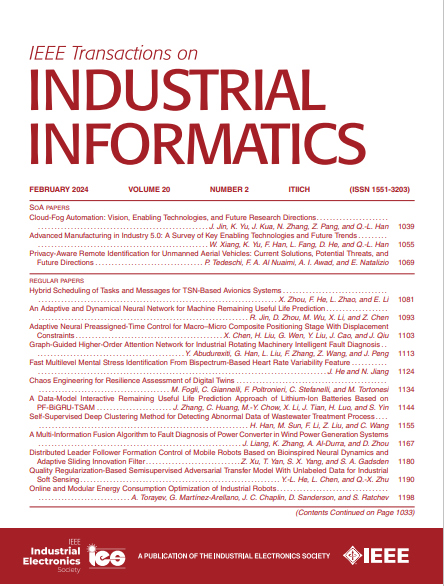
The IEEE Transactions on Industrial Informatics is a multidisciplinary journal dedicated to publishing technical papers that connect theory with practical applications of informatics in industrial settings. It focuses on the utilization of information in intelligent, distributed, and agile industrial automation and control systems. The scope includes topics such as knowledge-based and AI-enhanced automation, intelligent computer control systems, flexible and collaborative manufacturing, industrial informatics in software-defined vehicles and robotics, computer vision, industrial cyber-physical and industrial IoT systems, real-time and networked embedded systems, security in industrial processes, industrial communications, systems interoperability, and human-machine interaction.



 京公网安备 11010802042870号
京ICP备2023020795号-1
京公网安备 11010802042870号
京ICP备2023020795号-1

 分享
分享
 求助内容:
求助内容: 应助结果提醒方式:
 扫码关注我们
