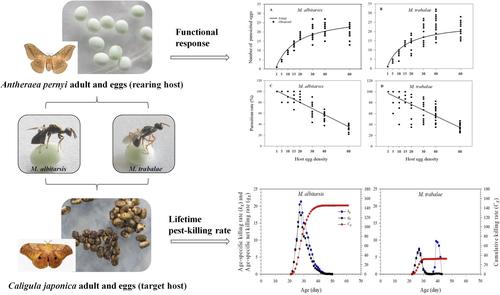
The Japanese giant silkworm (JGS) Caligula japonica is a significant defoliator pest in East Asia, causing severe economic losses in forest and fruit production. To establish a cost-effective biological control program against JGS, the age-stage, two-sex life table method was used to accurately assess the potential efficacy of two Mesocomys species (M. albitarsis and M. trabalae) in controlling this pest. Our study focused on the functional response of two Mesocomys species to Chinese oak silkworm (COS) Antheraea pernyi eggs (factitious host), as well as their reproductive attributes when exposed to JGS eggs (target host).
Both Mesocomys species exhibited a type II functional response to increasing densities of COS eggs. Mutual interference of M. trabalae was greater than that of M. albitarsis at high parasitoid densities. Two Mesocomys parasitoids reared from COS eggs effectively parasitized JGS eggs, albeit with differing parasitism capacities. M. albitarsis had an average fecundity of 190.4 offspring, which was 3.8-fold higher than M. trabalae. Consequently, M. albitarsis demonstrated superior reproductive metrics when parasitizing JGS eggs, with more oviposition days (Od), intrinsic rate of increase (r), finite rate of increase (λ) and net reproduction rate (R0) compared to M. trabalae. Additionally, the net killing rate (C0) of M. albitarsis was 145.2 eggs/female, significantly higher than M. trabalae (32.6 eggs/female).
Mesocomys albitarsis was identified as a more potent biocontrol agent against JGS than M. trabalae under indoor conditions. Some mutual interference at high parasitoid rearing densities likely reduces the per capita parasitization efficiency of both Mesocomys parasitoids. © 2025 Society of Chemical Industry.







 京公网安备 11010802042870号
京ICP备2023020795号-1
京公网安备 11010802042870号
京ICP备2023020795号-1

 分享
分享
 求助内容:
求助内容: 应助结果提醒方式:
 扫码关注我们
