Jiangchun Chen, Hao Lan, Sicong Wang, Xinyu Liu, Qiaonan Zhu, Xudong Zhang, Mengyao Tang, Shuai Dong, Jie Yang, Mirtemir Kurbanov, Lin Guo, Hua Wang
{"title":"Realizing an Energy-Dense Potassium Metal Battery at −40 °C via an Integrated Anode-Free and Dual-Ion Strategy","authors":"Jiangchun Chen, Hao Lan, Sicong Wang, Xinyu Liu, Qiaonan Zhu, Xudong Zhang, Mengyao Tang, Shuai Dong, Jie Yang, Mirtemir Kurbanov, Lin Guo, Hua Wang","doi":"10.1021/jacs.4c12126","DOIUrl":null,"url":null,"abstract":"Potassium (K)-based batteries hold great promise for cryogenic applications owing to the small Stokes radius and weak Lewis acidity of K<sup>+</sup>. Nevertheless, energy-dense (>200 W h kg<sup>–1</sup><sub>cathode+anode</sub>) K batteries under subzero conditions have seldom been reported. Here, an over 400 W h kg<sup>–1</sup><sub>cathode+anode</sub> K battery is realized at −40 °C via an anode-free and dual-ion strategy, surpassing these state-of-the-art K batteries and even most Li/Na batteries at low temperatures (LTs). By introduction of a strongly associating salt as an additive to this anode-free K battery, an anion-derived solid electrolyte interphase can be established for a highly reversible, zero-excess K plating/stripping behavior on a bare current collector. Meanwhile, a binary solvent is rationally designed for lowering the cation desolvation energy barrier, which ensures comparably facile cation and desolvation-free anion kinetics in this dual-ion structure even at LTs. Consequently, the K||Al half-cell delivers a high Coulombic efficiency of 99.98% at −40 °C. By pairing with a high-energy cathode, a proof-of-concept anode-free K dual-ion battery (N/P = 0) is fabricated, delivering a record-high energy density of 407 W h kg<sup>–1</sup><sub>cathode+anode</sub> with stable cycling of 183 cycles (80% capacity retention) at −40 °C. This work paves a way toward energy-dense batteries at extreme scenarios.","PeriodicalId":49,"journal":{"name":"Journal of the American Chemical Society","volume":"40 1","pages":""},"PeriodicalIF":15.6000,"publicationDate":"2025-01-09","publicationTypes":"Journal Article","fieldsOfStudy":null,"isOpenAccess":false,"openAccessPdf":"","citationCount":"0","resultStr":null,"platform":"Semanticscholar","paperid":null,"PeriodicalName":"Journal of the American Chemical Society","FirstCategoryId":"92","ListUrlMain":"https://doi.org/10.1021/jacs.4c12126","RegionNum":1,"RegionCategory":"化学","ArticlePicture":[],"TitleCN":null,"AbstractTextCN":null,"PMCID":null,"EPubDate":"","PubModel":"","JCR":"Q1","JCRName":"CHEMISTRY, MULTIDISCIPLINARY","Score":null,"Total":0}
引用次数: 0
Abstract
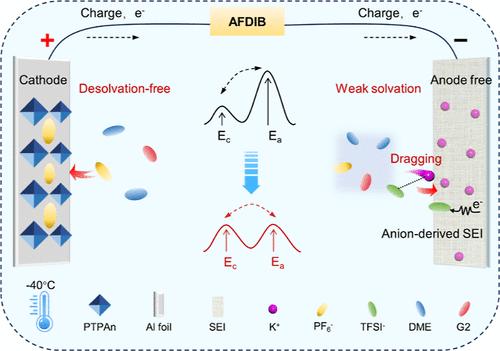
Potassium (K)-based batteries hold great promise for cryogenic applications owing to the small Stokes radius and weak Lewis acidity of K+. Nevertheless, energy-dense (>200 W h kg–1cathode+anode) K batteries under subzero conditions have seldom been reported. Here, an over 400 W h kg–1cathode+anode K battery is realized at −40 °C via an anode-free and dual-ion strategy, surpassing these state-of-the-art K batteries and even most Li/Na batteries at low temperatures (LTs). By introduction of a strongly associating salt as an additive to this anode-free K battery, an anion-derived solid electrolyte interphase can be established for a highly reversible, zero-excess K plating/stripping behavior on a bare current collector. Meanwhile, a binary solvent is rationally designed for lowering the cation desolvation energy barrier, which ensures comparably facile cation and desolvation-free anion kinetics in this dual-ion structure even at LTs. Consequently, the K||Al half-cell delivers a high Coulombic efficiency of 99.98% at −40 °C. By pairing with a high-energy cathode, a proof-of-concept anode-free K dual-ion battery (N/P = 0) is fabricated, delivering a record-high energy density of 407 W h kg–1cathode+anode with stable cycling of 183 cycles (80% capacity retention) at −40 °C. This work paves a way toward energy-dense batteries at extreme scenarios.
由于K+的小斯托克斯半径和弱刘易斯酸度,钾(K)基电池在低温应用中具有很大的前景。然而,在零下条件下的能量密度(>; 200w h kg - 1阴极+阳极)K电池很少有报道。在这里,通过无阳极和双离子策略,在- 40°C下实现了超过400 W h kg - 1的阴极+阳极K电池,超过了这些最先进的K电池,甚至在低温(lt)下的大多数Li/Na电池。通过将强缔合盐作为添加剂引入该无阳极K电池,阴离子衍生的固体电解质界面可以在裸集流器上建立高度可逆的零过量K电镀/剥离行为。同时,合理设计了二元溶剂,降低了阳离子的脱溶能垒,保证了该双离子结构中即使在LTs下也具有相对容易的阳离子和不脱溶阴离子动力学。因此,k| |Al半电池在- 40°C下可提供99.98%的高库仑效率。通过与高能阴极配对,制造了一种概念验证的无阳极K双离子电池(N/P = 0),在- 40°C下,阴极+阳极的能量密度达到407 W h kg - 1,稳定循环183次(80%容量保留)。这项工作为极端情况下的能量密集电池铺平了道路。
期刊介绍:
The flagship journal of the American Chemical Society, known as the Journal of the American Chemical Society (JACS), has been a prestigious publication since its establishment in 1879. It holds a preeminent position in the field of chemistry and related interdisciplinary sciences. JACS is committed to disseminating cutting-edge research papers, covering a wide range of topics, and encompasses approximately 19,000 pages of Articles, Communications, and Perspectives annually. With a weekly publication frequency, JACS plays a vital role in advancing the field of chemistry by providing essential research.



 京公网安备 11010802042870号
京ICP备2023020795号-1
京公网安备 11010802042870号
京ICP备2023020795号-1

 分享
分享
 求助内容:
求助内容: 应助结果提醒方式:
 扫码关注我们
