Esmee Driehuis , Imre Demirhan , Wanda S. Konijn , Theodôr J.F.M. Vogels , Namiko A. Goto , Marjolein I. Broese van Groenou , Marianne C. Verhaar , Brigit C. van Jaarsveld , Alferso C. Abrahams
{"title":"Determinants of Caregiver Burden Among Spouses of Patients With Kidney Failure: A Qualitative Study","authors":"Esmee Driehuis , Imre Demirhan , Wanda S. Konijn , Theodôr J.F.M. Vogels , Namiko A. Goto , Marjolein I. Broese van Groenou , Marianne C. Verhaar , Brigit C. van Jaarsveld , Alferso C. Abrahams","doi":"10.1053/j.ajkd.2024.11.005","DOIUrl":null,"url":null,"abstract":"<div><h3>Rationale & Objective</h3><div>Spousal caregivers participate extensively in the care of patients with kidney failure. Although previous studies suggested that these caregivers experience a high burden, a comprehensive understanding of the determinants of this burden and strategies to alleviate it are needed. Therefore, this study sought to explore the contributing and alleviating determinants of burden in spousal caregivers of patients with kidney failure.</div></div><div><h3>Study Design</h3><div>A qualitative interview study with 15 spousal caregivers.</div></div><div><h3>Setting & Participants</h3><div>Dutch-speaking, adult spousal caregivers were recruited and interviewed by the Dutch Kidney Patients Association for the Kidney Decision Aid.</div></div><div><h3>Analytical Approach</h3><div>A directed qualitative content analysis using the stress-appraisal model of caregiver burden as a framework to inform a disease-specific model on spousal caregiver burden for kidney failure that characterizes the impact of care provision on all aspects of spousal caregivers’ lives, the burden associated with it, and possible mitigating factors.</div></div><div><h3>Results</h3><div>Providing care for patients with kidney failure is complex and burdensome for spousal caregivers and results in many lifestyle changes, which are largely caused by kidney failure–specific tasks and the shifting responsibility for daily life tasks. Spouses identified disease-specific determinants of burden including the impact of kidney disease on spouses with the disease as well as the associated caregiver tasks, such as adjusting to dietary restrictions and attending dialysis appointments. Dialysis options (eg, the choice for home or in-center dialysis) were kidney failure–specific moderators of burden. Support of spousal caregivers by health care providers plays a key role in preventing overburdening.</div></div><div><h3>Limitations</h3><div>Potential limited transferability owing to the study of only Dutch-speaking spouses willing to be interviewed and videotaped.</div></div><div><h3>Conclusions</h3><div>This comprehensive overview of the contributing and alleviating determinants of burden experienced by spousal caregivers of patients with kidney failure highlights 4 principal areas: (1) personal and relational, (2) social environment, (3) health care, and (4) work and legislation, in which such burdens occur and may be alleviated.</div></div><div><h3>Plain-Language Summary</h3><div>Spousal caregivers are crucial for supporting patients with kidney failure, but they often experience significant stress and challenges. This study explored factors that contribute to spousal caregiver burden and ways to alleviate it. We interviewed 15 spousal caregivers of patients with kidney failure. We found that providing care for patients with kidney failure is complex, burdensome, and has a major impact on caregivers’ lives. We identify factors that contribute to caregiver burden but also factors that may ease this burden. This study underlines the need for acknowledgement of spousal caregivers in 4 areas, namely (1) personal and relational, (2) social environment, (3) health care, and (4) work and legislation.</div></div>","PeriodicalId":7419,"journal":{"name":"American Journal of Kidney Diseases","volume":"85 4","pages":"Pages 477-490.e1"},"PeriodicalIF":8.2000,"publicationDate":"2025-04-01","publicationTypes":"Journal Article","fieldsOfStudy":null,"isOpenAccess":false,"openAccessPdf":"","citationCount":"0","resultStr":null,"platform":"Semanticscholar","paperid":null,"PeriodicalName":"American Journal of Kidney Diseases","FirstCategoryId":"3","ListUrlMain":"https://www.sciencedirect.com/science/article/pii/S0272638625000010","RegionNum":1,"RegionCategory":"医学","ArticlePicture":[],"TitleCN":null,"AbstractTextCN":null,"PMCID":null,"EPubDate":"2025/1/7 0:00:00","PubModel":"Epub","JCR":"Q1","JCRName":"UROLOGY & NEPHROLOGY","Score":null,"Total":0}
引用次数: 0
Abstract
Rationale & Objective
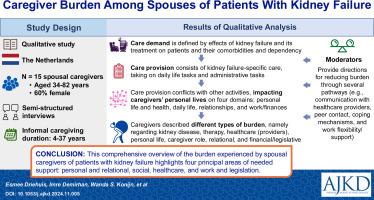
Spousal caregivers participate extensively in the care of patients with kidney failure. Although previous studies suggested that these caregivers experience a high burden, a comprehensive understanding of the determinants of this burden and strategies to alleviate it are needed. Therefore, this study sought to explore the contributing and alleviating determinants of burden in spousal caregivers of patients with kidney failure.
Study Design
A qualitative interview study with 15 spousal caregivers.
Setting & Participants
Dutch-speaking, adult spousal caregivers were recruited and interviewed by the Dutch Kidney Patients Association for the Kidney Decision Aid.
Analytical Approach
A directed qualitative content analysis using the stress-appraisal model of caregiver burden as a framework to inform a disease-specific model on spousal caregiver burden for kidney failure that characterizes the impact of care provision on all aspects of spousal caregivers’ lives, the burden associated with it, and possible mitigating factors.
Results
Providing care for patients with kidney failure is complex and burdensome for spousal caregivers and results in many lifestyle changes, which are largely caused by kidney failure–specific tasks and the shifting responsibility for daily life tasks. Spouses identified disease-specific determinants of burden including the impact of kidney disease on spouses with the disease as well as the associated caregiver tasks, such as adjusting to dietary restrictions and attending dialysis appointments. Dialysis options (eg, the choice for home or in-center dialysis) were kidney failure–specific moderators of burden. Support of spousal caregivers by health care providers plays a key role in preventing overburdening.
Limitations
Potential limited transferability owing to the study of only Dutch-speaking spouses willing to be interviewed and videotaped.
Conclusions
This comprehensive overview of the contributing and alleviating determinants of burden experienced by spousal caregivers of patients with kidney failure highlights 4 principal areas: (1) personal and relational, (2) social environment, (3) health care, and (4) work and legislation, in which such burdens occur and may be alleviated.
Plain-Language Summary
Spousal caregivers are crucial for supporting patients with kidney failure, but they often experience significant stress and challenges. This study explored factors that contribute to spousal caregiver burden and ways to alleviate it. We interviewed 15 spousal caregivers of patients with kidney failure. We found that providing care for patients with kidney failure is complex, burdensome, and has a major impact on caregivers’ lives. We identify factors that contribute to caregiver burden but also factors that may ease this burden. This study underlines the need for acknowledgement of spousal caregivers in 4 areas, namely (1) personal and relational, (2) social environment, (3) health care, and (4) work and legislation.
期刊介绍:
The American Journal of Kidney Diseases (AJKD), the National Kidney Foundation's official journal, is globally recognized for its leadership in clinical nephrology content. Monthly, AJKD publishes original investigations on kidney diseases, hypertension, dialysis therapies, and kidney transplantation. Rigorous peer-review, statistical scrutiny, and a structured format characterize the publication process. Each issue includes case reports unveiling new diseases and potential therapeutic strategies.



 京公网安备 11010802042870号
京ICP备2023020795号-1
京公网安备 11010802042870号
京ICP备2023020795号-1

 分享
分享
 求助内容:
求助内容: 应助结果提醒方式:
 扫码关注我们
