Association of systemic immune-inflammation index with all-cause and cardiovascular mortality among adults with depression: evidence from NHANES 2005-2018.
{"title":"Association of systemic immune-inflammation index with all-cause and cardiovascular mortality among adults with depression: evidence from NHANES 2005-2018.","authors":"Xinping Yu, Heqing Zheng, Mingxu Liu, Lanxiang Wu, Sheng Tian, Wei Wu","doi":"10.1186/s12888-024-06463-y","DOIUrl":null,"url":null,"abstract":"<p><strong>Background: </strong>The relationship between the systemic immune-inflammatory index (SII) and the mortality of adults with depression is uncertain.</p><p><strong>Methods: </strong>This study included adults with depression who were surveyed in the National Health and Nutrition Examination Survey (NHANES) from 2005 to 2018. Cox proportional hazards regression models to compute hazard ratios (HR) and 95% confidence intervals (CI) for mortality.The restricted cubic spline(RCS), Kaplan-Meier curve analysis, time-dependent ROC analysis, subgroup and sensitivity analyses were also used.</p><p><strong>Results: </strong>A total of 2442 adults with depression were included in the final analysis(average age: 46.51 ± 0.44 years). During a median follow-up of 89 months, there were 302 all-cause deaths and 74 cardiovascular deaths. The fully adjusted model showed that an increment of 100 unit in SII corresponded to an increased HR of 1.05(95% CI,1.02,1.08, p = 0.003) for all-cause mortality and 1.06(95% CI,1.02,1.10, p = 0.004) for cardiovascular mortality, respectively. The RCS analysis indicated a J-shape relationship between SII and all-cause mortality and a positive linear association between SII and cardiovascular mortality.The time-dependent ROC analysis exhibited excellent efficacy in SII for predicting all-cause and cardiovascular mortality at 1, 3, 5 and 10 years.</p><p><strong>Conclusions: </strong>Higher SII levels were associated with increased risk of all-cause and cardiovascular mortality in adults with depression.</p><p><strong>Clinical trial number: </strong>Not applicable.</p>","PeriodicalId":9029,"journal":{"name":"BMC Psychiatry","volume":"25 1","pages":"25"},"PeriodicalIF":3.4000,"publicationDate":"2025-01-08","publicationTypes":"Journal Article","fieldsOfStudy":null,"isOpenAccess":false,"openAccessPdf":"https://www.ncbi.nlm.nih.gov/pmc/articles/PMC11707943/pdf/","citationCount":"0","resultStr":null,"platform":"Semanticscholar","paperid":null,"PeriodicalName":"BMC Psychiatry","FirstCategoryId":"3","ListUrlMain":"https://doi.org/10.1186/s12888-024-06463-y","RegionNum":2,"RegionCategory":"医学","ArticlePicture":[],"TitleCN":null,"AbstractTextCN":null,"PMCID":null,"EPubDate":"","PubModel":"","JCR":"Q2","JCRName":"PSYCHIATRY","Score":null,"Total":0}
引用次数: 0
Abstract
Background: The relationship between the systemic immune-inflammatory index (SII) and the mortality of adults with depression is uncertain.
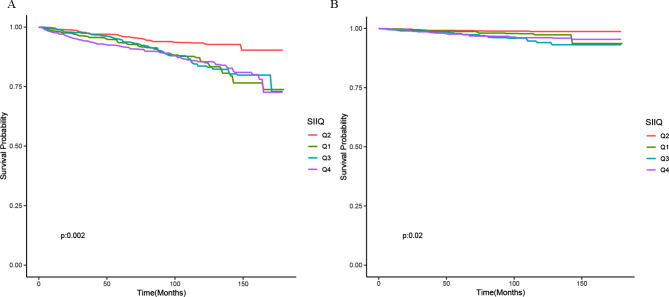
Methods: This study included adults with depression who were surveyed in the National Health and Nutrition Examination Survey (NHANES) from 2005 to 2018. Cox proportional hazards regression models to compute hazard ratios (HR) and 95% confidence intervals (CI) for mortality.The restricted cubic spline(RCS), Kaplan-Meier curve analysis, time-dependent ROC analysis, subgroup and sensitivity analyses were also used.
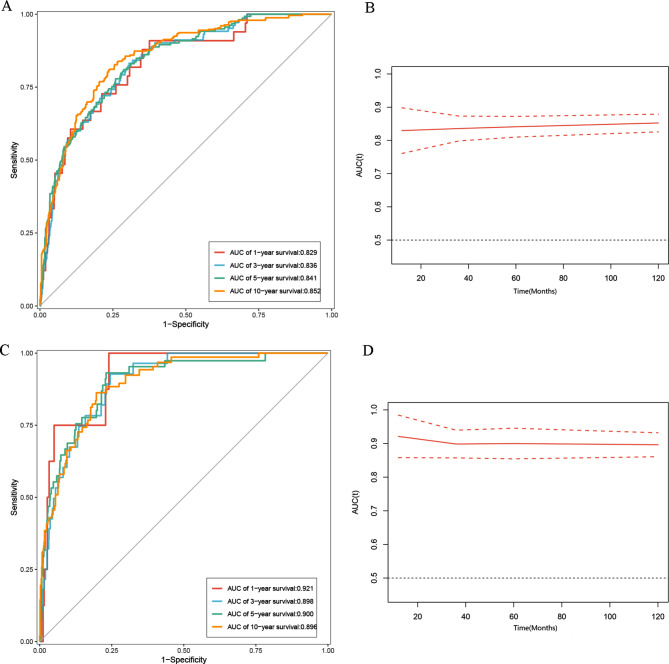
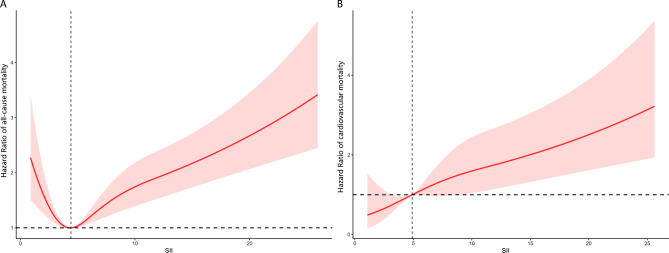
Results: A total of 2442 adults with depression were included in the final analysis(average age: 46.51 ± 0.44 years). During a median follow-up of 89 months, there were 302 all-cause deaths and 74 cardiovascular deaths. The fully adjusted model showed that an increment of 100 unit in SII corresponded to an increased HR of 1.05(95% CI,1.02,1.08, p = 0.003) for all-cause mortality and 1.06(95% CI,1.02,1.10, p = 0.004) for cardiovascular mortality, respectively. The RCS analysis indicated a J-shape relationship between SII and all-cause mortality and a positive linear association between SII and cardiovascular mortality.The time-dependent ROC analysis exhibited excellent efficacy in SII for predicting all-cause and cardiovascular mortality at 1, 3, 5 and 10 years.
Conclusions: Higher SII levels were associated with increased risk of all-cause and cardiovascular mortality in adults with depression.
背景:成人抑郁症患者的全身免疫炎症指数(SII)与死亡率之间的关系尚不确定。方法:本研究纳入了2005年至2018年参加国家健康与营养检查调查(NHANES)的成年抑郁症患者。Cox比例风险回归模型计算死亡率的风险比(HR)和95%置信区间(CI)。采用限制性三次样条(RCS)、Kaplan-Meier曲线分析、随时间变化的ROC分析、亚组分析和敏感性分析。结果:共纳入成人抑郁症患者2442例,平均年龄46.51±0.44岁。在中位随访89个月期间,有302例全因死亡和74例心血管死亡。完全调整后的模型显示,SII每增加100单位,全因死亡率和心血管死亡率的HR分别增加1.05(95% CI,1.02,1.08, p = 0.003)和1.06(95% CI,1.02,1.10, p = 0.004)。RCS分析显示SII与全因死亡率呈j型关系,SII与心血管死亡率呈线性正相关。时间相关的ROC分析显示SII在预测1、3、5和10年的全因死亡率和心血管死亡率方面具有出色的疗效。结论:高SII水平与抑郁症成人全因死亡率和心血管死亡率增加相关。临床试验号:不适用。
期刊介绍:
BMC Psychiatry is an open access, peer-reviewed journal that considers articles on all aspects of the prevention, diagnosis and management of psychiatric disorders, as well as related molecular genetics, pathophysiology, and epidemiology.



 京公网安备 11010802042870号
京ICP备2023020795号-1
京公网安备 11010802042870号
京ICP备2023020795号-1

 分享
分享
 求助内容:
求助内容: 应助结果提醒方式:
 扫码关注我们
