Samantha L Grimes, Brook E Heaton, Mackenzie L Anderson, Katie Burke, Laura Stevens, Xiaotao Lu, Nicholas S Heaton, Mark R Denison, Jordan Anderson-Daniels
{"title":"The coronavirus nsp14 exoribonuclease interface with the cofactor nsp10 is essential for efficient virus replication and enzymatic activity.","authors":"Samantha L Grimes, Brook E Heaton, Mackenzie L Anderson, Katie Burke, Laura Stevens, Xiaotao Lu, Nicholas S Heaton, Mark R Denison, Jordan Anderson-Daniels","doi":"10.1128/jvi.01708-24","DOIUrl":null,"url":null,"abstract":"<p><p>Coronaviruses (CoVs) encode non-structural proteins (nsp's) 1-16, which assemble to form replication-transcription complexes that function in viral RNA synthesis. All CoVs encode a proofreading 3'-5' exoribonuclease in non-structural protein 14 (nsp14-ExoN) that mediates proofreading and high-fidelity replication and is critical for other roles in replication and pathogenesis. The <i>in vitro</i> enzymatic activity of nsp14-ExoN is enhanced in the presence of the cofactor nsp10. We introduced alanine substitutions in nsp14 of murine hepatitis virus (MHV) at the nsp14-nsp10 interface and recovered mutant viruses with a range of impairments in replication and <i>in vitro</i> biochemical exonuclease activity. Two of these substitutions, nsp14 K7A and D8A, had impairments intermediate between wild type-MHV nsp14 and the known ExoN(-) D89A/E91A nsp14 catalytic inactivation mutant. All introduced nsp14-nsp10 interface alanine substitutions impaired <i>in vitro</i> exonuclease activity. Passage of the K7A and D8A mutant viruses selected second-site non-synonymous mutations in nsp14 associated with improved mutant virus replication and exonuclease activity. These results confirm the essential role of the nsp14-nsp10 interaction for efficient enzymatic activity and virus replication, identify proximal and long-distance determinants of nsp14-nsp10 interaction, and support targeting the nsp14-nsp10 interface for viral inhibition and attenuation.IMPORTANCECoronavirus replication requires assembly of a replication transcription complex composed of nsp's, including polymerase, helicase, exonuclease, capping enzymes, and non-enzymatic cofactors. The coronavirus nsp14 exoribonuclease mediates several functions in the viral life cycle including genomic and subgenomic RNA synthesis, RNA recombination, RNA proofreading and high-fidelity replication, and native resistance to many nucleoside analogs. The nsp-14 exonuclease activity <i>in vitro</i> requires the non-enzymatic cofactor nsp10, but the determinants and importance of the nsp14-nsp10 interactions during viral replication have not been defined. Here we show that for the coronavirus murine hepatitis virus, nsp14 residues at the nsp14-nsp10 interface are essential for efficient viral replication and <i>in vitro</i> exonuclease activity. These results shed new light on the requirements for protein interactions within the coronavirus replication transcription complex, and they may reveal novel non-active-site targets for virus inhibition and attenuation.</p>","PeriodicalId":17583,"journal":{"name":"Journal of Virology","volume":" ","pages":"e0170824"},"PeriodicalIF":3.8000,"publicationDate":"2025-02-25","publicationTypes":"Journal Article","fieldsOfStudy":null,"isOpenAccess":false,"openAccessPdf":"https://www.ncbi.nlm.nih.gov/pmc/articles/PMC11852845/pdf/","citationCount":"0","resultStr":null,"platform":"Semanticscholar","paperid":null,"PeriodicalName":"Journal of Virology","FirstCategoryId":"3","ListUrlMain":"https://doi.org/10.1128/jvi.01708-24","RegionNum":2,"RegionCategory":"医学","ArticlePicture":[],"TitleCN":null,"AbstractTextCN":null,"PMCID":null,"EPubDate":"2025/1/10 0:00:00","PubModel":"Epub","JCR":"Q2","JCRName":"VIROLOGY","Score":null,"Total":0}
引用次数: 0
Abstract
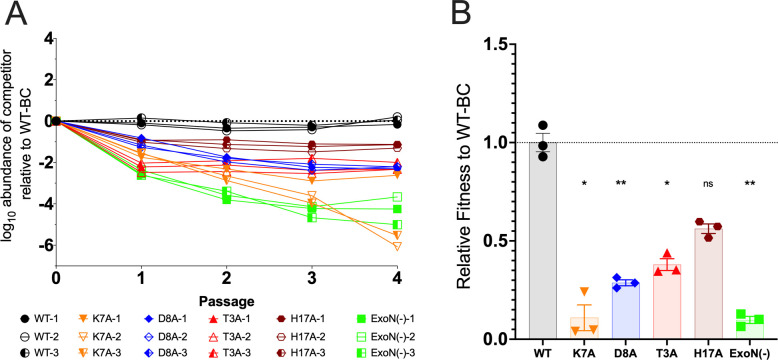
Coronaviruses (CoVs) encode non-structural proteins (nsp's) 1-16, which assemble to form replication-transcription complexes that function in viral RNA synthesis. All CoVs encode a proofreading 3'-5' exoribonuclease in non-structural protein 14 (nsp14-ExoN) that mediates proofreading and high-fidelity replication and is critical for other roles in replication and pathogenesis. The in vitro enzymatic activity of nsp14-ExoN is enhanced in the presence of the cofactor nsp10. We introduced alanine substitutions in nsp14 of murine hepatitis virus (MHV) at the nsp14-nsp10 interface and recovered mutant viruses with a range of impairments in replication and in vitro biochemical exonuclease activity. Two of these substitutions, nsp14 K7A and D8A, had impairments intermediate between wild type-MHV nsp14 and the known ExoN(-) D89A/E91A nsp14 catalytic inactivation mutant. All introduced nsp14-nsp10 interface alanine substitutions impaired in vitro exonuclease activity. Passage of the K7A and D8A mutant viruses selected second-site non-synonymous mutations in nsp14 associated with improved mutant virus replication and exonuclease activity. These results confirm the essential role of the nsp14-nsp10 interaction for efficient enzymatic activity and virus replication, identify proximal and long-distance determinants of nsp14-nsp10 interaction, and support targeting the nsp14-nsp10 interface for viral inhibition and attenuation.IMPORTANCECoronavirus replication requires assembly of a replication transcription complex composed of nsp's, including polymerase, helicase, exonuclease, capping enzymes, and non-enzymatic cofactors. The coronavirus nsp14 exoribonuclease mediates several functions in the viral life cycle including genomic and subgenomic RNA synthesis, RNA recombination, RNA proofreading and high-fidelity replication, and native resistance to many nucleoside analogs. The nsp-14 exonuclease activity in vitro requires the non-enzymatic cofactor nsp10, but the determinants and importance of the nsp14-nsp10 interactions during viral replication have not been defined. Here we show that for the coronavirus murine hepatitis virus, nsp14 residues at the nsp14-nsp10 interface are essential for efficient viral replication and in vitro exonuclease activity. These results shed new light on the requirements for protein interactions within the coronavirus replication transcription complex, and they may reveal novel non-active-site targets for virus inhibition and attenuation.
期刊介绍:
Journal of Virology (JVI) explores the nature of the viruses of animals, archaea, bacteria, fungi, plants, and protozoa. We welcome papers on virion structure and assembly, viral genome replication and regulation of gene expression, genetic diversity and evolution, virus-cell interactions, cellular responses to infection, transformation and oncogenesis, gene delivery, viral pathogenesis and immunity, and vaccines and antiviral agents.





 京公网安备 11010802042870号
京ICP备2023020795号-1
京公网安备 11010802042870号
京ICP备2023020795号-1

 分享
分享
 求助内容:
求助内容: 应助结果提醒方式:
 扫码关注我们
